Plays for the seasons
Fayza Haq
Ashish Khondakar's passion for theatre goes a long way back in time. He recalls being attracted to the stage as a child and his family encouraging him, especially his mother. As there were drama classes at school in Gaibandha, he took part in plays on weekends. To begin with, as a college student he joined the Podatik theatre group. He was interested not only in the performance but other aspects of the theatre.He was happiest to be able to learn from foreign theatre personalities in the process. Talking to them made him fascinated with world theatre. To fulfil his dreams in 1986 he got a scholarship to study theatre at the National School of Drama (NSD) at New Delhi. He studied in India for three years, where he was formally introduced to world theatre. There he met many teachers and academicians connected with the theatre world. Ashish began his environmental theatre in the 1990s, when he returned to Bangladesh, his artistic career having been developed through the disciplines at New Delhi. Returning home he was faced with the stage and street theatre. He wanted to bring in a new form, and began with the environmental theatre which centred the play around a particular space. Mohammed Amin, done in the pond space of the Institute of Art, Dhaka University, was one of the first of these environmental plays. After that came Chandrbindu about the Bangla Academy's Bardhaman House. Here he worked with the history of a particular space, so that the play brought up the background of the area where the play was being staged. Environmental theatre became interwoven with space theatre as in Dateline Jaggannath Hall, which dealt with the attack on the students' halls on March 26 in 1971. The three-hour play was staged near the mass grave. Next, he produced Karkhana at the Teachers Students Centre (TSC). Members of other theatre groups also participated in his environment plays. Sometimes the actors went outside Dhaka, as to Idrapur Fort in Munshiganj, to perform Shei Shomotatey Ei Jonopodey. "This developed community cultural awareness," says Ashish. Ashish has worked with many stage plays too such as Raja Protapadittya, Girish Karnad's Ogni Jal, Father and The Freedom of the City. He has also written some plays such as Ekti Shironamhin Natok, based on the Liberation War of Bangladesh. Dwelling on the problems that he faces, Ashish says, "In the Third World you face a number of difficulties. Here in Bangladesh, people prefer the satellite to the stage. But theatre remains 'the mother of art', and I'm proud of being a theatre activist. This is though I often feel the dearth of necessary finances and a national theatre institute where we can develop our skills over a period of say four years. There is nothing like the Royal Shakespeare Academy here." Talking about the Friday Theatre School that he has recently set up for children at the Alliance Franç aise, Ashish says that the children here will learn the basic elements of acting and the school will provide the necessary acting knowledge to build up artistic capacity in the field of theatre. They will learn basic elements such as the primary knowledge of acting. They will be taught to concentrate, imagine, and control their voice and speech. They will have to master their gestures and memory development. Mask and doll making will also be a part of their course.
|
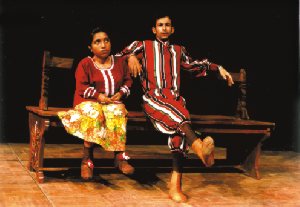
A scene from Ashish Khandokar's Bouder Pathshala, an adaptation of Moliere's The School for Wives |

