Iraq elections: Defiance to terror and desire for democracy?
Dr. Alamgir Hussain writes from Singapore
The great enthusiasm, the strong will and the festive mood displayed by the Iraqi voters on the election day, despite the state of immense terror and fear, are extraordinary by any standard. Al-Zarqawi's threat of flooding the street with the blood of those coming out to caste their votes has been more than real and deadly -- with over 200 "al-Zarqawi suicide bombers" waiting to explode on the voting day, any reasonable mind must have anticipated a casualty figure of hundreds if Iraqis would come out to vote in force.However, the most memorable day of Iraq's living history ended with only 9 or so human bombs exploding resulting in killing of 25-30 people -- an extraordinarily lower casualty than had been feared. Most thrilling thing is that Iraqis defied the huge risk on their lives to come out in great number dancing in the streets on their way to voting stations in many parts of the country, including in dangerous Zarqawi-dominated Sunni places like Baquba. The voter turn-out is said to have broken the pre-election expectation of 57 percent [which itself sounded heavily inflated] the actual fiqure now may stand in the range of 60-70 percent. This huge turn-out, despite the extraordinary state of terror and fear, is surely a determined expression of a strong desire for peace, democracy and justice by the Iraqi people. This unprecedented event in the history of Iraq is a defiant rejection of violent terrorism unleashed by al-Zarqawi. The Iraqis have spoken the language of freedom, democracy, justice, peace and human rights. Jordan's King Abdullah, whose country is in the frontline of democratic reform in the Middle East, told CNN's Christiane Amanpour: "Obviously, a successful Palestinian election and what seems to be a successful Iraqi election can only assure people that this is a process that the Middle East needs, and one that needs to be taken seriously." Surely, this unprecedented Iraq election would serve a blow to the monarchies in Middle East and would have a great positive impact in that -- religion and beyond. Despite the fact that Iraq election has exceeded all expectations, big challenges surely lie ahead. This is the stepping stone for Iraqis to move forward from their brutal past and a bloody and anarchic present. There is no doubt that Iraqis will only move forward from here but blood-baths of what-so-ever extent by the extremists are yet to follow. The sooner the Iraqi security forces become capable and intelligence agencies become effective in identifying and catching the murderous extremists, the better it is for Iraq's future. The second critical issue that must be addressed is the "election boycott" by a good majority of the Sunnis because of combined reasons of threat of "blood bath" by the extremist groups and a "boycott call" by section of Sunni political parties fearing marginalisation in the upcoming governance of Iraq. It must be remembered here that the minority Sunnis (20% against 60% Shiites), empowered by Saddam, oppressed the Shiites for decades. Logically, it should have been the Sunnis to reach to the Shiites for mending the relationship because of the atrocities they committed under Saddam's patronisation. Ironically, however, the onus of reaching out has now fallen on the Shiites, because of Sunnis' boycott of elections. It is now most critical that ordinary peace-loving Sunnis and the Shiites must work together if Iraqis want to defeat the extremists, which will ensure their march into a better future. If not, Iraq may still plunge into a state of further chaos, anarchy and violence leading, probably, to a civil war which will be catastrophic without any doubt. However, the pleasing and hopeful thing is that Iraqis have endured and crossed the most vulnerable phase of their march toward democracy and peace. This success should mostly be credited to the Shiites, who endured further brutal violence against their lives and properties with towering patience, following ousting of Saddam. Shiites still have to take that patience and the gesture of peace and reconciliation one step further. Iraq's interim Prime Minister Iyad Allawi has already expressed that essence of reaching out for reconciliation with all Iraqi groups in his post election comments: "The terrorists now know that they cannot win," he said. "We are entering a new era of our history and all Iraqis -- whether they voted or not -- should stand side by side to build their future." He promised to work to ensure that "the voice of all Iraqis is present in the coming government." Given that Prime Minister Allawi has already assured the presence of voices of all sections of Iraqis, irrespective of race, religion and sect, it can be hoped that a proactive approach would be taken by the ensuing Government to persuade the Sunnis to participate in the political and administrative affairs of Iraq in a fair manner. Given the economic status, a long history of tyranny, oppression and injustice and a rather inexperience in democracy and freedom -- it will be a difficult path for Iraqis to follow. The ground Iraqis have founded through their choice for democracy, peace and justice by defiant and courageous participation in the ballot -- there is every chance that Iraq might emerge a peaceful country with vibrant democracy and freedom and a strong economy in a decade.
|
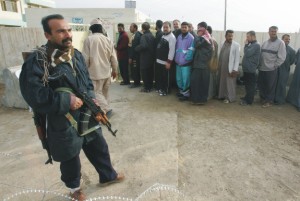
Iraqi voters queue to vote in one of the polling stations in Baquba |

