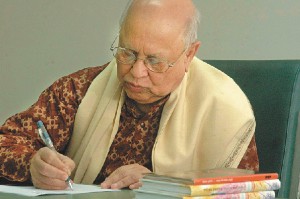
A poet of Language Movement
Mahbub Ul Alam Chowdhury on his poem on Ekushey
Harun ur Rashid
Poetry has always been a popular medium for expression of national events of Bangladesh especially the Language Movement of 1952 and the Liberation War of 1971. One such poem is Mahbub Ul Alam Chowdhury's Kadtey Ashini Fashir Dabi Niye Eshechhi. The poem's significance, both literary and historical, is immense as it is the first poem written on the incidents of February 21.The poem pays tribute to the incomparable sacrifice of the brave sons of the nation as well as it poses an undaunted protest against the gruesome killings of that time. What was the feeling or inspiration that led the poet to compose the poem? "I wrote the poem at one sitting on the evening of February 21," says Mahbub Ul Alam, but the poetic bent of mind had developed over a decade, he believes. "Since the Quit India Movement of 1942, besides the political career my creative perceptions had developed and prepared my poetic self for that eternal moment when I felt the lines emerging in my mind." A youth of 14 or 15 years in 1942, Mahbub was a worker of the District Students Congress in Chittagong. The tremendous excitement of the Quit India Movement led him and his fellows to burn the Sub-Registry office at the Chittagong Court. The following years were also similarly eventful. Mahbub Ul Alam brought out a little magazine named Shimanta. In 1944, he joined the first celebration of Rabindra birth anniversary in Chittagong. In 1945 he participated in the All Bengal Students Conference. Many revered writers and political figures like Annada Shankar Bhattacharya, Manik Bandyopadhyay and Sukanta Bhattacharya took part in that conference. In August, 1946, Mahbub took part in cultural activities protesting the riot that broke out in Kolkata, Bihar, Noakhali and Chittagong. The same year he organised the celebration of Nazrul birth anniversary in his city. Mahbub brought out the November 1947 issue of Shimanta as a strong protest against religious fanaticism and racism. The acclaimed issue featured writings by renowned poets and writers such as Dr Muhammad Shahidullah, Abul Fazal, Buddhadev Basu, Subhash Mukhopadhyay and Jasimuddin. Since 1948, when Urdu was proposed as the only state language of Pakistan, Mahbub Ul Alam got actively involved in the protest activities. On February 20, 1952, Mahbub fell ill while working in the dock and railway areas of Chittagong to mobilise the labourers in the strike called the next day. On the evening of February 21, Mahbub Ul Alam learnt that the police had opened fire on processions which caused death of "40 activists" as mentioned in his poem. Initiatives were taken to print the poem on leaflets which they planned to circulate the next day. "When almost everything was complete at the Kohinoor Electric Press, the police cordoned and raided the press. Fortunately, they failed to discover anything as all copies were hidden before hand," recalls Mahbub Ul Alam. On February 23, worker leader Chowdhury Harunur Rashid recited the poem at a meeting. "On February 24 the government banned the poem, issued a warrant against me, and arrested Dobir Ahmed Chowdhury for publishing the poem, Krishna Gopal Sen for circulating and Harunur Rashid for reciting it," says Mahbub Ul Alam Chowdhury. Mahbub had to go underground and wait for February 21 next year before returning to normal life. "I believe I am the only poet after Kazi Nazrul Islam whose poem was banned," claims Mahbub Ul Alam. The poem remained banned till the birth of Bangladesh in 1971.
|