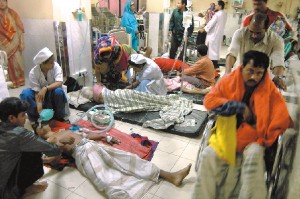
National Cardiovascular Institute in Shambles
Sorry, not enough room for aching hearts
Mizanur Khan
The National Institute of Cardiovascular Diseases (NICVD) at Sher-e-Bangla Nagar is facing an acute shortage of space in the coronary and post coronary care units. Patients with serious cardiac problems who rush to the institute from distant places face untold sufferings everyday. On a visit to the institute, it was found that all the beds at the Coronary Care Unit (CCU) and the Post Coronary Care Unit (PCCU) were occupied. Patients, making it difficult for doctors and nurses to walk through occupied even the aisles. The CCU of the 250-bed institute has only 12 beds while the PCCU has 25. But more than a hundred patients are treated there daily. On February 17 morning, 27 patients were treated at the coronary unit and 67 at the other unit. A nurse at the CCU said: "Everyday we face the same situation. We feel very sad as we cannot give them proper treatment." Mahfuza, who was attending to her mother Nasima Akhter, 40, from Bangshal in Old Dhaka, said: "Patients who were admitted before my mother are still lying on the floor. How could I ask for a bed?" Attendants of Alamgir Mollah, 34, a bus conductor from Faridpur, and of Sadeque Bepary, 67, from Matlab, also said that they have been waiting for beds for long. "Today the situation is better. Most of the days the place is so crowded that you cannot find any room for even one more patient," said Peyara Begum, a cleaner who has been working in the institute for a decade. Ehteshamul Haque, an assistant commissioner who was brought to the hospital from Cox's Bazar on Tuesday, is lying on the floor too. From the CCU he was sent to the PCCU the next day. "I know the situation and that's why I don't ask for a bed," Haque said. Some attendants also alleged that patients in critical conditions are sent to the PCCU from the CCU before they fully recover because of the bed crisis. They also alleged that some brokers arrange beds for a bribe. Sahidul Islam from Brahmmanbaria said a hospital worker asked him Tk 200 for a bed. "They (the workers) are very powerful and organised who try to cash in on patients' woes," said Nasreen Khan, an attendant. The brokers also entrap patients to private clinics from the institute assuring them of better treatment. Sources said both units presently do not have enough cardiac monitors to offer better treatment to emergency patients. Cardiac arrest patients are given electric shock treatment even on the floor. There are only 15 monitors to cater to the present patients and the institute also runs short of drugs and other emergency equipment. It is also alleged that medicines are hardly found in the drug store of the NICVD. "We don't find medicines on time. We are compelled to buy medicines from private pharmacies near the institute," an angry attendant said. "They make us hostage specially at night and sell drugs at higher prices," she added. The authorities denied these allegations but acknowledged the space crisis and said they are talking with the government to increase the number of beds. "Because of severe shortage of beds we are forced to keep patients on the floor. This is a public hospital and we cannot refuse treatment to patients," said an on-duty doctor at the PCCU. He said everyday nearly a hundred patients are admitted to the hospital, which is three to four times the number of beds. "We have enough doctors and nurses, but we don't have beds. There is space at the institute and the authorities should take steps to put in more beds as soon as possible," the doctor said. The NICVD, which started in 1979, has 220 doctors and 300 nurses to treat 56,000 outpatients and 22,000 inpatients a year. The bed occupancy rate is around 170 percent round the year. "In both units we have only 37 beds against a demand of almost 120. We have informed the ministry of how grave the situation is. The government is working on it," said Dr Mohammad Nazrul Islam, director of the hospital. A project proposal was submitted to the health ministry in 1998 to increase the number of beds. He said the parliamentary standing committee on the health ministry in a meeting on January 15 has asked the ministry to increase the number of beds to 400 from 250. "I feel very bad when I see patients on the floor but we have no other alternative. It's really a pathetic situation," he expressed. He said patients' chance for survival dims when it takes them a long time to reach the hospital because of traffic jam. "Many lives could be saved if we could set up coronary care units in all districts and other corners of the city," said Dr Islam.
|