Lawyers' Probe Into Aug 21 Grenade Attack
Police action allowed attackers to escape
Staff Correspondent
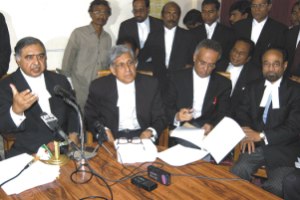
A high-profile lawyers' investigation into the August 21 grenade attack on Awami League rally questioned the role of the police on that day and observed that the police made way for the attackers to leave the venue immediately after the explosions.Instead of helping the victims, the policemen showed apathy and themselves moved to safe distance, observes a report published by six senior lawyers. Supreme Court Bar Association President Rokanuddin Mahmud headed the investigation. The grisly grenade attack on the AL rally on Bangabandhu Avenue in the capital killed 22 people including AL leader Ivy Rahman and wounded over 200. Immediately after the blasts, police lobbed huge teargas shells making the spot dark with smoke that allowed the attackers to escape, notes the report signed by Dr Kamal Hossain, Abdul Malek, Amir-Ul Islam, Dr M Zahir and Muhammad Ayenuddin. Presenting the report at a press conference on the Bar Association premises yesterday, the lawyers concluded 'beyond doubt' that Awami League chief and Leader of the Opposition Sheikh Hasina was the prime target of the attackers. Other AL leaders present at the rally were also the killers' specific targets, they observed. The investigation report recommends that the government must publish within one month all reports of investigations, and inquiries into all grenade and bomb attacks -- including the August 21 attack -- and the illegal arms seizure cases in the past. "If the government fails to publish the inquiry reports in a month, people may start believing that the government was involved in these incidents," said Rokan. The lawyers' investigation does not hold any particular terrorist group responsible for the attack but mentioned that the attack was "part of a pre-planned conspiracy." "Our mandate was not finding who the culprits were. This is the job of the intelligence agencies," Rokan explained. He said that the lawyers' report could have been more informative if the government co-operated with the investigation. The committee sought official documents related to the investigation but the government did not co-operate with them. Even the government's lone judicial inquiry commission report filed by Justice Jainul Abedin was not given to them. Justice Jainul claimed that a 'foreign enemy country' was behind the attack. The lawyers started the investigation from August 27, visited the spot, interviewed a cross section of witnesses including Sheikh Hasina, and the police present at the venue. They also examined Hasina's bullet-hit motor vehicle. About a dozen grenades were thrown just when Hasina finished her speech at the rally. The law-enforcers retrieved three unused grenades from the attack spot, which were of Arges model. The same model grenades were used in the attack on British High Commissioner Anwar Choudhury on May 21 last year in Sylhet. Another Arges grenade was recovered from the Dhaka Central Jail on August 22. The investigators wanted to know the model of the 25,000 grenades seized in Chittagong on April 10 last year along with huge illegal arms and ammunition. But the government did not respond to the investigators' request. The report blames the police for being inactive before and after the grenade blasts. A photograph taken just after the first explosion shows that a policeman is pointing gun at a building rooftop. "It seems the police may have seen the attackers," noted Rokan. "If the police sincerely tried, they could have nabbed the attackers that day. " "The police forces deployed at the south, east and west of the meeting place did not come to help the victims of the grenade attacks," it noted. "Not only that, they left their places of duty, moving to a safe distance. Even when the bullets were fired at the jeep of the leader of the opposition while it was leaving the place of occurrence, no police force was seen there." Normally during such rallies, police take positions on nearby rooftops to provide security. But in this case, there was no policeman on the nearby building rooftops, the report observed. "AL activists were not allowed to go to the rooftops." "Disciplinary action should be taken against those found to have failed to discharge their duties as required by the constitution and law, with regard to the grenade attack. The law enforcement agencies must account for the actions they took at the time of the incident." The report also suggests that the victims can file writ petitions against those who are responsible to protect their basic rights under articles 102 and 44 of the constitution. The report urged the Bar Association to provide assistance to the victims in this regard. It recommends setting up of a commission comprising judges and eminent independent persons. This commission will evaluate the results of the government investigations into different bomb blasts including the August 21 incident. "The government is failing to perform its constitutional duties as it is not conducting any investigation or explaining to the public what it is doing about these terrorist activities," noted Dr Kamal at the press conference. If the government is unable to do so, it should apologise to the public and allow alternative ways for investigation, he added. "We have done our investigation, but the actual investigation remains pending. The whole nation keeps on waiting to see that the government will find the culprits and punish them," Dr Kamal said. Amir-Ul Islam observed that the grenade attacks in the country were of a certain pattern which gives the impression that these were carried out by a particular terrorist group. "The police and other law enforcement agencies and investigators should be allowed to work freely," he said.
|