Tête-à-tête with Alpana
Doing it her own way in Berlin
Fayza Haq
"I think colours excite the soul. I'm also concerned about the form. I minimise my work in mixed media, " says talented artist Morsheda Arzu Alpana. Here in Dhaka after 14 years of success in Germany, she is busy teaching fine arts for the period she is here at University of Development Alternative (UDA).Alpana's works are mostly figures and portraits. She does studies of landscapes too, and sometimes she combines the figures with a background landscape. Asked how she went about her work, Alpana says, "My paintings are my primary concern and even if I sometimes feel homesick that is dispelled by the self-satisfaction that I get from my work. I don't have the time to fret for home. "When in Berlin, I spend most of my time in my studio. In the morning, after a slice of bread with butter and coffee, I'm off to work. I spend more than 12 hours in the studio. I work on about 12 canvases at a time." She says that she uses Taschism, a technique with a special use of pigment, which creates a fascinating visual quality. Alpana's interest in drawing goes back a long way. She had helpful teachers like Kazi Abdul Baset, Rafiqun Nabi, Mahmubul Amin, Mahmudul Haque and Aminul Islam at the Institute of Fine Arts. She found Shahid Kabir's guidance most inspiring. She was in the same batch with Shishir Bhattacharjee, R A Kajol and Masudul Hassan. "I got on well with my classmates and went with them, specially Shishir, for landscape painting to Sadarghat and Swarighat in the early hours of the morning. We worked together and exchanged views. After graduation I went to Shantiniketan, India, on a scholarship, and studied under KG Subramanyam," she says. As a lecturer at the Institute of Fine Arts in 1993 she got a DAAD exchange scholarship to Germany. She was at first at Gottingen and then at Berlin. Her favourite teacher was Helmut Otto, who taught her print on silk. Within a year she got requests for her work from all over Germany. She maintained a studio with her scholarship money and the sale of her work, right from the beginning, and worked at will. She then studied experimental paintings under Rebecca Horne, Carl Horst Hodicke and Koberling. Hodicke encouraged her to work on large forms and even gave her a studio of her own to work in. "I found no barriers and progressed at will. People came to my studio and financially I had no problems. I graduated to a larger studio and have my exhibitions at various galleries including ones in USA and UK. In Berlin itself I have an exhibition or two a year and the rest are group efforts in other German cities, such as Dusseldorf, where I've just exhibited. I could not have asked for more," Alpana says. Alpana's decision to live in Germany has encouraged her to develop a highly idiosyncratic blend of Asian and European influences, says a critic. Most of her paintings concentrate on human portraits, combining them with high-tech objects like computer, mobile and mouse. Alpana has won over a dozen awards for painting, including the Best Overseas Artist Award in oil, Golden Jubilee Trust, London, UK in 1992, and the Shilpacharya Zainul Abedin Award in 1983.
|
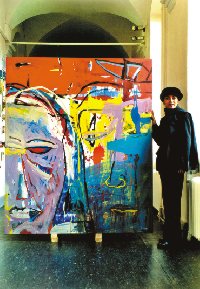
Alpana with one of her recent works seen at her studio in Berlin |

