Ataur Rahman Khan's Birth Centenary
A leader remembered
Aliya F Khan-Munir
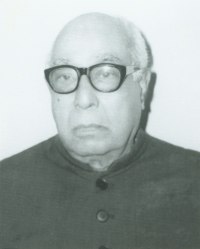
GREAT men come and go. History is written and rewritten, men are remembered and forgotten and life goes on.Greatness cannot be placed in a bottle and shown to others. If it were so easy then my task of writing on Nanu would be a breeze. For how does one write about a person who possessed so many qualities of excellence that in this day and age, they might sound exaggerated? Ataur Rahman Khan, my Nanu was, in short, a person who was not only endowed with honesty, integrity, patience, wit and intelligence, but he possessed the greatest gift, the ability to love all human beings. When I was asked to write this piece on him, my first instinct was to ask my mother. She was his eldest and she had poured out stories about him since my birth. Even now after so many years when time has moved ahead and memories are like dull aches in our heart, my mother's eyes fill with tears as she remembers a father, who would enquire about his children's well-being, who was compassionate and patient towards a wife who was handicapped, who never complained about his hectic life and who always had a kind word to say to his loved ones. My mother used to always tell me that Nanu felt that "no one was above a mother." He loved his mother tremendously, looked after his brothers and sisters and loved his youngest brother Shamshur Rahman like his own child. He loved his grandchildren whole-heartedly, and those of us who are old enough to remember him still smile when we think of him. As for me, my memories of him are like old pictures, I have so many that I wish to share them all. My earliest memories are of my Nanu writing peacefully on his desk, the scratching of pen against paper, the silent murmur of the breeze floating through the window. As I grew older this was a common scene, so was his busy life, which revolved around politics. Yet, never during those busy times did I feel that I could not ask him to spare his time. I think all the people who visited him felt the same as well. He always tried to meet with everyone, patiently listening. My fondest memories are of him telling me stories, each possessing a moral, a message to heal all the confusions, doubts and fears we tend to have during the journey of life. For a young girl teetering between adolescence and childhood, he gave me the greatest support. He taught me not only to value others and myself, but he taught me to always try and lead my life morally, without any shame or guilt weighing me down. He would always laugh and tell me that life on Earth was too short, one should enjoy it and love it, yet at the same time one should always remember the life after. I can still see him sitting in his study smoking a hookah, talking to people, reading a book or saying his prayers. The joba kushum in his hair, the white pyjama and panjabi encasing his tall frame, all symbols of a person from a different time, a different world. The peaceful quality in his room while he would recite from the Koran, for no matter how busy he was or how ill, he never missed his prayers. Even when he was in the hospital he said his prayers using signs. I have till now never met a person who knew not how to frown. He never complained and he never spoke negatively against anyone. At the most, his witty answer would be, since all the fingers on our hands are not the same, how can we wish for everyone to be similar? He never lost his temper. I often wondered at his patience. My mother always told me, every time I lost my temper, to look upon Nanu as an example. It was difficult for a paltry human such as myself; temper is an emotion, which cannot be controlled. Yet I looked upon him with awe and hoped and wished that some of his gentleness would rub off on me. I think that everyone who has known him was drawn to him because of that very quality. I know him not as a political leader or the Prime Minister of Bangladesh and Chief Minister of then East Pakistan, I simply saw him as he was -- my Nanu, who loved unconditionally, who had no demands, no wants, no expectations. I saw him as a man who loved people and saw them as they were. He made no distinctions between the rich and the poor and his heart was always sympathetic to those who were unfortunate. Even during his busy schedules, he would make sure that those who were with him were comfortable. He would always enquire after servants and those who worked for him. He missed his children and wife whenever he went outside the city. I suppose it is only natural for me to love him or see him in a different light than others. Yet even after so many years I have not met any person like him. He was a peaceful person and he never craved for fame or riches. Perhaps that is the reason that history does not give him all the recognition that it should. He made so many bridges, schools and colleges, sadly not one street has been named after him. Yet, I also understand that in this materialistic world, history and people are more interested in glamour. It is unable to scrape away and see beneath the surface. History should remember him as a leader who loved his village, his country. Minister of then East Pakistan, 5000 khals were cut, hence 15 lakh land was opened up, which is turn created an abundance of rice cultivation. A jute organization was created so that poor farmers would not be cheated of their earnings. Ramgoti to Bhabaniganj a seven-mile bhadh was constructed so that the salty seawater could not enter the lands. The day he was inaugurated in his office as the Chief Minister he gave the instructions for the Dhaka-Aricha road, one of the major roads leading to North Bengal today. The inland water transport authority IWTA was set up by him. Nanu undertook the setting up of Water and Power Development Authority (WAPDA) as well. He was responsible for setting up Fenchuganj fertilizer factory and also for the Savar cattle and dairy farm, which was built on 25 acres of land. He played a major role during our Independence and was one of the first to announce in a public speech that Bangladesh should and will speak in our mother tongue. The list of things he has done is long and would take time, I wished only for the readers to get a taste of the kind of person he was and for the historians to give him the credit he deserved, instead of hiding behind the red tape of politics and bureaucracy. His death was expected for he was suffering from the loss of his wife and from illness. But to those who loved him it was a tremendous loss, for we knew that there can never be another like him. As I walk through what is left of my grandparents' house, I am reminded of laughter and joy and of a time when we felt we were encased with a glow of peace and well-being. The house is not the same any longer and memories like ghosts float around, telling us how honoured it had been to have nurtured a great human being, reminding me how fortunate I was to have known someone like my Nanu. In these modern days, where life moves at a hectic pace and we revolve around the materialistic world, catering to the pomp and glory of the rich and the famous, there is no time for the old values and beliefs. For me, my Nanu's memories remind me of a time when tradition and ethics played a far larger role in a person's life than the attainment of wealth and fame. Great men do come and go and history might choose to remember them or forget them. My Nanu will forever continue to be in my memories, not only because he was Ataur Rahman Khan, but because he was simply my Nanu.
|
|

