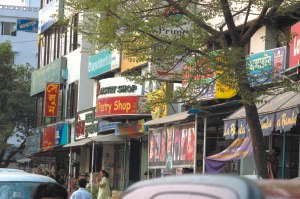
Woes of a once serene Dhanmondi
Sabrina Karim Murshed
The once serene Dhanmondi area has lost much of its residential characteristics due to gradual invasion of non-residential and commercial organisations.According to a survey of Dhanmondi Paribesh Unnayan Jote conducted by an NGO in July 2003, at least 296 non-residential and commercial organisations existed in the area. "The number is not static. It is increasing by the day," said Sultana Kamal, President of the Jote. "Road 11 and 11 A alone house 37 non-residential organisations. Imagine how it is affecting us," said another resident Morshed Anwar adding that many people have moved to other places as living in Dhanmondi is not a pleasure any more. "Dhanmondi was a quiet residential area in the 1950s when it was being developed. But an increase in its population led to establishment of numerous multistoried apartment houses," said Rowshan Alam, president of Dhanmondi Residence Owners Association. "These apartments and also the independent houses have now been rented to different commercial houses. Some organisations have built their own buildings also." At least 142 among the 296 commercial organisations marked in the 2003 survey were educational institutions. The rest included hospitals, clinics, offices of business firms and NGOs, pathological laboratories, beauty parlours, community centres. "We feel unsafe now as a lot of outsiders enter the area. Mugging, robbery and other criminal activities are common these days," said Rowshan Alam. Faruqul Islam, another resident said some empty 'pocket lands' in Dhanmondi have turned into dens of drug addicts and other anti social elements. Most residents however said that the major problem is the severe traffic congestion. "It becomes impossible to commute especially when the schools start or close," said ABM Faruqul Islam who has been living in Dhanmondi since 1991. Others also held the schools and educational institutions responsible for the traffic congestion. "What else can we have apart from traffic jams when there are seven universities inside such a small residential area," said a resident. They said the traffic situation worsened after the Mirpur road had been made off-limit to rickshaws. The authorities of educational institutions on the other hand, tried to establish the necessity of their presence in a residential area. "Parents would not want to send their children to a school far away or one that is situated in a commercial area. They look for a school in the neighbourhood for their kids," said Syed Fakhruddin Ahmed, principal of Mastermind School. Ahmed however, felt that the numbers of schools were increasing in every area and the government should exert some control over the situation. "Not all of these schools provide proper education," he said. Some school officials said that complaints about the presence educational institutions from residents are close to hypocrisy. "They do not think about the environment of 80 per cent of the city's people. They are only bothered about Dhanmondi's environment as they are privileged enough to live there. They should remember that their own children study in these institutions," said the principal of a school. Officials of offices and other commercial organisations feel that Dhanmondi turned into a commercial area naturally. They said it happened due to paucity of space in the city. "If a person sits by the roadside with a basket of oranges to sell, someone else would follow him in doing the same. This has been the case with Dhanmondi. One or two commercial organisations began setting up their office here and the others just followed," said the director of public relations department of an NGO. He said it was impossible to maintain a separate residential character in present reality. "In any mega city you will find residential and commercial buildings in the same area," he said. The residents, however, said the government should at least control the commercialisation of the area. "They can designate a few roads to be used for business and commerce. But non-residential or commercial organisations should not exist in every nook and cranny," said Faruqul Islam. Sources in the Rajdhani Unnayan Kartripakkha (Rajuk) said Dhanmondi was still a residential area on papers. "Only the plots adjacent to Mirpur Road, Satmasjid Road, Road 27 (old) and Road 2(old) received permission to be used for commercial purposes," said a Rajuk official. However, he added not buildings over six stories were not allowed there. Rajuk Chairman M.D. Shahid Alam said Rajuk only approves the building plans. But the entire Dhanmondi area was under the Public Works Department (PWD). "We know that Dhanmondi is losing its residential nature but still no one has come up with official complaints and there has been no initiatives from within the PWD itself," said one of the senior officials of the PWD.
|