End of an extraordinary era of papacy
Barrister Harun ur Rashid
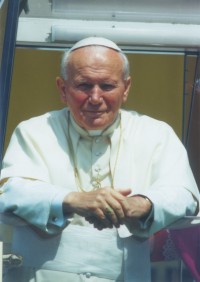
The death of Pope John Paul II on April 3 terminates an era of extraordinary papal reign. He was the third longest reigning Pope in history and became one of the most familiar faces in the world. At the age of 58 (a young age for Pope) he became the Pope in 1978 and was the first non-Italian Pope for more than 450 years. He was Cardinal Karol Wojtyla from Poland and his election stunned the Catholic world.There is an interesting story before the election of Pope John Paul II. When his predecessor Cardinal Albino Luciani became Pope in 1978 as Pope John Paul I, he is said to have commented: "I will only rule for a short time. There is a Cardinal near me, who will soon be Pope in my place." Ironically, what was to prove one of the shortest pontificates in the history of the papacy, that of John Paul I, has been followed by one of the longest. Pope John Paul II served 26 years as the head of one billion Catholics all over the world. In 1981 he was shot and wounded in St. Peter's Square by Turkish national Mehmet Ali Agca, and was operated on for six hours. He pardoned Agca for his crime and in later years he met and befriended Agca. He was known as the "Pilgrim Pope" because he visited more than 120 countries and his style was to kiss the ground of the airport of a visiting country after his arrival. Some say his total foreign trips would be equivalent to circumnavigating the globe more than 26 times. He has been the most televised Pope and the first to have his own website. As head of the Catholic Church, he appointed more Cardinals from all parts of the globe than his predecessors and made saints more than others. He wrote many books and only a few months before his death, he published another book. During his reign he released many encyclicals (instructions sent to all Catholic Bishops on issues of importance). His 13th Encyclical in 1998 called for a reconciliation of faith and reason while condemning the spiritual poverty of Western philosophy. He was born in 1920 in Krakow, Poland. As a young man he was known to be wrestler and a good sportsman. He had a great love for theatre and at one stage considered seriously becoming an actor. The Second World War saw Karol Wojtyla working as a labourer. He studied theology from 1942 and was forced into hiding in 1944 following a crackdown on religious teaching by the communists. He had experienced bad days under communism and he had been a lifelong crusader against communist rule in Eastern Europe including his native land, Poland. He was secretly ordained as a priest in 1946 and by 1964 he became the Archbishop of Krakow. He was appointed Cardinal in 1969. His journey to Rome began as a Cardinal and soon he impressed others in the Vatican by his depth of theological knowledge. His legacy
His lasting legacy was the removal of communist regimes in Eastern Europe. As Pope he visited Poland many time and his speeches for freedom ignited the Solidarity movement led by the union leader of Gdansk shipyard Lech Walesa. He reportedly met Walesa during his many trips to Poland, and the Vatican supported his movement with both moral and material assistance. It is no coincidence that the first country in Eastern Europe to discard communism was his homeland, Poland. He was always opposed to war and termed war as "defeat of humanity." In 1991 he wrote letters to President Bush Sr. and President Saddam Hussein in a bid to avert the first Gulf War. In 2003, he was again at the forefront of the international church campaign to avert the Iraq war. In 2001, he invited Catholics to take part in a day of fasting for peace after the September 11 attacks on New York and Washington. He was the great reconciliatory Pope with other major religious leaders. He apologized to the Jews and Muslims for past wrong doings to them, and in 2000 visited Jerusalem and Israel to patch up the long-standing enmity between Jews and Christians. He apologized to Muslims for horrors created by crusaders under the direct patronage of Pope Urban II in the 11 century. His critics say that the Pope was socially very conservative. He opposed abortion, stem cell research, women's ordination, and family planning practices, and his opposition to these issues have had an effect on million of lives. He inherited a divided Church and left it divided. How is the Pope elected?
The choice of who will succeed Pope John Paul II is to be decided by a conclave -- a meeting held under lock and key in the Sistine Chapel in the Vatican -- by up to 120 Cardinals under the age of 80, the maximum allowed under a law adopted in 1975 by Pope Paul VI. There are 117 Cardinals under 80. Of these nearly 100 were appointed by John Paul II, who are known to reflect his conservative views in the choice of the successor. When a Pope is selected a plume of white smoke emits from the chapel and black smoke indicates that no Pope has yet been elected. Two-thirds vote of the Cardinals plus one is required to elect a Pope. That means that out of 117 Cardinals, 79 votes must be obtained by the successful candidate to become the Pope. Some say that the Cardinals believe the Holy Ghost is with them to guide their decision. Under John Paul II, the College of Cardinals has become so internationalized that the next Pope could come from anywhere in the world, although there is a powerful sentiment to return to tradition and elect an Italian. If this were to happen, Vatican watchers believe that strong candidates include Cardinals Dionigi Tettamanzi (70) of Milan, Angelo Scola (63) of Venice, Tarcisio Bertone (70) of Genoa, Angelo Sodano (77), the Vatican number 2 person, and Giovanni Battista Re, (71), the head of the Vatican Congregation. The Pope's other hat
The Pope is not only the supreme head of the Catholics, but also the head of the state of Vatican in Rome, on the western bank of the River Tiber, containing a total area of 0.44 square kilometres. The Vatican is the seat of government of Roman Catholicism. The Holy See is the central government of the Church while the Vatican is a territorial state. The Papal temporal authority, dating from the 8th century when it was recognized by Pepin the Short, King of Franks, and has been exercised from 1377. During the 19th century, the Vatican was merged with Italy, and in 1929 Mussolini recognized the Vatican's sovereignty Diplomatic representation of the Holy See extends to more than 100 countries including Bangladesh. Vatican diplomats are active in all forums including at the UN. They often perform mediation on disputes between states. In recent times, Vatican diplomats successfully mediated between Chile and Argentina on the dispute of the Beagle Channel and a peace treaty was concluded between them in 1985. Pope John Paul II and Bangladesh
Pope John Paul II visited Bangladesh in 1986. During his visit to Dhaka he rode a cycle rickshaw in Baridhara diplomatic enclave. He was so moved by the hard labour of the rickshaw puller that he bought the rickshaw for the puller. The writer had the privilege and honour to represent Bangladesh as Ambassador to the Holy See for more than three years from Geneva and met with the Pope several times. Pope John Paul was very warm and spoke in a baritone voice. He had great respect for the Bangladeshi people for the heroic struggle in 1971 against the Pakistan army's brutalities. He was a champion of liberty and freedom all through his life. Pope John Paul II could speak 12 languages. Conclusion
Pope John Paul II was a remarkable person. Throughout his reign, he relentlessly campaigned against war, underscored the maintenance of dignity of all individuals, and cautioned against the dangers of modern life. His personal magnetism and warmth of heart made the Pope one of the few men who has left an indelible mark on history. Barrister Harun ur Rashid is a former Bangladesh Ambassador to the UN, Geneva.
|