SD Burman: Remembering the unparalleled musician
Sachin Dev Burman was a titan amongst composers and singers for Indian films and outside them. Born on October 1, 1906, in Comilla, he was a scion of the princely family of Tripura, now a state of India. His noble lineage is reflected in the grace of his musical creations, spanning a period of 43 years until his death in Bombay in 1975.Sachin Dev was the youngest of Nabadip Chandra Dev Burman's five sons and four daughters. Nabadip Chandra was the direct heir to the kingdom of Tripura when "palace politics" forced him to step aside. It was he and his fourth son Lt Col Kiran Kumar, who gave Sachin Dev the inspiration to delve into music. Sachin's childhood gurus were the old Madhav who sang passages from the Ramayana and the young Anwar, his "sparring" partner in angling, who would sing the bhatialis with a dotara. Sachin had his formal education in Comilla, from where he passed his Matriculation (1920) and Intermediate (1922) examinations. After completing his BA from Comilla Victoria College (1924), he left for Kolkata for his MA in English. But music was his destiny. He chose the legendary KC Dey (Manna Dey's uncle) as his first guru. The great exponents of classical music of the time notably, Ustad Badal Khan, Ustad Allauddin Khan and Pandit Bishwadev Chatterjee, were also to become his teachers. He first sang for All India Radio Kolkata in 1928 and cut his first disc as a singer-composer in 1932. The disc, with a semi-classical number (E phathey aaj esho priyo) on one side and a folk -based song (Dakley kokil roj bihaney) on the other, was a super hit. A star was thus born to give a new direction to the art of singing and composing, so much so, that he surpassed his contemporaries and exponents of Tagore and Nazrul songs, to become the highest paid singer. In Bombay, Sachin created some of the greatest hits of all times. His music composition was derived mostly from northeastern Indian folk and Hindustani classical music. But he also fused folk music from other areas of India and the rest of the world. Saiyaan dil mein aana re (Bahar), Thandi hawayee (Naujawan), Tum na jane kis jahan mein (Saza), Taqdeer se bigdi huyi (Baazi), Hai apna dil (Solva Saal), Khilte hai gul yahan (Sharmeeli), Yeh laal rang (Premnagar), Tere bindya re (Abhimaan) are some of Sachin's compositions. Be it a classical number (Nache mora manwa in raga Bhairavi) or one with a folk touch (Aaj ki raat piya), a seductive piece (Roop tera mastana), a qawwali dash (Kisne chilman se mara), a romantic refrain (Gun guna rahe bhromor), a comic strip (Pyar ki aag mein), or just a hotch potch (Babu samjho ishare), Sachin Dev excelled in all, to become the most versatile composer of his time. As a class singer himself, he knew the weaknesses of all great singers and therefore could draw the best out of them. He gave turning points to the careers of Hemanta Mukhopadhyay, Kishore Kumar, Manna Dey, Geeta Dutta, Asha Bhonsle and Suman Kalyanpur. His music was sometimes art and sometimes craft. A perfectionist and a hard taskmaster, he recorded a song only after his requirements were met. Classic examples were the postponement of the recording of Nache mora manwa magan (Meri Surat Teri Aakhen) until the arrival of the tabla maestro Pandit Samta Prasad from Beneras or the drum from Sikkim for Honto pe aisi baath (Jewel Thief). There was a time in Bombay when the lyrics were set to tune by the music directors. SD Burman changed the theory. The tune first, the lyrics later. Today nine out of 10 songs are composed in this manner. Sachin Dev received the prestigious Sangeet Natak Academy Award, Swami Haridas Award and the Padma Shree for his contribution to music, apart from many other awards including the Indian national awards for singing and composing. Sachin left for his heavenly abode on October 31, 1975, after a paralytic stroke had felled him a year earlier. There was a time when the royal family of Tripura had severely criticised him for making a living out of music as it belittled the image of royalty. Sachin Dev was hurt and slowly he snapped his ties with Tripura. Now the Tripura royal family is known for Sachin Dev Burman. Compiled by HQ Chowdhury
|
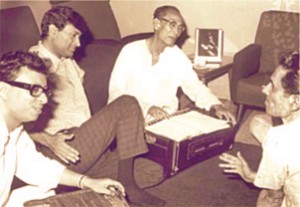
Those were the days! SD Burman on the harmonium with Dev Anand, RD Burman and lyricst Neeraj(L-R) |

