Hope fades fast at Savar
7 more bodies recovered, 3 rescued; over 300 still trapped
Star Report
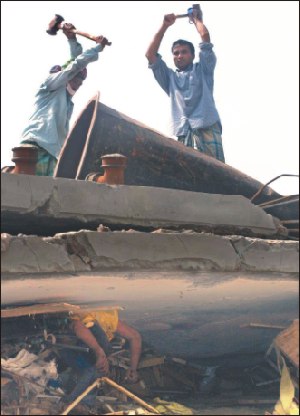
Hope dies fast at Palashbari. As a rescue team pulls out a body, stiff in rigor mortis with both hands raised in the gesture of prayer, it only gives a grim reminder of what awaits the over 300 workers who are still trapped under the debris of the nine-storey building. Yesterday, 48 hours after the collapse of the readymade garment factory near the Savar EPZ, the death toll rose to 30 as seven more bodies were dug out. Only three were rescued alive, pushing the number of survivors up to 85. Desperate rescue workers hammer away at the collapsed structure, trying to cut away concrete slabs with pneumatic hammers, pickaxes, hammers and gas cutters. But they know time is running out and with that the hope of finding anyone alive. For, the frantic effort so far has only removed about 7 percent of the collapsed structure and after 48 hours of a cave-in, not more than 25 percent of the trapped people do survive. "Another 24 hours and the chance of survival will slide to 15 percent," says Parimol Chandra Kundu, assistant instructor of the Fire Service and Civil Defence Department. "After 72 hours, the survival rate comes down to only 5 percent." As of now, no-one can say for sure how long it will take for rescuers to penetrate the collapsed structure. They are facing equipment shortage, slowing down the rescue operation even more. "It is anybody's guess how long it will take us to get inside," says a fire fighter, looking tired and exhausted after 18 hours of continuous work. Several hundred fire fighters, army personnel, Rab members and policemen are working round the clock to clear the rubble. "It is taking us more time as we are cautious not to jeopardise the life of anybody trapped inside," says Faruqur Rahman, director general of the fire service. "We can pull apart the collapsed structure more swiftly. But that will compromise the rescue of the living persons," a grim-faced Faruq observes as firemen and army personnel try to drill a hole right in the middle of the collapsed roof. This will be the main rescue tunnel through which rescuers will climb down right to the bottom of the building. The tunnel will also be used to pump in oxygen. But after two hours of effort, the hole is yet to be made. And there are nine more storeys to bore through, all thick concrete slabs. A strong stench of decomposed bodies is already seeping through the cracks and crevices of the concrete mess. The only beings happy at the smell are the hordes of flies buzzing around the place. In a crevice, a lone green rubber slipper lies in dust. Its pair is missing and may still be on the foot of the person trapped dead or alive under thick slabs. Two huge excavators pull at a huge chunk of concrete and the whole structure shudders violently. Thousands of people -- relatives and neighbours -- kept at bay by security personnel, still wait. As bodies are pulled out and carried to a wooden platform in an adjacent field, the relatives rush for identification. "I am waiting here since the accident," says Jahanara whose red swollen eyes do not produce any more tears. She only whines at the thought of her trapped nephew. He used to work at the northern corner of the building where most of the casualties are thought to have happened. Then a body is carried to the podium and Jahanara turns restive. "Does the body have a brown shirt?" she asks anxiously. "Does he?" But then somebody says the body has already been identified by relatives and instantly Jahanara's face turns dark. Still she wants to break the security barrier to have a look at the body to be sure. But the armed police battalion guards would not buzz. Jamil stands like a statue for his cousin Shahin, a machine operator. The two brothers lived together at a mess. "I am hopeful that Shahin is still alive," Jamil says. "He was on the seventh floor and one of his colleagues has been rescued alive. I don't know how I will face his parents. It is clean murder. Not an accident. It is killing people." Those few lucky ones who could come out of the havoc narrate their harrowing tales of trapped hours. "Before I could realise what has been happening I found myself sandwiched between the collapsed roof and the floor," says Ruhul Amin, who clawed his way out seven hours into the tragedy. "It was pitch black and I could not see even the face of the person lying next to me. I could hardly raise my head because the slabs were pressing on me." As he heard his other colleagues screaming, he called out to know where he was. Then he started crawling, inch by inch. "It was dark and hot. I met debris everywhere and had to claw my way through," he recalls. "Every minute seemed like a year. Sometimes, I thought I was going to die." But the sheer determination to survive kept him crawling on. Suddenly he saw a narrow beam of morning light. "I started screaming at the top of my voice. And then I heard people on the other side of the wall. They drilled a hole and pulled me out," says Ruhul who managed to get away with a few small cuts on his head, shoulder and feet. But he does not know what happened to his colleagues who screamed back to him from the floor above. Nor does anyone else. "The bodies are decomposing fast and once the skin ruptures, they will start releasing hydrogen sulphide," says Porimal of the fire department. "After 96 hours, no human can survive in the gas." But the survivors doubt that endurance time. They say the air is very fast becoming too foul to breathe, as the space is too small. As evening approaches, the rescuers bring in searchlights packed in cartons to continue operation overnight. Boy scouts bring in large barrels of drinking water. Another body has been located, but it is too difficult to recover, as it is buried under a slope. Like mountaineers, rescuers rope themselves to a pillar and work on the slope in a semi-suspended position. Part of the collapsed building still stands intact and a few workers watch the rescue operation. As garment workers from the neighbouring EPZ troop past the accident site after the end of their shifts, they quietly look on in muted awe and apprehension. Inside the factory building, cartons stamped with the importer's name -- B&C -- ready for shipment lie stacked. A girl and a boy in red jerseys smile back from backboards to be inserted inside every packet of apparel. Only a few hundred yards away in the field, coffins are waiting.
|