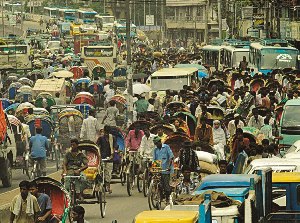
Dhaka traffic through the eyes of foreigners
Faizul Khan Tanim
David Montero, an English language trainer and journalist working for a Dhaka daily finds it difficult to fathom why drivers in Dhaka do not stick to one lane. The dangerous tendency of frequently shifting lanes baffles him.For most foreigners like Montero, the worst thing about the city's traffic however is the unnecessary honking of horns especially during jams. "Are they (the drivers) even aware of the sound pollution that is produced from such honking?" said Michelle Foster, an NGO official from Gulshan. Foreign nationals observe that Dhaka has insufficient signals, which prevents smooth flow of traffic. They also think it is illogical to have signals for vehicles that go left at intersections, as at least one side must be kept free so that the traffic can move in an organised manner. Sammy Burton, a French national who works at Alliance Francaise Dhaka felt that rickshaws should be preserved. "This is one vehicle which does not emit smoke and there is nothing mechanical about it. There is no pollution from rickshaws." Most foreigners echoed Sammy's sentiments. They believe there should be separate rickshaw-ways so that they do not fight for space with motorised vehicles on the streets. "The black smoke emitted from buses could be one of the main reasons for the respiratory problems suffered by some of my colleagues. Thailand had the same kind of traffic problem. Look at them now. They have constructed two, three and even four-storeyed flyovers, which are three to four kilometres long. Traffic congestion has come down greatly in Thailand," said Karishma Gangopadhhay, a US citizen working for a local NGO. Dhaka also does not have proper zebra crossings and signal lights for pedestrians. The limited number of pedestrian lights in Gulshan, the main hub for foreign residents in Dhaka, are hardly used. "The traffic signals and bottlenecks attract a lot of beggars. As soon as you give something to one, others come rushing in. This can be extremely disturbing," said Australian Beth Mander.
|