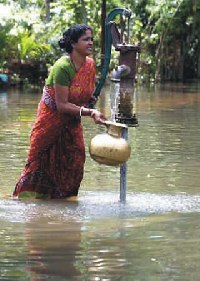
Water purification prevents water borne diseases
Star Health Desk
The quantity and quality of the water that we drink is directly linked to health. If the water is contaminated with germs or chemicals, health will be affected. Outbreaks of diseases transmitted by water have a major impact on human health. Examples of diseases which can be transmitted by water include cholera, typhoid, hepatitis A and many diarrhoea1 diseases. All of these diseases can also be spread by other means, but the quality of public water supplies is particularly important because such supplies are capable of transmitting contaminated water to many people.The diseases mentioned above are transmitted through water when it is contaminated by human faeces. Water treatment
The purpose of water treatment is to remove substances which may be dangerous to human health, such as pathogens (disease causing microbes). Disinfection
Disinfection of water is an important step in the control of water-borne diseases such as cholera, typhoid, hepatitis A and many diarrhoeal diseases. Water may be disinfected by chemical or physical means. It is important that disinfection is combined with source protection and, where appropriate, water treatment. Among the chemical disinfectants, halogen tablet is one of the easiest method. Halogen tablets are easily available in nearby dispensaries. One tablet of 0.5 g is needed to disinfect 20 liters of water. Other disinfectants include bleaching powder, potassium permanganate, iodine. Mechanical ways of disinfection like boiling is also very effective. Water quality monitoring
In any water supply, there is always a risk that water may become contaminated with pathogens (disease causing micro-organisms) either at the source or during treatment and distribution. In all water supplies, especially where there are epidemic diseases such as cholera and typhoid, it is important to test water supplies regularly to make sure that the water is safe to use. In general, the risk of contamination of water supplies with pathogens, particularly if they are from excreta, is far greater than the risk associated with chemical contamination. Household water treatment and storage
Water can very easily and quickly be contaminated during household storage. This presents an especially high health risk where members of a family or community do not all practice good hygiene. Good hygiene includes : *having and using excreta disposal facilities, such as latrines or toilets ; *regular handwashing especially after defecation and before preparing food or eating ; *personal and domestic hygiene. Water stored in the home may become contaminated during handling if it is not stored and protected properly. So even if water is purified or collected from a clean and properly protected water source, it may become contaminated. Water sources
Sources of water for drinking water supplies fall into three broad categories : *Groundwater sources, including dug wells, boreholes, infiltration galleries and springs ; *Rainwater collection from roof and ground surfaces ; *Surface water sources, including intakes from streams and rivers, lakes and small dams.
|