Exhibition
Evocative images on canvas
Fayza Haq
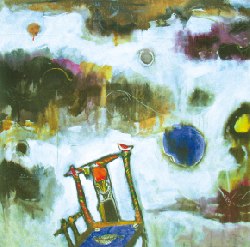
Tasadduk Hossain Dulu, who works through symbolism, presents it via the apparently trivial elements of life around us. He has struck a strong blow at socio-economic and political injustice -- prevailing in Bangladesh in particular. Qualifying from the Institute of Fine Arts, Chittagong University, he is frank and to the point. He uses simple items of daily wear -- such as gloves, clothes pins, bolsters, undergarments, mugs and coiled rubber balloons. This is seen at his fifth solo exhibition, which opened at Chitrak Gallery on May 6. Tasadduk, coming from a cultured background, with music and literature being encouraged as a child, took to painting and drawing in his youth. Today he works in an organisation that encourages visual art -- painting after his office hours, as long as he can stay up. He labours with his acrylic on canvas, preferring acrylic to oil, with his brother and wife to egg him on. As a student he had his teachers at the Chittagong University like Abul Mansur, and Dhali al Mamun to guide and coax him, along with the inspiration of older masters. Sporting a walrus moustache and dark-rimmed glasses he appears overwhelming but he remains soft-spoken though firm and incisive. Tasadduk has chosen the apparently minor objects in our day to day living to tell his tale of unmitigated oppression and injustice. Taking See-4 we discover two gloves on a wash-line. The blue and red gloves have a yellow peg. "We are clapping at everything before us like the silent gloves, who have no other recourse. The tiny red clay bird perched on the rope represents us as insignificant and helpless. Two gray-blue combs with fine teeth are introduced in See-6. By these objects the artist denotes the futility of the prevailing law and order situation, where desperate remedies are reportedly taken to remove evil. However uncertainty and havoc prevail. The multicoloured and apparently vibrant bolster of a child, seen in See-3, also has a vicious slant. The bolster, in See 3, the artist explains, is a local cry in one night stands in sleazy hotels. He is not running down sex-workers, but the men who ply the helpless women, and so make the society questionable. His angst-ridden, moralising tone is continued in See-9 where he has introduced the shapely legs of dancers sans clothes. The floating ruby-red cast-off garment on the waters evokes the nightlife of cities like Los Angeles, Paris and other hubs of civilisation, viewed worldwide. Tasadduk's message is simple and straightforward. He has used a large measure of black to drive home his point that "there is something evil in the kingdom of Denmark". His is a loud cry for a revival of the pristine existence, which he believes society enjoyed many years ago. This exhibit is a protest against mechanisation, industrialisation and the get-rich-quickly, stressful existence in our urban society. Tasadduk has participated in innumerable group exhibitions, including four Asian Biennials and four National Art Exhibitions of the Shilpakala Academy, Dhaka. His work is certainly mind-whirling.
|
|

