All Time Greats
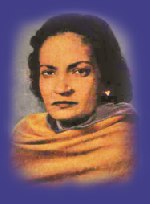
Begum Akhtar: The Queen of Ghazals
Akhtaribai Faizabadi, or Begum Akhtar, as she was more popularly known, earned the epithet of Mallika-e-Ghazal. Almost synonymous with the concept of ghazal gaayaki, she evolved her unique --and unparalleled --style of singing. Her voice became mature in the course of time and acquired richness and depth. In her distinctive style, she sang ghazals and other light classical pieces. She has nearly 400 songs to her credit. She was a regular performer on All India Radio and usually composed her own ghazals. Most of her compositions were raga based. Begum Akhtar was born on October 7, 1914 in the small town of Faizabad, Uttar Pradesh in northern India. She was born in a upper crust family that was not musically inclined. However, at her uncle's insistence, she was sent to train under Ustad Imdad Khan, the great sarangi exponent, and later under Ata Mohammed Khan. Later, she travelled to Calcutta with her mother and started learning music from classical stalwarts such as Mohammad Khan, Abdul Waheed Khan and finally she became the disciple of Ustad Jhande Khan Saheb. At the tender age of 15, she gave her first --and highly successful-- public performance. No less a famous personality than poetess Sarojini Naidu appreciated her singing during a concert which was organised in the aid of victims of the Bihar earthquake (in the 1930s). This encouraged her to continue singing ghazals with more enthusiasm. She also cut her first disc for the Megaphone Record Company at that time. A number of gramophone records were released carrying her ghazals, dadras and the 30s thumris, among others. With the advent of the talkie era in India, Begum Akhtar acted in a few Hindi movies in thirties. East India Film Company of Calcutta approached her to act in King for a Day (alias Ek Din Ka Badshah) and Nal Damayanti in 1933. Like others of that era, she sang her own songs in all her films. She continued acting in the following years. The movies she acted in are: Ameena (1934), Mumtaz Begum (1934), Jawaani Ka Nasha (1935) and Naseeb Ka Chakkar (1935). Subsequently Begum Akhtar was approached by the famous producer-director Mehboob Khan, to act in Roti (1942). In 1945, Begum Akhtar tied the knot with barrister Ishtiaq Ahmed Abbasi and became known as Begum Akhtar. However, after marriage, due to her husband's restrictions, she could not sing almost five years, and subsequently, she fell ill. Music was prescribed as the only remedy! In 1949, she returned to the recording studios. She sang three ghazals and a dadra at Lucknow Radio Station. She wept afterwards and returned to singing in concerts, a practice which lasted until her death. Begum Akhtar continued her association with films. At the behest of music director Madan Mohan, she sang in two Hindi movies: namely Daana paani (1953) and Ehsaan (1954). Satyajit Ray's Bengali film Jalsa ghar (1958) was her last role where she played the role of a classical singer. Her musical career ended in a concert held in Ahmedabad. She had raised the pitch of her voice as she felt that her singing that day had not been as good as she had wanted it to be. She had not been feeling well that day to begin with. The additional demand and stress she put herself under resulted in her falling ill and being rushed to the hospital. She passed away on October 30, 1974 leaving a big void in ghazal lovers' hearts. Just eight days before she passed away, she recorded a ghazal penned by Kaifi Azmi: Sunaa karo merii jaan un se un ke afsaane
Sab ajanabii hain yahaan kaun kis ko pahachaane She was posthumously awarded the Padmabhushan. Compiled by Cultural Correspondent
|