BookReview
Always the human body, always...
Khademul Islam
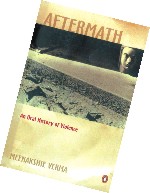
Aftermath: An Oral History of Violence, Meenakshie Verma; Penguin Books India; 2004; pp. 178+lxxiv; Rs. 250.Meenakshie Verma, a cultural anthropologist trained in the Sociology department at the Delhi School of Economics, has attempted to study here an enormously complicated subject, the savage communal killings during the 1947 Partition, and the way that violence is recalled in the public sphere, how memories of violence and survival, individual as well as collective, 'are constituted by the dominant political, social and cultural discourses.' The book itself is constructed around the oral interviews of ten people, five men, four women, one hijra, or eunuch. All of them have experienced communal violence--two of them, Heera Lal and Mangat Ram, actually being the aggressors--ranging from the 1947 Partition to the killing of Sikhs in Delhi after Indira Gandhi's assassination to the Gujarat masscres in 2002. It is an experience of violence which has fundamentally altered their lives, and though the frame of violence is common, each voice is unique, each sorrow or guilt separate. For a Bengali reader, the experience most immediately felt is Madhabi's, representative of Hindus who fled in 1971 from the Pakistan army genocide to refugee camps in West Bengal. It is the story of familial and personal disintegration: her husband Manik goes missing, her son Bimal becomes wayward, her daughter Moyna is lured into prostitution, a narrative of the everyday violence visited on the rootless, the transient, the homeless. It is these ten voices that make readable, that gives body and shape to a book which is otherwise difficult to read, since this is really a book about memory and slaughter, the way human beings recall killing another, or being killed, or attempts at being killed, in monstrously grotesque ways--grotesque because the savagery is not personal, but aimed at their identities as members of an ethnic or religious community. Cruelly enough, it is that very impersonality that gives communal killing, what Meenakshie terms as 'ethnocidal violence', its distinctive savagery which is 'sited' on bodies, individual human bodies which carry the unique marks of religion and locale: hair, circumcision, turban, tongue, et cetera, all of which have to be obliterated, men's bodies mutilated in a certain way, women's bodies in a different way, as in the Gujrat carnage of 2002, where one foreign aid worker noted that: I have never known a riot which has used sexual subjugation of women so widely as an instrument of violence as in the recent mass barbarity in Gujarat. There are reports everywhere of gang rapes of young girls and women, often in the presence of members of their family, followed by their murder by burning alive, or bludgeoning with a hammer and in one case with a screwdriver. But all this can be justified by the perpetrators according to certain precepts of community 'honor', 'pride', 'revenge', precepts which have been fashioned from a community's collective sense of itself, its identity. And it is in the construction of that identity--a continuous, dynamic process, never a fixed point but a 'dialectical, ceaseless activity'--where communities 'discover (or construct) a past, a collective memory,' that the personal narratives get connected to the social. Or to put it in Meenakshie words, 'the self and the community are intertwined in the personal.' And out of this mammoth tapestry of personal narratives of violence and trauma, of acts of recollection and memory, begins the reification of culture in various forms of 'ethnicity, nationalism and cultural revival.' Based on unspeakable sorrow, a world is then invented, (a process whereby memory becomes consciousness, needing expressive language and symbols), a world without doubt, a universe with all the answers, a world of certitude so formidable that any kind of violence seems permissible. As can be seen in the case of one of the voices in the book, a woman known forever hence as Adhdha ('Half') because her breasts had been cut off. Always the human body--symbolic of the communal body of the Other-- specifically targeted in such acts of violence. Always. And into this vivid, emotive morass step in 'rightwing groups' who the world over 'thrive on the interplay of memory, history and identity.' And in the case of India, it means the saffronization of the public sphere, things ranging from Doordarshan serialization of the Ramayana and the Mahabharata to the appropriation of 'Partition memories' by RSS historians to the very recent claims by the Hindu Vishwa Parishad that the Taj Mahal is founded on the remains of a Hindu temple. 'Unlock the door to the basement of the Taj' they are demanding, but what they are really unlocking is a very different kind of door, one of historical interpretations of gender, of ideas of Hindu masculinity, passive and docile, ‘allowing’ invasion after invasion to sweep over the body of Bharatmata. To what Meenakshie points out as the 'modern Hindu identity…under constant construction during the past few decades…primarily based on one particular theme: the great and urgent need for masculinity, virility and aggression among Hindu men.' Anxieties, self-doubt, neuroses, psychosis, rage. And which lead to the 'volatile intersection between male sexuality and militant political agency', to male fantasies of conquest and vengeance. Thus a rightwing historiography now searches out Alpha Hindu males as role models (Shivaji, now embodied as the Shiv Sena; history, memory and identity politics again). The same processes are no doubt at work in the rest of South Asia. Violence against Sikhs and Hindus in Pakistan during Partition were no less extreme. The current campaign of violence (though mostly verbal, but again attempting to build up the narrative against the outsider, what Ashish Nandy calls the 'foundational myth' to stigmatize and then attack the Other) against the Ahmediyas in Bangladesh has similar roots: it is linked to the long history of sectarian violence within Islam, to notions of 'purity' and 'pollution' in the faith, to 'cleanse' the religion so that it can be a bulwark against a cosmos seen hopelessly awash with a corrupt Westernization. It is simply that neither in Pakistan or in Bangladesh have studies been, or are being, carried out on this topic, close-focused research brought to bear on, say, historically gendered ideas of the Bangladeshi Muslim or Pakistani Muslim male. Or of the fundamentalist Muslim male, a figure with potent psychological links to glorious caliphates, Saladin and latterday anti-colonialism. With its consequences for the public and political sphere in the modern ummah. It is to the credit of Indians that they are beginning to examine this subject, with the aid of current social science tools and methodology, with disciplines ranging from psychoanalysis to anthropology. It is a sign of advancement, both academic and moral. So how does one de-link these processes, or are they twined inseparably in the souls of modern nation-states, communities, and human beings? To her credit, Meenakshie does not pretend to have any answers. What she does instead is question, her community, the respondents, notions of memory and public space, even her own discipline, methodology and role as researcher. And which lends to her book a greater sensitivity and depth than it would have had otherwise. One wishes the book had been fatter, that she would have ventured farther, more relentlessly. Khademul Islam is literary editor, The Daily Star.
|
|

