Indigenous people's temple, land in grabbers pocket
Anwar Ali and Abu Kalam, Chatmohor, Pabna
Musclemen of a local influential with links to Jamaat-e-Islami damaged an indigenous people's temple and forcibly seized a piece of crop land at Bagholbari Koi village in Chatmohor upazila of Pabna a month ago, setting off a wave of panic. Since then, all the male members of some 32 Mahato families in the village have been fleeing their homes, fearing harassment by police, who, they say, have been siding with the influential Abdus Sattar, a wealthy man loyal to Jamaat-e-Islami. Left behind, the women and children of the families allege that, in the absence of their men, they are now living in anguish amid intimidation by Sattar's men and frequent threats of crossfire by police. The villagers alleged that the men of Abdus Sattar, acting on earlier threats, seized a piece of 88 decimals of cropland and forcibly reaped paddy from the field on April 21. When villagers protested, the musclemen injured an indigenous member named Abas. "They (Sattar) want to evict us from our land, on which we have been living for years. Some 144 families in four villages are under threat of eviction," said Sreebas Chandra Mahato, president of Handial Union Adibashi Samabay Samity. Since then, their attempts to seek justice have only added to their woes, resulting in further harassment that underscores the extent of police bias, they said. Guided by a NGO called Samata, the indigenous villagers went to file a case, but local police refused them, said Chibas Das Mahato, one of the affected. Police, however, recorded a case of Abdus Sattar accusing 25 indigenous men and 5 Bengali men, including a Samata worker, Golam Maola, for reaping the paddy. As the villagers were making preparations to file the case with a magistrate court, Sattar's men raided their village on the night of April 23, the villager alleged. Finding no men, they beat up female members, including Chandana Rani, Molina, Dipali and Bonoda. Among those who participated in the raid were Sattar's wife, Feroza Begum, his sons Shariful, Faruk, his relatives Fazlu, Rajab, Bellal, Samad and others unknown, according to villagers. The attackers left the village by the temple road, threatening to kill the villagers and destroy their temple if they dared to file a case. On the following morning, the villagers discovered their temple was destroyed, their Gods and Goddesses toppled to the ground. In a silent protest, the indigenous families have left the temple unchanged, saying they will not clear away the broken idols until higher authorities look into their problems. Abdus Sattar denied the allegations against him and told The Daily Star that he bought the disputed land in 1986. "We are quite brotherly to the indigenous people," he said, adding "Is it not very natural that I reap my own harvest?" Asked about the temple attack, the 55-year-old bearded man replied, "Why should I go to harm another's religion?" The indigenous families eventually went with local Bengali villagers to the Chatmohor police station to lodge a complaint. Police recorded the case against 18 suspects, but instantly arrested a villager, Abdul Latif, over the paddy reaping case. Latif, who was freed on bail, told a group of visiting newsmen that the police tortured him and forced him to provide a statement saying it was the indigenous people who damaged their temple. "Police are biased to Sattar and are still haunting innocent indigenous people, who are fleeing their homes as Sattar's men raid the village, often to humiliate the lonely girls," said Jotish Chandra Mahato, a villager. Local indigenous leader Bheem Raj Mahato explained that the Raja Prodanath Roy's son, Protibhanath Roy, bestowed the land for the temple, but that the government came to own it after Independence. "We have been enjoying the land from time immemorial and the temple is run with production from the land." Handial union BNP organising secretary Anwarul Islam said that local people have held several demonstrations, including processions and meetings, to protest the temple attack and the land capture. "We informed local Jamaat-e Islami lawmaker KM Anwarul Islam, but he did not paid heed to us," Islam said. Speaking with The Daily Star, Abu Bakkar Siddique, officer in charge of the Chatmohor police station, said that police were investigating the matter without any bias to anyone. "We will take action if any policeman has beem proven to pose threats to the indigenous people."
|
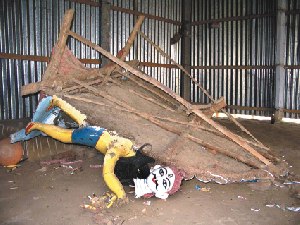
A broken idol lies toppled on the ground of a temple of indigenous people after a group of musclemen recently vandalised the images of the gods and goddesses in Chatmohor, Pabna. PHOTO: STAR |

