Fuel price hike again
Pricey diesel to hit farmers; inflation feared to spike further
Rejaul Karim Byron
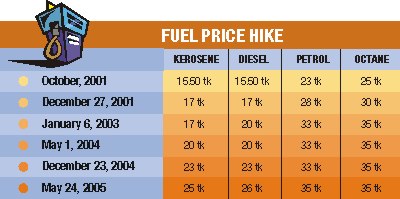
Bowing to multilateral donors' insistence, the government yesterday increased the prices of diesel, kerosene and petrol only six months into the last price hike.The price of petrol has been reset at Tk 35 per litre, raising it by Tk 2, diesel at Tk 26, marking a rise of Tk 3, and kerosene at Tk 25, pushing it up by Tk 2. The price of octane, however, remains unchanged. Until this latest hike, the prices of diesel and kerosene were the same. Now, diesel will cost Tk 1 more a litre than kerosene. Officials of the energy ministry said, after paying the import costs and duties, the actual cost of a litre of diesel comes to Tk 35 and kerosene Tk 38. "If we had not adjusted the prices, Bangladesh Petroleum Corporation would have incurred a loss of Tk 2,075 crore this year due to the wide gap between import cost and selling price. This price adjustment will help reduce the amount of that loss," said an official. Explaining the reasons for the price hike, State Minister for Energy AKM Mosharraf Hossain told The Daily Star last night, "As per our energy pricing formula, price of petroleum products has to be adjusted every six months. It was not due to any pressure but to scale down the huge loss being incurred by the state-owned oil agency BPC that we have reset the prices." "Even after this price hike, BPC will incur an loss to the tune of Tk 1,200 crore this year. To avoid this loss, the government is considering lowering the duties on import of petroleum products," Mosharraf said, adding, "On an average the import duty on petroleum products now is 25 percent and BPC pays the government more than Tk 2,500 crore every year in import duties." According to the minister, "The rise in prices is but slight and therefore it will not make any negative impact on the inflation." On diesel subsidy for farmers, he said he was not in a position to talk about it, adding the finance ministry could shed light on the issue. He however maintained that "As the irrigation season is over, I don't think this hike will affect the farmers," But Bangladesh Institute of Development Studies Research Director (BIDS) Dr Zaid Bakht was of an opposite view. "The fuel price hike will affect the inflation," he said, "And as the price of octane remains the same, while that of diesel, kerosene and petrol mostly used by the poorer segments of the society have been raised, it will hurt the poor the most." Over 90 percent of petroleum consumed in Bangladesh are diesel and kerosene. The rural people use 30 percent of the diesel and the major bulk of kerosene. Both these products are used largely in agriculture, for water pumps and transport, and thus act as a major cost factor for the country's food production and supplies. Bakht also questioned the motive of this price hike, when the recent announcement of the new pay scale for state employees has already worsened the over 6 percent average inflation. "Apart from donors' pressure," he surmised, "it might be the case that anticipating a hike in market prices following the new budget, the finance minister wants to complete such unpleasant tasks in advance." He suggested that the government should take measures to offset the negative impacts of this price hike. BIDS Senior Research Fellow Dr Sazzad Zahir said, "The price hike in diesel will raise the irrigation cost. But it does not always happen so that a cost hike in irrigation brings about an increase in commodity prices." "If the commodity price remains unchanged, then this price hike in diesel price will wholly affect the farmers, reducing their income," he pointed out, adding, "That would mean a negative impact on the rural economy." On irrigation subsidy, Dr Zahir said, "Though the situation demands the subsidy, under the prevailing weak governance it would only add to the wide-scale corruption and misuse of the facility." "So," he said, "it would be better to keep the price of diesel unchanged." Energy ministry officials last night also reiterated the age-old claim that huge quantity of petroleum is 'being smuggled to India, as it is costlier there'. The government has been presenting this argument time and again since 1991, when a litre of petrol cost Tk 13. "Today, the price of diesel in India is Tk 41 a litre, petrol Tk 57 and octane Tk 65," said one of them. However he did not say any thing when it was pointed out to him that the newly adjusted prices still leave enough profit margin for 'smuggling'. After coming to office, the BNP-led coalition government first increased the prices of kerosene, diesel, petrol and octane on December 27, 2001. That time, the prices of kerosene and diesel were increased by Tk 2 per litre to Tk 17, petrol to Tk 28 from Tk 23 and octane to Tk 30 from Tk 25. It also increased the price of jet fuel a couple of times. Until December last, the government increased the price of diesel thrice, kerosene four times, and petrol and octane twice. The government last increased the price of diesel and kerosene by Tk 3 a litre in January this year. That time it also increased the price of gas. The World Bank and International Monetary Fund have been hammering on the government to increase the petroleum prices, making it a condition for their Development Support Credit-3 and Poverty Reduction Growth Facility loans. Disbursement of both the loans has remained suspended, as the government did not increase petroleum prices and fulfil some other conditions. Yesterday's price hike will allow Bangladesh to get these loans next month, sources said.
|