Motor launches: Veritable death-traps
Capt Husain Imam
On May 15, MV Prince of Patuakhali was caught in a Nor'wester and capsized near Galachipa with nearly 200 passengers on board. At least half of them are reportedly missing or dead. On May 17, MV Raipura sank in the river Jamuna near Aricha with more than 300 passengers on board. Again, caught in a storm, the launch instantly capsized, and at least 150 passengers are feared dead. On May 19, one trawler with more than 100 passengers on her way to char Jahiruddin from Borhanuddin upazila of Bhola was caught in a storm and sank. The casualty figure is not yet known. At least 20 passengers are reported missing. In less than one week, there have been three launch disasters, one after another, and more than 300 passengers are believed to have lost their lives. What a human tragedy! What a country we live in! People are not safe here -- at home, on the street, in the river, nowhere. Worldwide, river transport is considered to be the safest mode of transport. We find the reverse scenario here. Is it because we are not moving forward? Is it that the politics of development and production -- as practiced by our politicians -- are nothing but rhetoric and bluff? Launch disaster is not a new phenomena for us. It has become almost a regular feature over the years. Every time such an incident occurs, the television crews and media get busy with their coverage. People witness the incidents with shock and horror. Some of us, as I am doing now, write articles expressing our anguish, sorrow, and sympathy. The minister in charge rushes to the spot and consoles the bereaved family members saying: "It is the will of God. We can only pray for eternal peace of the departed souls." The department concerned orders inquiry, often by those officials who are directly or indirectly responsible for the incidents, gets a report, as usual shifting the responsibility onto others, and shelves it. Nothing happens. With the passage of time, the public forgets the incident until the next one occurs, and the authorities also get away from public accountability for their responsibilities, if any. This is how we dealt with MV Rajhonshi, which went on a head-on collision with another vessel in the Meghna in the winter night of December 28, 2000, and sank instantly, leaving more than 200 passengers dead, another 100 or more missing. This is how we have dealt with MV Mitali and MV Majlish which were caught in Nor'westers and capsized -- one in the river Buriganga near Pagla and the other in the Meghna near Bhairab on April 21, 2003, with 400 passengers and a bridal party of 100 respectively. This is how we dealt with MV Nasrin and MV Maharaj. The list can go on and on. The story is the same. The invisible serial killer is undaunted. Its thirst for dead bodies seems endless. The state machinery which is supposed to protect the life of its citizen, be it in the land, air, or water, seems to have utterly failed to do so. Is it because, it itself, in a manner of speaking, is the serial killer we are talking about? It is high time somebody did something to put a halt to these unending killings. I am not talking about the "roaring forties" of the southern oceans. I am not talking about the mighty seas of the Indian ocean caught in a tropical storm. I am talking about the Meghna or the Jamuna caught in a Nor'wester. If our river transport system cannot ride over the ripples of the Meghna or the Jamuna in the age of 21st century technology, we had better not talk about the politics of millennium development. This is probably the 6th article I am writing on launch disasters in the last 5 years. Published in the national dailies, in those articles, some of them jointly written by me and my senior colleague Zahidur Rahman, former Lloyds surveyor and one of the seniormost Chief Engineers (Marine) of the country, we tried to identify the causes of launch disasters and find remedies. Let me quote a few paragraphs from these articles to highlight the issue once again. "Causes of recurring launch disasters in the country are many. As have been highlighted by different quarters, these include: faulty design, structural weakness, lack of adequate safety measures, absence of qualified crew, weakness in inspection procedures, obtaining of fitness certificate through unfair means, overloading, disregard for weather forecast. If I am asked to identify one single reason, I shall without any hesitation mention that it is the inherent fault in the design and construction of these motor launches." (The Daily Star, April 29, 2003: Launch disasters: Where lies the remedy?) "Presently there is a dual control in the inland maritime administration. If these functions could be co-ordinated by a single organisation like say a classification society for inland vessels, then these calamities which are primarily the result of faulty design could be reduced to a tolerable level." (The Daily Star, January 24, 2001: Launch disasters: Looking into the causes) "It is now well-known that the main causes of launch disasters leading to such colossal loss of life and property are: (a) faulty design and construction, (b) overloading, (c) unqualified serang or crew, (d) indifference of launch owners towards safety requirements, and (e) corruption at every level. following immediate/short/long-term suggestions are put forward for all concerned: 1. Immediate measures: Excessive overloading must be stopped at any cost. Totally unfit vessels should be immediately withdrawn from operation. 2. Short-term measures: Vessels with proven designs, like those of Sandra, Sela, Lali, Mekla (belonging to BIWTC), can be built at local shipyards, replacing the condemned launches. 3. Long-term measures: As for long-term steps, it has to be an overall improvement over the existing designs of the vessels operating in our rivers. Free-style designs, as are the cases with launches playing in the river routes and which are veritable death-traps, cannot be allowed no matter how serious is the pressure from vested interests. The idea of forming a local 'classification team' seems to be a step in the right direction provided it is done in its true spirit and concept." (New Age, August 20, 2003: What ails our water transport?) The same observations hold good even today. I would like to conclude this article repeating a paragraph from the article "Launch disasters: Looking into the causes" (mentioned earlier) which reads: "It should be a matter of great shame and disgrace on our part to have to admit that accidents and casualties in our river transport system have shot up astronomically compared to that of colonial days. Despite the establishment of IWTA as a regulatory body and promulgation of many statutory rules and regulation for the construction and operation of the mechanised rivercraft, the almost unsafe and un-sea/river worthy vessels continue to ply and incidents involving loss of lives in hundreds continue to multiply because of gross negligence or indifference to public safety by the profit mongering launch owners on one side and the corrupt regulatory bodies on the other." The author is a Master Mariner (UK) and ex-Marine Superintendent, BIWTC.
|
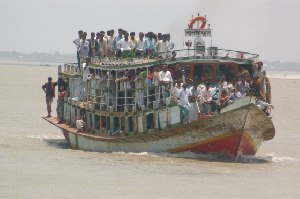
River journeys on over-crowded launches are a disaster waiting to happen. PHOTO: STAR |

