Loss of democracy in Nepal regretted
Staff Correspondent
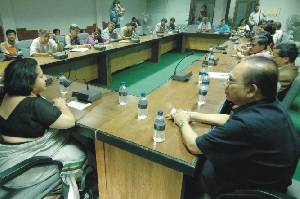
Speakers at a discussion yesterday expressed their great regret at the loss of democracy in Nepal.They said Nepal's democracy has suffered a serious setback through the action of King Gyanendra in February this year. They also blamed the rise of Maoist terrorism as having contributed to the hampering of the progress of democracy. The speakers also held the view that the infighting between the political parties and the rivalry between the leaders allowed the king to take anti-democracy measures. They observed that the countries in the South Asian region should learn a lesson from the recent political developments in Nepal to safeguard democracy. Mahfuz Anam, editor of The Daily Star, who recently visited the kingdom as a member of an SAHR delegation, was the main speaker at the discussion organised by the South Asians for Human Rights (SAHR), Bangladesh chapter, at the National Press Club in the city. Founder-secretary general of Saarc Abul Ahsan, Ambassador Waliur Rahman, deputy chief of Royal Nepalese Embassy Yug Nath Paudel, Prof Ajoy Roy, Hamida Hossain, Elina Khan, Advocate Adilur Rahman and Advocate Subrata Chowdhury took part in the discussion yesterday, with Advocate Sigma Huda, also a member of SAHR, in the chair. In his lecture on 'Political events in Nepal and implications for South Asia', Mahfuz Anam said that the takeover of political power by the king of Nepal in February was a major setback to democracy in that country. He said Nepal has witnessed changes of 11 governments since the establishment of constitutional monarchy in the 1990s. The monarchy in Nepal took the opportunity of intra-party feud and weaknesses in the political forces, he said, adding that that the fundamental rights were suspended and press freedom was severely curtailed. "The other countries in the region should learn a lesson from the failure of democratic political forces in Nepal," Anam added. During the visit in April, the SAHR delegation members met about 35 dignitaries, including high government officials, army chief, civil society members, lawyers, human rights activists, professionals and political leaders to have an idea about the existing situation in Nepal. Yug Nath Paudel, deputy chief of the Nepalese Embassy, said some provisions, including fundamental rights of the people, had been suspended when a state of emergency was declared for only a three-month period. However, the fundamental rights of the people have been restored with the withdrawal of state of emergency, he said. He also said Nepal is committed to democracy and human rights. Sigma Huda said the recent political upheaval is not only a problem in Nepal but also a great concern for the South Asia region. The SAHR was established to monitor the human rights situation in the region, she said. Abul Ahsan stressed the need for consolidating democracy in South Asia on the basis of lessons learnt from Nepal.
|