Eating Dangerously
Watchdog limps with weak laws, staff shortage
Pinaki Roy
City markets are flooded with adulterated and contaminated food items, cheating consumers and exposing them to grave health risks, while the government, hindered by weak laws and staff shortages, is nearly powerless to check it. A recent investigation by The Daily Star has found that food is no longer what it seems. Several weeks of investigation and dozens of spot inspections have revealed that, largely unknown to the public, wholesalers and retailers mix various substandard and artificial chemicals sometimes even deadly poisons - in food items to make them look more attractive. Hardly anything available in the market - from life saving medicine to fine quality rice, colorful pulses, vegetables, fruits and big fish, jams, jelly, ice-cream, and sweetmeat - remains uncontaminated by this evil alchemy. The Daily Star has also found, through interviews with several government agencies, that adulteration flourishes because of a widespread breakdown in the government regulatory system. Few effective measures are taken to prevent this pervasive adulteration practice even though the national constitution makes the government responsible to ensure food safety and public health. Section 18 (1) of the constitution, which deals with food, clearly states, "The State shall regard the raising of the level of nutrition and the improvement of public health as moving its primary duties, and in particular shall adopt effective measures to prevent the consumption…" Over the next few days, The Daily Star will publish a series of articles exploring what we eat - a dimension of everyday life often overlooked, but highly relevant given the harmful elements to which the public is daily exposed. "Please write down that 99 percent of the food items we get for tests are adulterated and substandard. The market is flooded with adulterated food," Dr. Md. Zahurul Islam, head of the Public Health and Drug Testing Laboratory, told The Daily Star. Food adulteration flourishes because concerned officials, despite knowing about the epidemic of adulterated food, are powerless to stop it, claiming they do not have sufficient authority to rein in the vast and organised groups behind it. Meanwhile, they admit that the tendency of adulterated food is increasing day by day, affecting greater portions of the public, and that thousands of cases they have filed can do little because of weak laws. The Bangladesh Pure Food Rules of 1967, the law addressing food, is now 38 years old, armed with such weak fines that traders are hardly intimidated by it. The highest penalty for adulterating food is Tk 5,000. But the expenses involved in proving such cases in court and realising the penalties are much higher. "If we file a case, the defaulter does not even go to a pleader, as the fees of the pleaders are much higher than his penalty," said an official from the health directorate, requesting anonymity. Food adulteration also flourishes because of deficiencies in government-regulated quality assurance practices. Before going to commercial production, it is mandatory that the producers secure a certificate from the Bangladesh Standard and Testing Institute (BSTI), an agency that ensures the standard of products available in the market. The certificate is supposed to be renewed every year, and BSTI officials are supposed to make inquiries at the factory to test the product on a regular basis. But this rarely, if ever, happens, sources said. Instead, most of the BSTI seals featured on products are fake, leaving the public in the dark about which is a quality product, and which is not. Among the 143 enlisted products of BSTI, more than 54 food items are entitled to receive the standard certificate. These include fruit and vegetable juice, syrup, squash, jam, jelly, vinegar, honey, tinned and bottled fruits, sauce, marmalade, pickle, tomato paste, chutney, ketchup, milk powder, butter, baby food, butter oil, ghee, biscuit, bread, candy, chocolate, toffee, tea, liquid glucose, soft drink, noodles, iodized salt, mineral water, ice cream, chilli powder, vegetable oil, soyabean oil, mustard oil, coconut oil, palm oil, flour and sugar. Among these products, hundreds in the market are being sold without any standard seals or with fake seals. A dearth of manpower, evident in several agencies and regulatory bodies, is crippling the government's efforts to check food adulteration. BSTI sources said that, despite performing their routine duties, they are unable to check all the products available in the market. Even they are aware that most of the seals seen in the market are fake. "The process is so lengthy that we can not check all the items available in the market. We do not have the manpower," said one of the directors working with the BSTI. BSTI sources added that there are only 13 BSTI field officers for the whole country, five in Dhaka division, for checking seals and conducting mobile courts. "We need at least two more field officers for every district. We could perform better if we had more manpower," said Lutfar Rahman Khan, director, Certification Marks (CM), of BSTI. The government amended the BSTI Act and fixed Tk one lakh as a fine for fake labeling. The mobile court from Dhaka has meanwhile been conducting seizures in different districts. In the last year, they have realised more than Tk 38 lakh, BSTI sources said. But that is far less than the required seizures, the sources added. At the upazila level, sanitary inspectors sometimes seize adulterated products and send them to the Mohakhali public health institute laboratory for testing. If reports are negative, indicating adulteration, the inspector can file a case in the court. The health directorate has four hundred such inspectors, but most of them are inactive, concerned sources said. In Dhaka City, less than 18 inspectors are tasked with ensuring the health safety of more than one crore people living under the city corporation area.
|
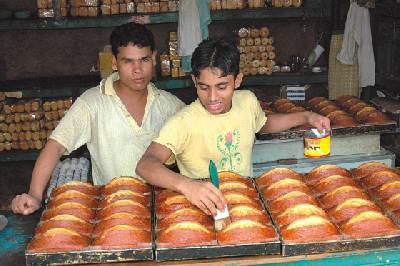
Foods prepared with substandard items and in unhygienic conditions pose serious risks for public health. The photo taken yesterday shows the inside of a bakery in the capital. PHOTO: Syed Zakir Hossain |

