World Day Against Child Labour Today
12.90 lakh engaged in worst forms of child labour
Mahbuba Zannat
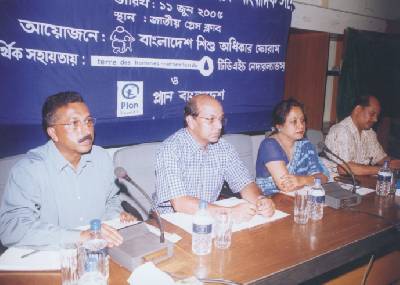
Today is the World Day Against Child Labour. The country is observing the day for the fourth year when a total of 12.90 lakh children are engaged in hazardous child labour.According to the National Child Labour Survey 2002-2003, the number of boys engaged in hazardous child labour are 11.70 lakh while the number of girls is 1.20 lakh. Of them, 6.7 percent are engaged in formal sector where as 93.3 percent in various informal sectors. A research report on State of Child Labour 2001, Bangladesh Shishu Adhikar Forum and Unicef identified some 430 forms of child labour. Among them, 67 are identified as hazardous. The report labeled seven sectors, including bidi factory, match factory, seafood, domestic help as excessively hazardous for children. Many children are also employed in bedding stores, stone breaking and construction, saw mills, glass and garment factories, tannery and other economic activities. No doubt, they engage themselves to help the families. Most of the children come from poor families and support the families, risking own security and health. Milon (not real name), 11, is working at a tannery industry at Hazaribag for the last two and half years. His job is to pile up dry leather one after another. He gets a one-hour lunch break in between his daylong shift starting from 8:00am to 5:00pm. The poor boy works 48 hours a week to receive only Tk 245, which is Tk 35 per day. He comes from Barisal and stays at his sister's house. "My father couldn't bear my expenses, so he sent me to my sister. Then my brother in-law managed this job for me. Now I can help my family a little bit," Milon said adding that his work here is not that tough and there are many boys like him in the factory. But, the boy doesn't even know that his 'easy work' costs him so much. It is found that corrosive chemicals, used for tanning and preservation of the hides and skins, are unhygienic with horrid smell. The children may develop anthracosis manifested by painful ulcer in the hands and feet, fever, severe weakness and toxic condition, dermatitis and fungal infection, digital and nail fold ulcer, diarrhea, anorexia or vomiting, according to a research conducted by the Department of Labour and IPEC/ ILO. Around three to four hundred children are engaged in some worst forms of child labour in the 200 tanneries in Hazaribag. These children are never recruited as permanent workers and deprived of all sorts of facilities, including a reasonable standard wage. The employers, especially who run the industries with a small capital, employ the children for cheap labour. As a result recruiting child workers are not stopped even though a bilateral agreement was signed in 2002,sources from International Programme on Elimination of Child Labour (IPEC) project of ILO said. The agreement signed among Bangladesh Finished Leather, Leather Goods and Footwear Exporters' Association, Bangladesh Tanners Association and Hazaribag Tannery Workers' Union with the Employers said no more child workers would be recruited in the tannery industries and it would soon be declared as child labour free industry. " But the treaties are not implemented fully. Few large industries stopped recruiting child labours, but that does not represent the whole scenario, as the small industries are yet to follow the agreement. Continuous pressure by the Tannery Workers Union and awareness building programmes taken by the ILO decreased the number of child workers, which was almost 2,000 in 1995," said the president of Hazaribag Tannery Workers' Union, Abul Kalam Azad. However, the factory owners were unwilling to admit the fact that they had child workers in their factories claiming that for the last seven to eight years, no hazardous chemicals are being used in the factories and they had appointed women workers instead of children. The government as well as different NGOs are working together to resist child labour. Education programme for the children, vocational training, economic empowerment, creating awareness in the society are going on. Rehabilitation of some 30 thousand children, engaged in hazardous work, is also carried out. On a more practical level, the Ministry of Labour and Employment is currently implementing a USAID funded project, titled "Eradication of Hazardous Child Labour in Bangladesh". Interventions under a "demonstration" project, which covers areas in Dhaka and Chittagong Municipal Corporations, include non-formal education and skills training for the working children and micro credit support for their guardians or parents. "Yet the child labour is not declining as it should have been. Lack of education, appropriate plan and implementation of laws are possibly the main reasons behind it," said the chairperson of Bangladesh Shishu Adhikar Forum (BSAF), Advocate Rokhsana Khondker. BSAF recommended political commitment from the policy makers and implementation of the Poverty Reduction Strategy paper. It also demanded for a taskforce on national child labour elimination. Introduction of national child labour policy and appropriate laws as well as signing the ILO Convention 138 were also suggested by the forum.
|