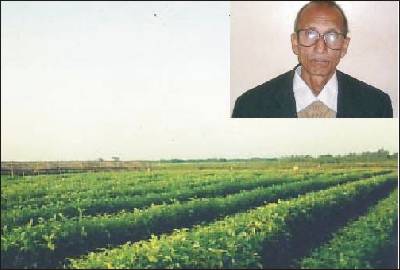
Lone warrior longing for a pat on the back
Despite no patronisation, farmer Abu Musa grows quality tea in Nilphamari
EAM Asaduzzaman, Nilphamari
Nilphamari holds good prospects of cultivation of world famous flavoured Darjeeling variety tea, opening up a new chapter in the country's tea industry.This has been proved by educated farmer Abu Musa. He planted 7000 tea saplings on his one acre land at Bhogdaburi village in Domar Upazila in 2003. He was inspired after Bangladesh Tea Board (BTB) scientists tested the soil in Domar and found it suitable for cultivation of Darjeeling variety tea. Abu Musa had collected sapling from a private nursery in Sona Patila village in Panchagarh, where this variety is now grown well. As there is no activity of BTB in Domar, he consulted tea farmers in neighbouring Panchagarh district and learnt nursing tea plants. Abu Musa is harvesting tea leaves in a limited scale since April this year. He processes tea leaves in a rudimentary way by crushing those in manually driven husking peddle (Dheki) and drying in frying pans. He sells tea in local markets. The tea is of very good quality and flavour, he told this correspondent during a recent visit to his garden. But there is no facility in the area for mechanised processing of tea leaves, he lamented. April to October is the peak time to collect tea leaves, he said. Many in the area now want to plant tea saplings but their spirit has been daunted as there is no patronisation either by BTB or any government agency, he regretted. BTB Development Officer at his Panchagarh regional office, Ameer Hossain, when contacted, said tea plantation has good prospects in Nilphamari but they can not assist farmers there as they do not have resources. It needs planning and finance from the government, he said. He said production will start in full swing in Abu Musa's garden from the fifth year of plantation. Panchagarh district is on the north of Nilphamari and India is on its north-east. Vast green tea gardens are visible in Indian territories a few kilometres from bordering Chilhati Bazar in Nilphamari. Even Panchagarh district in Bangladesh is now producing high quality tea. Scientific Officer at BTB's regional office at Panchagarh, Ismail Hossain, told this correspondent that Nilphamari has the same temperature and the same low acidity soil like that of Panchagarh. Both the districts have the same rainfall and same heights from the sea level. All these factors are ideal for tea cultivation, he added. He also said Patgram upazila in Lalmonirhat district is also suitable for producing good quality tea. After the BTB soil test, a local NGO conducted a survey and found that about 5,000 hectares of land in Chilahati, Bogdaburi, Niz Bhogdaburi, Dangapara, Gosaiganj, Chandkhana, Ghunuram, Ketkibari, Gomnati, Ambari, Jorabari, Bamunia, Boragari and some other villages of Domar Upazila are fit for tea cultivation. Earlier, after newspaper reports, a BTB team from Dhaka headed by its Chief Scientific Officer tested the soil in Panchagarh and Thukurgaon in 1999 and found the lands suitable for tea cultivation. BTB then set up a regional office in Panchagarh town in 2000 and took up a 20-year plan including a five-year pilot project (2002- 2007). Now tea is being cultivated in Panchagarh in three categories-- small farmers, small holdings and big holdings by tea companies. Seeing the prospect for growing good quality of tea in Panchagarh, the European Commission (EC) also provided fund there. Mentionably, Darjeeling variety tea produced by a Bangladeshi company in Panchagarh, earned fame in international auction in last several years, sources said. Their high quality tea is being sold at good prices abroad. Despite such good prospect, neither BTB not any government agency has taken any initiative to patronise tea plantation in Nilphamari.
|