Miniature Painting
Small is beautiful
105 artists assemble at Shilparag
Fayza Haq
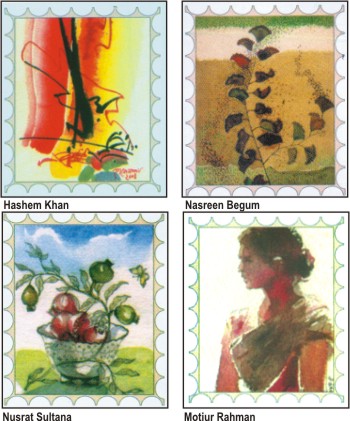
Miniature paintings have been a recognised art form for 500 years. Not only is it reduced to a small frame, but it's carefully handled and the workmanship is flawless. The ongoing exhibition at Shilparag is an effort to revive and inspire this art form in our culture, drawing both professional and amateur artists. This is in continuation of a similar exhibition held in 2003.Shilparag is keen to continue with this art form as more artists wish to participate in this type of exhibition. Last year there were 58 artists and this year there are 105. The scope this year is much wider. Nowadays we tend to live in smaller apartments, so miniature paintings fit our dwelling with limited spaces. As more paintings are in demand, the artists get more encouragement. The artists participating in this year's exhibition, such as Monirul Islam, Abdus Shakoor, Hashem Khan, Naima Haque, Nadvi and Chandra Shekhar Dey, had participated in the previous exhibition as well. The young ones are the students from the Institute of Fine Arts. Watercolour, acrylic, print and pencil work are to be seen in the exhibition. Terra-cotta and paper work have been included as well. The special attraction is the collection of nine sketches by Quamrul Islam. Monirul Islam's creation is a combination of lines and delicate splashes that create an ethereal atmosphere. Dramatic gray lines set on royal blue and vermilion, bring in the beauty of a village woman in Abdus Shakoor's portrait. Simple, bold lines complete the details of the face, clothes and ornaments. Naima Haque's mixed media is an abstraction, which brings in motifs in dots, swirls and lines on black, purple and gray. Chandra Shekhar Dey has painted a delicate portrait of a woman in an open blouse. This is in shades of yellow, with orange and black lines. N Ahmed Nadvi brings in a pristine image with three lines of crows sitting neatly on electric poles. Atiya Islam Anne, in her masks of laughing men, shows the weird world of human fantasy. The charm of the countryside, with people driving bullock carts, has been idealised in dark and contrasting shades, with details worked in carefully. Motiur Rahman's watercolour presents a profile of a woman in a sari. The realism in gray and black with washes of warm pink is remarkable indeed. Md Fokrul A Tofa's watercolour brings in the beauty of the play of light and shade in a village home. Mahmudul Islam's paper folding shows a seated village woman, seen against a branch of a tree. Mahmudul Hassan's terra-cotta shows details from a temple with boats, horses and men at arms. The watercolour by Marjita Prima depicts the ruins from Sonargaon, highlighting the broken bits of brick that speak of the glory of a bygone world.
|
|

