Theatre
Mangula: Hajongs in the spotlight
Ershad Kamol
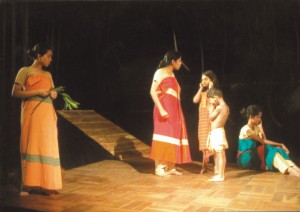
Little is known about the oppression on the Hajong community, an ethnic minority on the verge of extinction, living at the border region of greater Mymensingh and Sylhet. For hundreds of years the Hajong community has never been able to decide its own fate. Playwright Golam Shafiq has depicted the chronological history of their struggle for survival against their oppressors in his play Mangula.Palakar staged the premiere show of Mangula, inaugurated by poet Rafiq Azad, at the Experimental Theatre Stage, Shilpakala on June 11. The play begins on a festive note with six women artistes, in traditional attire of the Hajongs, dancing while a troupe of male performers join in. The audience is then introduced to the harsh reality: the violation of human rights of Hajongs by the Garos, a powerful ethnic group is depicted. There are several stories of oppression on the ethnic minority by the zamindars, British Raj and the Pakistani government. These stories have been depicted through the interruption of the peaceful and festive mood of the Hajongs by the brutal attack by the rulers. Mangula is not a complete narrative of the Hajongs, rather a fragmented story of struggle and uprising. Playwright Shafiq has wrapped up the play with Hajong's historic Beo revolution against the Pakistani government. But, Shafiq has not depicted their present condition. His way of ending the play shows that the Hajong community doesn't exist anymore just after the Beo revolution, which is opposed to reality. Director Aminur Rahman Mukul has narrated the play through a Gayen (bard). The presentation of the running river, Swameshwari, hunting scenes and weaving handloom scenes through quality choreography deserves plaudits. However, he has failed to link the oppression stories effectively. SM Riad's stylish set design is an example of quality experimental work. He has created a huge square arena and the audience sits at the three corners of the open space. At the fourth corner of the set, Riad has created an ashon. Two slopes of the ashon are suitable to create the ambience of hill tracts. The characters of higher social status stand at the upper part of the slopes, while the rest are at a lower point. Nasirul Haque Khokon's light design is superb. He knows his metier. He has used the floor of the set as the cyclorama. Through symbolic colours and dark-shadow effects Khokon has created the mood and tempo of the play. Mangola is the teamwork of 35 actors. Selim Haider as Manu Sardar, child artistes -- Rode and Aritra -- were impressive.
|