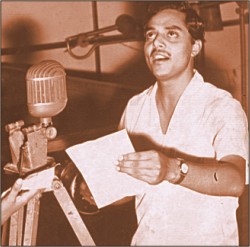
Remembering Khondokar Faruq Ahmed
Novera Deepita
Neel akasher nichey ami rasta cholechhi eka--there would be hardly any movie-goer of the 1960s-'70s who has not heard the song by the late Khondokar Faruq Ahmed. A very popular singer of the time, Faruq was one of the pioneers of the golden era of modern Bangla songs, especially film songs. Many other songs by Faruq Ahmed became instant hits and attained similar popularity and are still very prominent to this date. Indeed, songs like Kachhey asho jodi boli from Abirbhab, Ami kar jonno potho cheye robo from Amar Prem, and Tomari upohar ami chirodin from Upohar still play in the minds of the elderly as well as allure the young generation by the inherent romanticism of their lyrics and melody. Today is the 65th birth anniversary of Khondokar Faruq Ahmed. Born in 1940 in Bogra, Faruq was passionate about singing since his school days. It was as early as in the 1950s when he developed interest in music--the soundtracks of the movies he used to watch at the local movie theatre Indrapuri in his hometown. He took his primary lessons in music under Ustad Bimalendu Dewan. His other mentors of classical music were Ustad Yusuf Khan and Ustad PC Gomez. But it was not until he came to Dhaka and met great singers like Anwar Uddin Khan and Najmul Huda Bachchu that he took music seriously and cherished to build a career. These musicians, especially Anwar Uddin Khan, paved his musical career by promoting him in radio and TV. Tuned by Anwar, Faruq's debut song on radio was Joarer gaan shagor shonay in 1961. His first hit on radio was Shohagi go ki debey bolo. Soon Faruq was enlisted in television. It was in the early 1960s when Faruq stepped into the celluloid world with his melodious voice. In Narayan Ghosh Mita's film Chawa Pawa he marked his debut performance with the song Rikto hatey jarey phiriey diley tuned by eminent music composer Satya Saha. As Faruq's voice was very melodious and appealing, many romantic hit songs in movies of the time followed. Ami nijer mone nijei jeno goponey dhora porechhi, Dhaka shohor aisha amar and Amar bou keno kotha koy na are some of his hit numbers from different movies including Ashikkhito, Bahram Badshah, Alor Michhil, Shamadhan and Malka Banu. Faruq was chosen the best singer by Express, an exclusive periodical by Zahir Raihan in 1969. The same year, he was also voted the best singer by the TV. He received a gold medal from proletariat leader Maulana Bhashani in 1970 for his song Rickshawala bolei karey tumi aj koro ghrina. In 1974, Bangabandhu Sheikh Mujibur Rahman awarded Faruq as the Best singer of the year for Faruq's performance in Alor Michhil and Malka Banu. As a singer Khondokar Faruq also used to inspire his wife Parveen Begum. "It was Faruq who motivated me as a singer in the media," says Parveen. "I still remember our first meeting. I was a student of the Department of Political Science in Dhaka University. I went to his house to request him for a performance in our department's cultural programme. He was pleased to know that I was also interested in singing. Later, he guided me to develop my singing career." Parveen still reminisces their first duet Tumi ar ami on TV in late '60s. A memory that Faruq always cherished in his heart was his first meeting with music maestro SD Burman. As Parveen says, "It was in 1972, Faruq performed in a cultural show held in Bombay, where SD Burman was also present. Faruq's soulful singing as well as his catchy dialect of Brahmanbaria amused Burman." And after that performance, SD Burman was so moved that he instantly blessed Faruq, saying, "You are bound to go distances as an artiste." Those words had always inspired Faruq for the rest of his life. And as a popular singer of our golden era of music, he will hold a special place in the hearts of the Bangla music lovers. Khondokar Faruq Ahmed passed away on July 11, 2001.
|