Ageing: A creeping problem for future society?
Mesbah-us-Saleheen
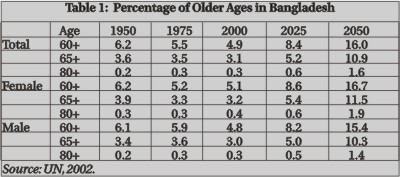
In most gerontological literature, people above 60 years of age are considered as 'old' and taken to be the 'elderly' segment of the population of a country. United Nations has also categorised the age segments as; between 60-69 belong to 'young old', 70-79 'old old' and 80+ are 'older' respectively. Manu, the ancient law giver, in his Dharmasastra divided the span of human life into four stages -- brahmacharya (student life), grihastha (family life), vanaprastha (in young old stage moving to forest) and finally sanyasa (asceticism). HelpAge International, an organisation of global action on ageing defines that the symbols of old age are: a) gray hair, b) wrinkles, c) loss of eyesight, d) loss of memory, e) ill health, f) dependency, g) physical limitations that hampers daily activities, h) walking with stick, I) menopause. In last two decades, Bangladesh has been experiencing two transformations and has passed through two demographic changes. They are firstly, the rapid population growth in urban areas and secondly, the demographic transition having lower fertility with higher longevity. Rapid growth of urbanisation and the growth of population in urban areas are mostly occurred due to rural-urban migration. In this process of rural-urban migration, mostly young and young adults are prone to migrate, leaving aged people behind, causing more aged people in rural areas. This is in conformity with the situation faced by many developing countries of the world. With the increase of urban population, particularly to the larger urban areas, Bangladesh have also gone through the consequences of demographic transition affecting the age structure and also experiencing more aged people in rural areas. Fifty years before, life expectancy was around 38 years. Gradual improvements in public health and medical services have led to substantial control of specific infectious diseases, which translated into significant decreases in mortality rates. Government, NGOs and private institutions sponsored family planning made some impact on fertility. On top of it better sanitation, increased attention to maternal health and improved childcare facilities also reduced infant mortality. Life expectancy at birth rose steadily and in the Economic Review of 2005, published during last budget had reached nearly 65.4 years for females and 64.5 for males, and the average is 64.9 years. While the retirement age from a government position is 57 and from the private sector 60 years old, "formal retirement" is not an option for poor older people in Bangladesh, as they must work to survive. The majority of poor older people, both men and women either work or have worked in the non-formal sector and do not "retire" until they are no longer physically capable of working. In our country, population above the age of sixty has reached over 7.2 million. The life expectancy is increasing on account of improved health services education and technology. The ageing is also becoming a subject of concern for the national planners dealing with socio-economic programms. In Bangladesh older people are revered and they hold a prominent position within the family and society based on our cultural values. Our population is moving from rural to urban areas and creating social gap and more and more old people are being isolated in the villages. The percentage of population aged 60 and over in Bangladesh was nearly 6 per cent in 2000 (Table 1). It will increase to 8.4 per cent and 16 per cent in 2025 and 2050, respectively. The percentage of older females will be higher than the older males in coming decades (Table 1). In The ageing index which indicates the number of persons 60 years old or over per hundred persons under age 15, will also affect the demographic structure of Bangladesh population. In 2000, the ageing index was 12.8, and it will increase to 29.8 per cent and 72.9 per cent in 2025 and 2050, respectively. Although the total dependency ratio of population of the country will come down from 71.9 per cent in 2000 to 50 per cent and 49 per cent in 2025 and 2050, respectively, the old-age dependency ratio will be tripled. It will increase from 5.4 per cent in 2000 to 7.8 and 16.2 per cent in 2025 and 2050 respectively. In the same periods the youth dependency ration will come down to 66.5, 42.2 and 32.8, respectively. Both the growth rates of older persons and life expectancy will increase in future. The total life expectancy will grow from 60.7 in 2000-2005 period to 70.6 and 75.0 in 2025-2030 and 2045-2050 periods, while the survival rate will also be increased to 66.2, 82.1 and 88.7 per cent respectively for those periods of time. The median age of the country's population will also increase from 20.2 in 2000 to 26.9 and 34.8 in 2025 and 2050 respectively. The potential support ratio, which indicates the number of persons, aged 15 to 64 per every person aged 65 or older will decrease from 18.6 in 2000 to 12.9 in 2025 and 6.2 in 2050. On the contrary the labour force participation was decreased from 50.9 per cent in 1990 to 46.6 per cent in 2000 and it will further decrease to 42.9 per cent in 2010. Traditionally, Bengali society had a structure of caring the life of older people. It was common in the joint families of our culture. The situation has been changing. Complexities of the societies with rapid urbanisation are influencing the traditional respects and caring structure of the elderly persons. Low wages, high living cost and employment insecurities make some of the urban dwellers not to meet the requirements of their ageing parents both living with them or living in rural areas. At present most people feel that respect for the elderly in society is diminishing. They suggested that reasons for this decline include poverty, the dowry system, and poor family education (e.g. children are not taught to respect their elders). Older people suggested that family relationships are now more based on the older person's contribution of land or money, rather than on respect. Older people, particularly men, feel that there is a direct correlation between their income earning ability and level of respect. This again highlights the role of poverty in the lives of older people in Bangladesh Older persons are often negatively perceived as being physically frail, and dependent. These perceptions can often leave older persons neglected. Improvements in medical care and nutrition have contributed to the fact that older persons today are generally healthy than two to three decades ago. In Bangladesh, most of the older people, particularly the poor, are not defined old according to chronological age. In general older people are defined "old" according to physical characteristics and limitations that affect their ability to function in daily life in both household and income generation work. In Islam, serving one's parents is a duty second only to prayer, and it is their right to expect it. It is considered hateful to express any irritation when, through no fault of his own, an old person is considered to be difficult. The Holy Quran says; Your Lord has commanded that you worship none but Him, and be kind to parents. If either or both of them reach old age with you, do not say 'uff' to them or admonish them, but speak to them in terms of honour and kindness. Treat them with humility, and say, 'My Lord! Have mercy on them, for they did care for me when I was little'. (17.23-4). In general older people feel that young people see them as being unable to earn income, dependent on their families for survival, and therefore as a burden. Even in rural areas where social and technological changes are less rapid, many younger people did not value the contributions of older people to the family and community. Many indicated that they see older people as difficult and irksome. In our society children living with parents would be expected to support their parents. Previously in most of the cases sons/sons-in-law would take a role in looking after the parents from son's side. Since 1990s things have been changing and daughter/daughter-in-law is now coming to the picture. From empirical studies, it has been observed that the elderly people, who are disabled, prefer to live with daughter than son, because of caring facilities. They could have stayed with their sons but they feel free at their daughter's house for their personal day to day affairs (going to the bathroom, shower etc as a helping hand). It is true that in our country, ageing is increasing in rural areas due to the rural out-migration of young adults. But it has been observed in several studies that the urban setting is less favourable to sustain the traditional extended family networks and linkages system than are in rural areas. Often the older rural-urban migrants have to face loss of social networks and lack of footing in urban areas that can lead to their aspiration of better living. It is found in several studies that countries with a history of rural to urban migration and the expansion of underdeveloped cities have a growing population of poor older persons. Our country having passing through both demographic and economic transition needs special attention to the ageing urban population. Policies for the betterment of ageing population both in urban as well as rural areas should be taken into consideration. Policies on social networks, economic security, health and housing for ageing population will strengthen the demographic scenario of the country. A long-term policy options need to be considered to ensure the affordable solutions of future ageing problems. In present socio-economic conditions, the practical implications of the ageing population are far-reaching. The number of aged people is increasing in absolute term within limited resources. The response to such creeping problems has to be well planned. The first step is the advocacy, to raise policy makers' aware of the multiple issues related to ageing in the country. Professionals, politicians, NGOs and the general public need to be aware to ageing problems. Since economic security is of prime importance, though not sufficient, the government has rightly introduced an Old Age Pension Scheme (OAPS) for some. The existing pensions need to be enhanced and the scheme should be elaborated especially to the rural aged, widows and people in urban slums. Sooner this will be achieved will be better, though the government is grappling with economic problems. The problem of caring for a vast elderly population is complex and there are no immediate and easy answers. The government alone cannot solve this problem. Participation of NGOs and community assistance providing necessary care and support to the elderly within the community is recommended on top of opening old age homes. Projects to keep old people economically active have also to be taken. Some incentives in the form of tax exemption for families providing care to old family members can also be recommended. Mesbah-us-Saleheen is Professor of Geography & Environment, Jahangirnagar University.
|
|

