Morshedul Islam on his latest venture and more
Fayza Haq
Morshedul Islam's involvement with theatre goes back to his young days with Dhaka Little Theatre. He has gained experience in direction since '78 when he had just passed his SSC exam. He then felt that the film was a powerful media as it drew larger crowds and its visual language was very effective if the film was made well. When he was in the Pharmacy Department of Dhaka University he established a film society in '82, and through it he got to see many good foreign films. "I was specially fascinated by the Italian Neo-realistic films such as those by Vittorio De Sica and Michaelangelo Antonioni. They shot on location and did not use stars. They were drawn by social realism. Satyajit Ray's Pather Panchali followed this trend. I also admired Akira Kurosawa and Andrie Tarkovski. Films can greatly motivate people, and at the same time can influence them adversely -- the earning of money being the sole motive for making the films." Morshed produced his first film, Aagami while still a student. This 25-minute black and white film won an award in New Delhi. This was the beginning of his career.Talking about the difference in today's films and those made 15-20 years ago, Morshed said that the film language is constantly changing as new experiments take place. Both technically and aesthetically films have changed. "Now, for instance, you can make digital films in 35 mm. Today there is a lot of camera, film and sound equipment, which were not present earlier. The aesthetic elements also change with time. There are some films, however, which are classic films, and they appear new even today, as in the case of Pather Panchali, Roshomon, Bicycle Thief and Eight and a Half. In general, however, the language of film is always changing," he said. Asked about the elements of a good film, Morshed said, "What goes into the making of a good film also goes into the making of a bad one. For every film you need a script developed from an idea, actors and actresses, camera, laboratory and sound equipment. A good film has creative ideas from its outset to the ending. Those who make bad films have little creativity and are there only to make money." Talking about the films that he had made so far, Morshed said, "I have made nine films so far. Khela Ghor, that I'm presently making, will be my tenth film. All have different themes. My first film dealt with the task of reinstating of the Muktijoddhas in society. My next film Shuchona was also about the freedom fighters. My third film Chaka is different from any other film in Bangladesh: it is about how a corpse is being carried from one place to another in a bullock cart. Next I made a film for children, Dipu Number Two and it had a simple narrative style. Later, in Dukhai I depicted the life of people who lived on the riverside and struggled against natural disasters as a matter of routine. The next film, Durotto was also for children. My present film Khela Ghor is a romantic story set against a backdrop that will interest everyone. I've tried to give every one of my films a different treatment." Putting in a few words about Khela Ghor, Morshed said," The shooting will take place at Sonargaon between August 20 and September 10. The cast includes Riaz, Saba and Ahmed Rubel. The story is based on a writing by Mahmudul Haque. I have written the script myself. The plot revolves around a young woman who is being courted. She appears moody, cold and distant at times, and wants to leave the young man. The hero finds that there is something strange about the woman and finally discovers from his friend, who initially introduced her to him, that she was assaulted on 25th March, during the Liberation War. Thus we see love in the background of the war." Asked what ideals he kept in mind while making a film he said, "I make films for myself and not to please the viewer. I have something to say, and if the viewers like that, I like it too." Morshed's Aagami won the Silver Peacock award in New Delhi in 1985. His Chaka won various prestigious awards in various international film festivals such as the Grand Prix in the Dunkerque Film Festival in 1994. His Dukhai received National Awards in nine categories.
|
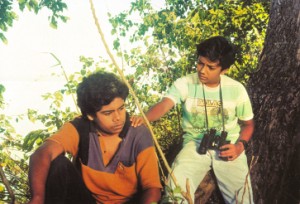
A scene from Dipu Number Two |

