Chronicle
Of love and infatuation in the energy sector
Nururddin Mahmud Kamal
The rarity of hydrocarbon exploration and exploitation and its unending need worldwide generally contrive to elude a quick and easy answer about the "sharks" of the business to a simple citizen. Thanks to our media, Niko, currently operating in Bangladesh, has come under public scrutiny. In five months the inexperienced company has given us two rude shocks -- two blow-outs in gas wells at Chattak. Unhappily, the Ministry of Energy has made Bapex a scapegoat for the unusual incident. Our energy advisor has not even hinted at penalising the foreign company for the drilling disaster. People are shocked and surprised.Based on available data and information, we articulated the incidence of the first blow-out in January, 2005, the loss of gas etc. worth about $270 million, equivalent to Tk 1600 crore. Apparently, the authorities were least perturbed. Instead, the former State Minister AK Mosharraf Hossain observed: "Nothing serious has happened. The place where blow-out occurred was a gas pocket. So, there was no loss." But this time, the atmosphere has turned heavy for Petrobangla and Bapex. They were reprimanded for the alleged faults of Niko! Our gas sector problems did not develop overnight. Some say that there were conspiracies to create shortages in the domestic supply. Indeed, it was a case of harakiri of a different kind. Over the past few years the state-owned enterprises -- Petrobangla and Bapex -- were put on a leash by the former state minister. Out of sheer anguish, these corporate bodies have attempted a suicide -- a crime that cannot be pardoned. While this was happening, Unocal, Cairn, and lastly the incompetent Niko, were allowed to produce and sell gas upto their peak production, while Petrobangla was starved. The conscientious citizens were agitated. Things turned messy, transcending accountability. The Hon'ble Prime Minister decided to act. The ring master was fully leashed, an action that was long overdue. The common people thought for a while that the undue patronising voices of the IOCs would now simmer down. Much to everyone's wariness, once again we heard the echo of familiar utterances on the television screen on June 24, 2005. It was the voice of Mr Mahmudur Rahman, advisor of the Energy Division. Common people were alarmed. Already a fear syndrome in the gas sector was created by the former state minister. The fear that gas development activities would be released from the public sector domain and gradually ushered into the foreign private entrepreneurs' domain is haunting us. Over the past several years, the people heard many a time the same familiar claim that government should not be involved in the gas business because the public sector is neither efficient nor as innovative as the private sector. Those who advocated privatisation of the publicly owned gas system included Mr Hussain, perhaps Mr Rahman too, as the chief of BOI. Consequently, there is an apparent sense of urgency to begin negotiations on some gas based projects. Some say that there are a new kind of gas export endeavours where an Indian business tycoon is essentially interested because of the "gas price factor." As BOI boss, Mr Rahman has already been promoting such foreign investment proposals. Perhaps, he was not fully conversant with the gas reserve position of the country vis-a-vis the domestic demand even up to 2015, let alone up to 2035. According to the National Gas Utilisation Committee Report (August 2002), the existing reserve of gas (between 12 and 15 trillion cubic feet) is going to be exhausted by 2015. If he knew, how could be allow discussions on supply assurance of gas to some investors for up to 30 years? He may please like to read the writing on the wall: "controversial gas export based projects will be resisted." For a while let's recall the last days of the state minister for energy in Calgary, Alberta (Niko's head office) and in Dhaka. Hurriedly, he had to return from Canada and face a hard fact of life. He was disgracefully relieved of his position. The electronic and print media disclosed the story of his fall with zeal and dedication, perhaps a little more this time because of the very expensive car deal. The week following June 19, countless comments aimed at the deposed state minister and his expensive car came through the media. The curious part of the story was that Niko was not alarmed, nor they were penalised for the dirty job. There were those who said that the shock was only temporary. There were also those who claimed that the shock was not real, but has been created by some bureaucrats who finally decided to disown the state minister. Some, however, maintained that the incident had been contrived by a small group involved in the politics of energy to divert attention from other bigger disasters. Meanwhile, can we request the seven-member inquiry team to ask the authorities in Bapex/Petrobangla to provide them with the draft (initialled) contract and the final (signed) contract as well between Bapex and Niko to see whether there are variations between the two? Now, few can claim to know who to believe. Credibility regarding the gas sector and the Ministry of Energy is in as short a supply as honesty was in the past several years. The energy sector corporate bodies such as Petrobangla and BPC were blamed for their corrupt practices and inefficiencies by the former state minister. These organisations, perhaps due to lumber haemorrhage, could not even occasionally rise to justify their actions. Or maybe they didn't want to do so because of their organisational malaise. Otherwise how can an organisation (Petrobangla) operate with only 40 per cent of its approved strength? Amazingly, some publicly denounced officials and union workers in Petrobangla, BPC, or in Bapex were defended by the former state minister. It is alleged that these questionable officials had a comfortable time under the former boss. The media disclosed the negligence of the state minister. Allegedly a void was created deliberately to strengthen those patronising the IOCs on the one hand and to promote some who will fight only for the interest of the foreign companies on the other. Would anyone believe that another baffling incident could occur within one week of the removal of the state minister? Incidentally, true to the predictions of the professionals, Chattak gas field faced the second blow-out within five months due to the callous and inept handling of the drilling programme, designed and implemented entirely by Niko. The second blow-out occurred on June 24, 2005, from an ill-designed "relief well." Niko committed the second offence. But the people were shocked to watch the television interview of the energy advisor: he accused Bapex for not monitoring the drilling, but didn't say anything about the offence of Niko, who actually is the operator of the project as per contract. Bapex is only a sleeping partner in this suspicious exploration-cum-production game. Indeed, if Chattak drilling is an exploratory work, it should have been an outcome of the competitive bidding under Production Sharing Contract (PSC). If it is still in development phase after its discovery in the late fifties, then it is simply a violation of PSC. This is a clear case of falsification, perhaps forgery of documents. Can the former state minister absolve himself of the guilt? Now, after the second blow-out, we hear the rumbling of a similar accusing tone towards Bapex by the energy advisor. We would like to urge the energy sector's new leader and his new associates to appreciate the real needs of the sector. Because all of us, in our multiple roles as consumers, producers, tax payers, voters and above all, citizens of Bangladesh, have the final say. Let's not forget that for a very brief period, due to the shrewd maneuvering of corrupt politicians, the gas sector was in great disarray. We hope the bad spell is over. Much of the valuable time has already been lost, but it's never too late to review these things at the national level, not at any individual level, as was practiced in the past several years. Nuruddin Mahmud Kamal is a former Additional Secretary and a former Chairman of Power Development Board.
|
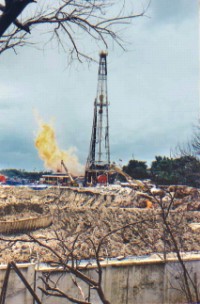
The latest blow-out has devastated the surrounding region and cost the nation millions |

