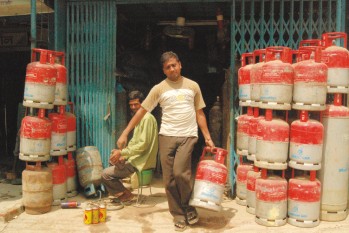
Housewives oppose govt's plan to supply gas in cylinders
Kausar Islam Ayon
Almost 97 percent housewives opposed government's plan of supplying gas in cylinders to households in the city instead of pipeline gas, as they believe it would be costly, risky and a hazard to daily life. The Star City ran an opinion survey on 30 housewives on the telephone -- 29 of them opposed the plan, while one refrained from answering. "This is just an unwise decision. I am sure even the wives of finance minister and adviser to the energy ministry will raise objections," said Sumaiya Tamanna, a housewife in Gulshan. The survey revealed that most housewives are apprehensive of and shocked at the government's plan to implement cylinder gas supply for the household use. "I am afraid of cylinders. I feel they may burst any time," said Nurunnahar Begum of Shahjahanpur. Although five participants were unaware of this plan, they opposed on hearing of it. In an inter-ministerial meeting, last week, the finance minister revealed that the government is considering the replacement of the present pipeline system of gas with cylinders for domestic use. "One of the few good things in the city is that we hardly face any difficulties in cooking because of the flow of pipeline gas, but if the plan is implemented, we will face great difficulties," said Jahanara Begum, a housewife in Dhanmondi. In answer to the question why they do not support the plan 90 percent said it would be costlier than at present and cumbersome to arrange delivery to homes. 'Some of my relatives back in the village use cylinder gas. A cylinder that costs Tk 550 cannot cater to a month's cooking for a 3-member family. A 5-member family would certainly need two cylinders a month and would cost over Tk 1,000," said Rubi Islam, a resident of Mohakhali. "The problem is not only the money, but the time wasted on having to collect the cylinders," she added. When asked what solution would the government have to stop wastage of gas, almost 53 percent said that a metre-system could be introduced as in the case of electricity, water and phones. "Metres can be installed to measure gas usage, just like electricity and other utilities, and pay only for the amount of gas used," said Nilima Zaman of Baridhara. But 24 percent replied no one burns gas unnecessarily, and there was no need to change the system, while 20 percent said they were not sure of an alternative. To the question whether or not gas is burnt up unnecessarily, 64 percent said they unconsciously keep the flames burning even after the cooking is done. They also admitted that sometimes they use the cooker to dry clothes especially on rainy days. "To stop a handful from wasting gas the government cannot punish thousands of users," said Saida Mohosin who resides in New Eskaton. When asked what these housewives would do if the government proceeded with the plan, 77 percent said they had no idea; three percent said they will not vote for this government in forthcoming general elections, while seven percent said they would accept the change if the cost remained the same. Nargis Sultana, another participant in the survey said: "If we are assured of home delivery at the same cost, we will no argue." However 10 percent believed that the government would withdraw the decision. "Such a decision would be suicidal," said Koohinoor Bilkis from Dilu Road in Moghbazar.
|