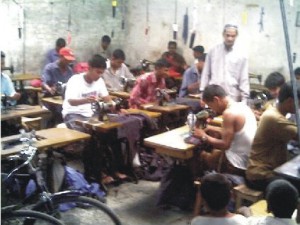
100 mini garment units in Saidpur cry for support
They earn forex but neither recognised not get bank loan
EAM Asaduzzaman, Nilphamari
They earn foreign exchange for the country and employ over 8000 workers including about 200 women. But they are neither recognised by the organised business bodies nor given any facility by the government.Garments including beautiful and high quality jackets, trousers, shirts and three-quarter pants produced in about 100 mini factories in Saidpur are in good demand in West Bengal and seven-sister states in India, Nepal and Bhutan. These are produced with cut-piece of imported fabrics, collected from big garments factories in Dhaka, Chittagong and other big cities. Transportation cost is also lesser because of close proximity to the border. These garments are acclaimed by buyers in those countries for their better quality because in India, garments are produced mostly from locally made fabrics, some of the owners of the factories told this correspondent. In the last financial year, these factories earned about Tk 15 crore in foreign exchange by exporting through official procedures. "Trained manpower is our greatest asset", said Reaz Ahmed Babu, owner of Aman Garments in Saidpur town. "We have nominal establishment cost compared to garments factories in Dhaka. With ordinary and old sewing machines we produce almost the same quality goods as is done with modern machinery in big factories in Dhaka", he said. But we do not get any facility and support including bank loan from the government, he said. He said they approached the Bangladesh Garments Manufacturers and Exporters association (BGMEA) for its membership, but was denied. BGMEA membership would have helped us a lot in development of a garments factories here with cheap labour, he said. The garments produced in Saidpur drew the attention of Indian buyers in 1995. Export started in 1999. Indian buyers import the garments mainly through Siliguri, from where these are dispatched to different areas in West Bengal, Assam, Tripura and other states in India and to Nepal and Bhutan. Nepal and Bhutan have free trade with India. Reaz said, failing to get a job, he started a small garment factory with four old sewing machines and a capital of Tk 5000. He collected some bundles of cut-piece fabrics and produced 300 jackets in one month and sold those in the wholesale market. He earned a small profit. He now owns 40 sewing machines and employs about 100 workers including 10 women. He produces around 10,000 pieces of jacket and 30,000 three-quarter pants a month. Production cost of a jacket is around Tk 70 and it is sold to an Indian importer at Tk 120. A trouser costs Tk 50 and a three-quarter pant Tk 20, which are sold at Tk 60 and Tk 40 respectively, he said. Dil Newaz, another small garments factory owner and exporter said garments of Saidpur are very popular, particularly among the middle class in West Bengal, Assam, Tripura in India and in Nepal and Bhutan. "Even big and fashionable garments shops in Kolkata and Gwahati also buy our products", he said. Though about 100 factories are engaged in production, only nine owners export the items. Because of lack of capital, they have formed a syndicate. The members are Reaz Ahamed Babu, Md Selim, Dil Newaz , Saidur Rahman, Arshad Ameer Pappu, Khorshed Alam, Md Masud and Motiar Rahman Dulu. They said, on an average, 10 truckloads of garments are exported to India a month now. Reaz said a truck can carry 10,000 pieces of jacket, 20,000 trousers and 40,000 three-quarter pants, worth 18,000 to 20,000 US dollars. From Saidpur, the goods are exported through Burimari land port in Lalmonirhat district and Chengrabandha in India. They also cited another problem. The garments thus imported by Indian buyers do not enjoy tariff facility under SAFTA agreement among the SAARC member countries. They said if patronised by the government and funded by banks, this could be a flourishing sector to create more employment and earn foreign exchange. The export can be increased manifold as there is very good markets just across the border, they said. Talking to this correspondent, Nilphamari Chamber of Commerce and Industry President Sohel Parvez said the government and the BGMEA should come to the aid of the small but flourishing business here because the cheap and trained labour may open up a new window for the country in the highly competitive garments market in the world.
|