Book Review
Some don't even use the 'L' word
Khademul Islam
In our crowded, complex, layered age sometimes one wants poetry to touch its old-fashioned roots, speak directly of what it used to so voluminously: romantic love. And so this anthology of Indian poetry in English consisting of love poems was pleasing to behold at first sight. Also pleasing to note was the fact that there could be an anthology on a single theme, since such anthologies--and not just your run-of-the-mill package of poets--make their appearance only when a critical mass of poetry has been reached, when there are enough poets and poems from whom to pick and choose. Indian poetry in English is fast approaching this volume and density of writing.But our age intrudes, as it must, and forces on the poets the primal question regarding love poems: how does one say anything new? It is a state of affairs that A K Ramanujan confesses to in the beginning poem of the volume, 'Love 10,' in rigorously measured lines: Love poems, he, says, are not easy to write
because they've all been written before.
Words play dead. The seasons are trite. But the poets ranged here, as the editors write in their Introduction, have 'responded to the challenge of the love poem in unexpected and innovative ways. Some of them engage with the politics of love, some deal with the emotional specificity of the encounter, some refract love through other senses, some don't even use the 'L' word but let that strange complex of feelings run like a subterranean river beneath their feet.' After beginning with Ramanujan and Kamala Das, the volume continues on strongly with Agha Shahid Ali and Sujata Bhatt (her 'White Asparagus' with its unabashed anatomical referent, which renders the textures of physical love so plainly and directly that in the sub-section of erotic love poetry written by Indian women in English it must represent a milestone of sorts; there are American influences at work on her, shadows of both Anne Sexton and Adrienne Rich). The volume falters somewhat midway with Sudeep Sen and Manohar Shetty, where the hinges of the poems' drama creaks too audibly: the scarf, the past flame, the knock on the door, etc. where one expects a turn in the alley, but the road merely continues on in a predictably straight line, mile after sentence after mile. However, it recovers strongly with poems by Jeet Thayil, Dilip Chitre, Smita Agarwal, Arun Kolatkar and Menka Shivdasani (whose voice remains her own, where as always in her poetry there are darker undertows, as in her 'Bass Notes' here, where there is also present the physicality, the bed, but where the grating male anxiety about performance: Later, he asked, anxious: 'Did you,
baby, did you?' for at a crucial moment,
There were silences that he didn't expect
.is thrown into larger relief as the poem finishes on a turn, on the double meaning of words.) Reproduced below are three poems (the more ironic, tongue-in-cheek ones) from the collection. Of special note is Vikram Seth's poem 'Prandial Plaint.' He, almost alone among Indian English poets, is one who consciously works with traditional English metres, and who exhibits not only an enviable ease with it, but also an unfeigned delight. The manner, the voice in the poems is always cool, determinedly understated, mocking, ironic, and( dare I utter that heinous word, dare I, while the women come and go? ) postmodern, a world where equal weight can be judiciously assigned to both picnic and paramour. And it is this tension, the interplay, between modern voice and traditional metre that sets up most of Vikram Seth's poems. As is amply displayed in 'Prandial Plaint,' which is a quatrain (stanza of four lines), and which along with the couplet and the tercet have been the basic stanzaic building blocks of English poetry. To one acquainted with English poetry this archetype, or any variation of it, specially with its rhyme scheme not flung into the winds of free verse, immediately triggers powerful traditional poetic associations, just as any shape resembling a mosque dome, say, does in the Muslim mind. Contrasting it is the gentle parodying of traditional English love poetry's cataloguing: the beloved's eyes, brows, breasts, nose, feet, etc. But the contrast acquires its most telling effect from the use of iambic pentameter, distinct and unambiguous in the first two lines, teasingly reminding the reader of all those lines written from Shakespeare's sonnets on down to what Andrew Motion called the 'sad music of postwar Britain' in Larkin's poems (a great shuffling artist of meter), where the beat then muffles and mixes (the spondee 'One word' thudding in the third line, stretching time), to end in the loving, finger-wagging chortle of the last line. Light stuff, of course, but wickedly accomplished. Prandial Plaint
(Vikram Seth) My love, I love your breasts. I love your nose.
I love your accent and I love your toes.
I am your slave. One word, and I obey.
But please don't slurp your coffee that way. Alibi
(Eunice de Souza) My love says
for god's sake
don't write poems
which heave and pant
and resound to the music
of our thighs
etc.
Just keep at what you are:
a sour old puss in verse
and leave the rest to me. Lines Written to Mothers Who
Disagree with Their Sons'
Choices of Women
(Kynpham Sing Nongkynrih) For managing to love
an object of scorn,
they place around my neck
a garland of threats. And the world is cold this winter,
cold as the matrimonial column
they lecture to my sewn-shut ears,
or the stares that stalk
the woman of my choice. But the cherries are pink
and festive as her love. Leave cherries to winter, mother,
love to seasoned lovers. Khademul Islam is literary editor, The Daily Star.
|
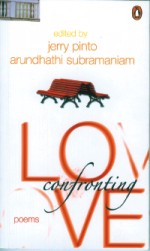
Confronting Love: Poems, edited by Jerry Pinto and Arundhati Subramaniam; Delhi: Penguin India; 2005; Rs. 125; 84 pp (pb). |

