50 tonnes of medical waste dumped a day
Poses serious health risks in Dhaka, promotes unscrupulous trade
Daud Khan
A lack of coordination among health agencies and hospitals, combined with outdated waste management policies, contributes to the open dumping of medical waste at city hospitals, posing a threat to public health and creating a secondary market in reused medical waste. It is a disturbing daily routine. Abdul Motaleb, 28, rummages through piles of medical waste in dustbins in Shyamoli every day, his slipper shod feet submerged in bloodied gauze, syringes, and dirtied latex gloves. On a recent afternoon he cleaned out the tube of a blood bag, blowing into it with his mouth to force the blood out the other side. For his labour he earns 80 or 90 taka per day, selling the plastic items and syringes to wholesalers in Dhaka. This thriving trade in reused medical waste, evident at dustbins throughout the city, symbolises the negative side effects of the city's waste disposal policy, which lacks provisions for separating and properly disposing of medical waste. Figures on the amount of medical waste produced in Dhaka City are difficult to come by, but some sources roughly estimate that city hospitals produce approximately 50 tonnes of medical waste every day, most of it openly dumped in dustbins on the street. Health experts say such indiscriminate dumping poses a serious health risk to the public. "This is an important issue, and we are considering it as a hazard for the environment and also the spread of diseases," said Abdul Hamid, the director general of Health Services. Sources say all city hospitals dump some or all of their medical waste in dustbins, where it is left to fester in the midst of the public. Dhaka Medical College Hospital (DMCH), for example, lacks the facilities to incinerate most of the medical waste it produces every day. Two of its three incinerators are broken, meaning the hospital can only incinerate 35 kgs of the total 150 kgs of medical waste produced each day. The rest is dumped in dustbins in the area, said a hospital official in charge of waste, requesting anonymity. From the street the medical waste becomes a reusable commodity, sold to middlemen and wholesalers after being collected by tokai (street urchins) like Ayesha, who was cleaning a used syringe at a dumpsite in Shyamoli, near the Orthopedic Hospital, on a recent afternoon. Nearby, a man named Farook Mohammad was busy breaking apart a syringe, placing the needle in his mouth and pulling off the plastic rod. Then he cleaned a tube from a blood bag by beating it against the wall, sending blood splashing out from the other end. Ayesha, who says she earns up to Tk 50 per day, sells her findings to various wholesalers, like the one just across the street from the hospital, whose small stand is overflowing with piles of plastic bottles and other refuse. The wholesaler who gave his name as Mohammad said he collects between 80 and 100 kgs of waste every day from street suppliers, 20 to 25 kgs of which is medical waste. This he sells to bigger wholesalers, who in turn sell it again, and so on and so forth up the line. The ultimate destination of these items remains unknown, but sources said they are most likely reused, perhaps burned down and turned into other plastic items. Whether or not they end up back in the hospitals could not be ascertained. Hospital officials say they have neither the capacity nor the responsibility to properly dispose of medical waste. "The main responsibility for waste is through the municipality. We have no arrangement to dispose of the waste ourselves," said Prof Dr Md Siraj-Ul-Islam, Director of the National Institute of Trauma & Orthopedic Rehabilitation in Shyamoli. "Though we want to separate out the infectious and non-infectious waste, we cannot dispose of it ourselves." Prof Siraj added that the Ministry of Health and the Dhaka City Corporation (DCC) should work together to develop a system for medical waste. Until then, he said, hospitals have their hands tied. "We can do our part, but the next phase should be developed by the municipality." Others agreed that better coordination among the city corporation, the ministries and the hospitals is crucial for improving the situation. "The coordination is not up to the mark in the present stage," said Dewan Md Shah Alam, deputy chief conservancy officer of DCC. The dangers posed by medical waste stem from a legal deficiency, Shah Alam pointed out, describing that waste collection operates according to an ordinance from 1983, which makes no special provision for collection of medical waste, even hazardous and infectious waste. All the waste is collected in the same manner, dumped together and not properly sorted, he described. The law needs to be updated, he added. "Now we are thinking about a separate policy for medical waste." Shah Alam said efforts are being made in that direction. The city corporation recently asked all hospitals to purchase special plastic bins for proper sorting of hospital waste. Currently the measure is only a recommendation, not a mandatory provision, he described, which is why medical waste is still being dumped openly on the street. "People are not so aware of medical waste yet," he said. But the city corporation intends to enforce it eventually, Shah Alam said. "We are pursuing the hospitals if they fail to do it in a time. We want to take action against them." Mayor Sadeque Hossain Khoka also maintained that the DCC is moving to improve the situation. "We are trying to improve our waste management system. We hope that we can overcome the problem of medical waste and other lapses," he said during a recent interview in his office. Hope is on the horizon, the mayor pointed out, saying the city corporation has recently begun working with an NGO, Bangladesh Prism, to properly collect and dispose medical waste. Each day, a yellow truck with "Bangladesh Prism" painted on its side makes the rounds of five hospitals in Shyamoli and Dhanmondi, collecting up to 100 kgs of medical waste. The truck, a grant from the city corporation, dumps the waste in a special acre of land at Matuail. This is so far the only programme of its kind targeting medical waste, according to Md Zahidul Islam Khan of Bangladesh Prism. The organisation soon hopes to expand its collection efforts to 59 hospitals and diagnostic centres.
|
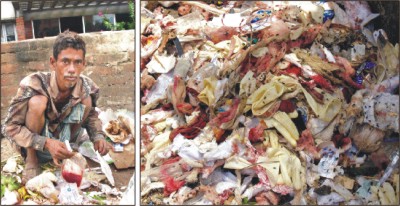
A man, left, collects used blood bags and syringes dumped in front of Suhrawardi Hospital; A pile of medical waste, right, on the premises of Pangu Hospital (National Institute of Traumatology and Orthopaedic Rehabilitation) in Dhaka. PHOTO: Syed Zakir Hossain |

