Revaluation of Yuan
Lesson for others
Golam Muhammad Areef
China has revalued its currency, the Yuan, for the first time under repeated calls by the United States and other Western powers for an upward revaluation. The announcement (21st July, 2005) to this effect was widely seen as the first step towards the liberalisation of China's currency. The yuan will no longer be pegged to the dollar, but will float against a basket of currencies. However, it was not indicated which currencies they would be. It will also appreciate against the dollar, mollifying critics who say a cheap yuan has helped Chinese exports. The move was hailed by USA and IMF as a right decision towards greater economic integration. China's currency had been pegged at 8.28 against the dollar, but the new move effectively strengthens it by 2.1 percent, to 8.11 to the dollar.The Chinese revaluation came a day after US Federal Reserve chairman Alan Greenspan warned that China faced a "very serious" risk to its economy if it did not allow its currency to rise in value. This revaluation will make the foreign products bit cheaper in the market, which would be good news for companies trying to put more sophisticated products into China's market. Many in USA blame job loss on unfair business practices by China. Some American senators are advocating for protection against unfair trade manipulation by China through keeping the currency artificially low priced. Many analysts have said China needs to bring its currency more in line with free market economies rather than maintaining an unfair trade advantage. Some economists say yuan is undervalued by 30 to 40 percent. By getting China to revalue its currency would make US products more competitive and Chinese productions more costly in USA. Even in our local market we find that the Chinese products are cheaper than other competitors the reason behind this mainly is if you produce a product in China under the artificially undervalued yuan, there's a built in discount on that product. If the value of the currency were raised, the discount would be diminished. But the government in Beijing has a different look over the dispute of currency pricing. If says it needs more time to improve its fragile financial system. A rushed revaluation could also reduce Chinese exports, which is needed to provide jobs to a growing workforce. In a recent speech to Asian and European finance ministers, Prime Minister Wen Jiabao said China was committed to what he called a responsive and responsible revaluation. Mr Wen said a change in exchange rates will have a far-reaching impact, and China needs time to prepare. He says a careful, gradual approach will contribute to stable development in China, Asia and the wider world. But the recent history gives China good reason to move carefully on currency reforms, if it takes lesson from the Asian financial crisis of the late 1990s, when overvalued Southeast Asian currencies collapsed under pressure from financial speculators. This Asian financial crisis told us the lesson that a rapid liberalisation without adequate preparation would be quite dangerous because capital can come into a country in a massive way, and then capital can just leave the country faster, thus causing a currency crisis. And perhaps that is one reason China is taking a cautious approach. Even the hasty liberalisation of capital market keeping the currency convertible may shatter the share market as we witnessed in 1996 in Bangladesh. Beijing's readiness to act on the currency front comes just as many in the United States are beginning to realise that while calls to revalue the yuan have a strong populist appeal, revaluation would have only a limited effect on the US trade deficit with China, which in May hit nearly US$16 billion. US Federal Reserve Chairman Alan Greenspan warned Congress that a rush to impose punitive tariffs on imports from China would harm US consumers. According to former US Senator Bob Kerrey, understanding is growing in the United States that forcing a Chinese currency revaluation will not be a panacea for US economic pains. "I don't think we have responded adequately to globalisation, and the consequence is social insecurity that translates into fear of economies like China's", Kerrey told media at a press briefing in Beijing. Chinese economists have long agreed the United States has little to gain economically from a higher yuan, either in terms of protecting its manufacturing industries or reducing its current account deficit, which they argue is a legacy of US consumers' piling up debt to finance current consumption. The Chinese policy-makers termed the currency pricing policy as a mark of national sovereignty. A developing country like ours has many things to learn from the Chinese slow going policy in currency pricing. The frequent movement of currency in any direction can jeopardise the economic growth, destabilised the economic stability and above all enhance the social disparity in a society like us where income distribution is so unequal and the tendency of capital outflow is keeping pace with rampant corruption. Golam Muhammad Areef is a banker.
|
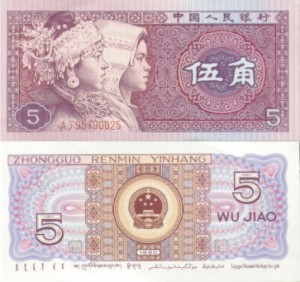
The Chinese Yuan pegged at 8.11 against US dollar |

