Inside The Militant Groups-3
Extremists get trained in armed combat
Zayadul Ahsan
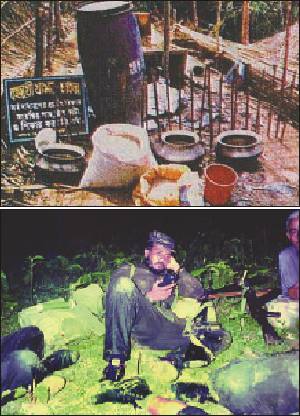
On January 22, 2001, Chittagong police held Salumullah Selim, a 45-year-old man, from a residence in the port city. On interrogation, they learned the true nature of his identity -- he is the army chief of an Arakan militant outfit called Arakan Rogingya National Organisation (ARNO). Records showed he was previously arrested in 2000.More quizzing brought out further startling information. He admitted to police that he trained local madrasa students in armed combat. According to him, more trainers from African and Middle Eastern countries frequently visit Bangladesh to train local Islamist militants. Away in the forest of Bandarban, police followed a narrow trail through rows of betel nut trees. The forest, about 25km from the town, was dense and dark. One had to walk for two and a half hours and cross two streams and hillocks to reach a thatched structure. The hut is a madrasa. Boys take religious lessons during the day; night turns it into a militant camp to train the same madrasa students in arms and explosives. This was one of the many madrasas that militants use as training centres. Three of them were sealed by the government after police raids found dummy rifles for training. They have mustered enough capability to create a dangerous situation, a Special Branch report in 2003 warned. A more revealing comment came from Sayed Kawsar Husain Siddiki, chairman of now banned militant group Shahadat Al Hiqma. On February 8, 2003, he said in a press conference in Rajshahi that Hiqma arranges arms training to its members. "Our commando fighters can conduct an attack at any place in 24 hours," Kawsar boasted. He was later arrested in a sedition case for making the comments. Intelligence agencies have reported the presence of militant camps in Ramu, Ukhia, Mongkhola, Dalujhiri, Chhagalnaiya and Jarulchhari. In the northern districts, such training is given at night along different rivers. Another militant, Abdur Rouf, arrested at Boalmari in Faridpur on September 19, 2003, also admitted taking training from Pakistan and working as a trainer at a madrasa at Bhaluka in Mymesingh. He was later released on bail. Modes of training Police arrested 11 suspected Islamic militants, including an infamous adherent of Bangla Bhai's Jagrata Muslim Janata Bangladesh (JMJB), and two Rajshahi University (RU) students at a training camp some 15km off Rajshahi city on July 19. Police seized diaries from their possession that detailed training methods, descriptions of sophisticated arms and also contained revolutionary Islamic slogans and songs, some of them anti-US. The descriptions included the operations of the AK-47 rifle, how it works, its target range, the distances from which it can kill and injure a man. Police described the revelations as 'a scary matter for the investigators'. The diaries also described different types of detonators, their construction and operation, and where the bomb-making materials can be found. The notes also mentioned commonly used arms in Bangladesh, India, Pakistan and Russia. "Such lessons are not even given to police and the BDR [Bangladesh Rifles]," commented a highly placed source in the law enforcement agencies. One of the songs says: "Mother, I will die for Allah (in Jihad). I will kill and I will die. I will not listen to anyone. I must attack US dens repeatedly." Another said: "Awami League and BNP are two snakes and they are the same. Supporting them is a foolish act." According to police, the militants are trained in crossing war fields, and instructed what to do when they are shot or taken for police interrogation. "They are even taught to sense the presence of other persons in their sleep. They have instructions not to possess unnecessary information about colleagues to avoid chain arrests," said a police source. Arms and supplies That the claims of the seized diaries are not empty was proven when police recovered both arms and explosives from militants at different places. The arrestees also admitted having links with international arms dealers and smugglers. On March 11, 2003, police recovered time bombs, detonators, petrol bombs, high-powered RDX explosives, bomb manufacturing equipment, audio recorders, mobile phones, cameras, several hundred cassettes, books on the operations of 200 militant groups and their donation receipts, and electronic wires from a Chapainawabganj house of a Jamaat leader rented by five Jama'atul Muhahideen Bangladesh (JMB) members. The recovery also included some books written by Maulana Masud Azahar, a close associate of Laden. On November 11 last year, 24 bombs made of gelatin and over 100 detonators were seized from 3 militants at Gaibandha. When Rogingya militant Salimullah Selim was arrested, he admitted to bringing in a cache of 200 AK-47s through Maheshkhali in 1994. A police case report said he gave the arms to criminals, including the cadres of Jamaat and Shibir. The JMB fought an overnight gun battle with police on August 14, 2003 when the law enforcers raided a militant training camp. The militants overpowered the police and took away three rifles and a wireless set from the law enforcers. According to intelligence reports, the militants buy arms from rebel groups in India, Myanmar, Pakistan, Thailand and China, which then come to Bangladesh by road and sea routes.
|