On the fringe of chaos
Brig Gen Jahangir Kabir, ndc, psc
Bombs are not new in Bangladesh. Nor are truckloads of lethal weapons that could have armed a sophisticated clandestine army. But targeting the entire country, as was done on August 17, is unprecedented even by Bangladeshi standards. Mercifully, the bombers did not seek much blood this time. It's not clear what their real intention was. It could have been a show of force or plain full-dress rehearsal for a dangerous course of action that is about to unfold on this unfortunate land. Remedial measures are still possible if only the truth is unearthed and the entire nation is drawn together for a comprehensive action plan. The blame game must stop here. With 459 blasts in only 30 minutes spread over 63 districts; its enormity is simply staggering. All lethal technologies like explosives, detonators, and sophisticated time devices were used. Why then were the bombs made small enough to avoid substantial damage. Bigger bombs would have needed less manpower and carried less risk of unearthing. What was than the intention of this high risk nationwide bombing? We have not had enough clues so far. If we believe the first confessional statement of our Home Minister, intelligence organisations have not done a bad job really. The immediate reaction of our Home Minister was that the government knew the threat of bombing between August 14 to 16, but somehow was surprised on the 17th morning. If the government had been warned of the possibility of such enormous scale bombings, what did it do to unearth the conspiracy and prevent the bombings? Security measures are primarily preventive, if dealt with, bombings of public places and government offices do not scale down or dismantle overnight. Why were people not warned of the impending danger? By evening the Home Minister understandably changed his statement to knowing nothing. Explosives are available in the clandestine bazaars, also detonators if one is willing to pay the right price. But what surprises one is the acquiring or making of hundreds of time devices worked in such a precision in that fateful half hour. It speaks of sophisticated training, discipline, and high ntelligence of the bomb makers and handlers. What is stunning is the national coordination and precision work of a dedicated brigade of evil doers. How comes not a single case of apprehension took place by effort or accident before the commission of the actual offence? Who are these people, what is the motivation and ultimate aim? Who all are providing leadership and organisation? These are very expensive activities. Where does the money come from? There had been many lethal bombings during the last couple of years -- Udichi, Ramna Batamul, numerous bombings at cinema halls and jatras, brutal killing of ASMS Kibria, attempt on the life of British High Commissioner and murderous attempt at Bangabandhu Avenue on the leader of the opposition, are only a few. The nation has no satisfactory answer to the bombings and killings and accidental recovery of 10 truckload of sophisticated arms, ammunition, and explosives from a government jetty in Chittagong. Jamaatul Mujahideen Bangladesh (JMB) had some leaflets on display but this could not be taken for granted without further proof. JMB and JMJB (of Bangla Bhai fame) could work as decoys or false front for a deeper game. It does not matter whether the Home Minister knew or did not, the nation is struck with bombs; the intended terror is delivered with desired result by those who wanted it that way. The prevention has failed; the Prime Minister has cut short her China visit to personally (supposedly) take charge of the operations to apprehend the bombers and the masterminds from the gray area of politics and deception. The blasts have threatened the very foundation of democracy in which neither BNP nor Awami League has any faith. The 7/7 bombings on the London transport system has set an example of the government and opposition sitting together for consensus during national crisis. Let's hope there is not going to be another frustrating experience. August has been a fateful month in Bangladesh. Legacies are as far-flung as the birth of Pakistan on August 14, 1947, that failed with the emergence of Bangladesh in 1971. Pakistan was carved out of India in the name of Muslims. For many, Jinnah, a non-practicing Muslim, neither was a good leader nor Pakistan an ideal state. As Pakistan became non-stoppable many took a vow to convert Pakistan into a theological state. Pakistan whole and leftover still remains an unfulfilled promise to them. The dream was further wrecked when Bangladesh came into existence in 1971, and more dissension was added when Bangladesh adopted secularism as one of the four national principles. To some, secularism is either an imported conspiracy or at least an existential disorder. The irony is that we were Muslims that founded Pakistan, but Bengalis in Pakistan had to struggle for their political rights. On emergence of Bangladesh many are calibrating back towards historical perception of Muslim homeland out of apprehension. Bangladesh culture today is the curious mix of modernism with fundamentalist hedging, drifting in wilderness rather than anchoring on any fringe. Drifting is more accommodating for unfulfilled adventures. I don't agree with those who are too eager to call Bangladesh a failed state or even a failed government. But I wonder how long Bangladesh can drift without getting into greater trouble.
|
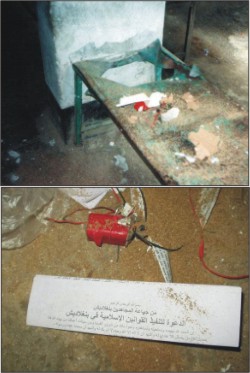
Bomb blast sites: Tangail judege's court premise (top) and Sylhet Judge's court premise. At least 450 such devices went off simultaneously in 63 districts across the country on 17 August |

