Muslim versus Muslim
K Z Islam
Most of the problems of Muslims are created by Muslims themselves. The conflict seems to have started right from the inception of Islam. After the demise of the Prophet (SM), the confusion that surfaced in the selection process for the Caliph has left a legacy of strife, internecine conflicts, political divisions, and schisms among the Muslims. However, it seems clear that the Holy Prophet had wished that the Caliph be elected by consensus. This is a sensitive subject and it is better not to incur the wrath of the maulanas, as there can be so many interpretations regarding the selection process of the Caliphs, therefore, it will not be elaborated. However, the Caliphate, a remarkable institution that took nearly thirteen centuries to outlive its utility, is synonymous with the history of Islam.Choudhury Khaliquzzaman, an extraordinary personality who is thoroughly under-recognised by historians, played a very important role in pre-partition politics, and the crowning glory of his career was when he was the Governor of East Pakistan in the mid-1950s. He was part of the medical mission which went to Turkey in 1912 under the leadership of Dr. M.A. Ansari, another distinguished Muslim lost in the pages of history. The mission went to Turkey during the Balkan Wars. Khaliquzzaman spent nearly a year in Turkey and was introduced to various outstanding personalities, one of whom was Taufiq Rushdi Aras. In 1938, Khaliquzzaman was one of the five Muslim delegates sent to London to attend the Palestine Conference. It is strange to read about this conference as many high-powered personalities from the Arab countries and from the Jewish community assembled in London to settle the Palestine problem. In this conference, Khaliquzzaman met Taufiq Rushdi Aras who was then the Turkish Ambassador in London. This meeting between the two was taking place after nearly twenty-five years. Khaliquzzaman inquired from Aras as to why Turkey had abolished the Caliphate. Aras was deeply moved and replied: "Whose Caliphs had we remained? You came from India to fight us at Quttul Amara (presently in Iraq), the Arabs killed us in Hijaz, and Syrians sniped at our army while returning to Turkish land. The small portion of Turkey that was left with us could not be strong enough to justify a claim to retain the Khilafat of the Muslim world. It was not we who abolished it, but the Muslim world which made us incapable of retaining it." Khaliquzzaman had no answer and was ashamed to talk about it. It may be recalled how the British duped the Arabs to fight against the Turks, giving them the impression that after the expulsion of the Turks the Arabs would become sovereign in their lands. In World War I (1914-18) among the British troops were thousands of Indian Muslim soldiers who fought against the Turkish Muslims. Postscript. In the draconian laws that Tony Blair is contemplating against Islamic fundamentalists is one specifically directed against Hizb ut-Tahrir, the radical Islamic group that calls for the formation of an Islamic Caliphate and is banned in several Central Asian and European countries. Hizb ut-Tahrir has tried to seize power in many countries by violent means, the last effort being in Uzbekistan. Hizb ut-Tahrir is a Sunni movement founded in the Middle East in the 1950s with the avowed objective of forming an Islamic state. It is disconcerting to think that the Caliphate may be revived with the King of Saudi Arabia being proclaimed as the Caliph. A more autocratic government it would be difficult to find. The richest Islamic country is virtually in league with the US, and apart from promoting the US agenda, has hardly contributed to the advancement of the Muslims worldwide. It is hilarious to note that the current kings of Saudi Arabia are the children of King Abdul Aziz who had 132 wives and over a hundred children. One can imagine the power tussle that goes on among the princes to become the king. Presently after the death of King Fahd, Prince Abdullah, now around 80, has succeeded Fahd and the prince regent is Prince Sultan, 77. The death of King Fahd consolidates power again in the hands of one leader, Abdullah the half-brother, who was sworn in as king. Though key decisions have been adopted by consensus, several senior princes and full brothers of the King -- particularly Sultan, the Defense Minister; Naif, the Interior Minister; and Salman, the Governor of Riyadh -- have created their own independent power centres. What leadership can this oligarchy be expected to provide the Muslims of the world? The next major exhibit for Muslim vs. Muslim conflict must go to the tyranny of West Pakistan against East Pakistan during 1971. No accurate figure can be quoted for the casualties, but it can be safely said they were substantial. If Muslims cannot live with other Muslims, how does one expect them to live with people of other religions? Let us turn to the tyrant Saddam Hussein. I remember reading in a book that Saddam could not sleep unless he had murdered somebody. The massacres of his own people (all Muslims) are a matter of historical record. Let us look at the 1980-88 Iran-Iraq conflict, which is the longest conventional warfare of the last century. Neither the First World War nor the Second lasted eight years. Other major wars like the Korean War and the Vietnamese War or the war between China and Japan in the 1930s appear to be mere skirmishes compared to Iraq-Iran War. With more than a million casualties (all Muslims) the Iraq-Iran War is one of the bloodiest ever. The cost of conducting it, and direct and indirect damage caused by it, is put at an astronomical figure of $1,190 billion. The gainers were the US and some European countries who supplied arms running into hundreds of billions of dollars both to Iran and Iraq. Readers may recall the Irangate scandal. The startling revelation in late 1986 was that the US had been selling arms to Iran -- officially branded as a terrorist state. The scandal immobilised the US administration for the best part of a year. President Reagan never quite recovered from the drop in his approval ratings from 67 to 46 percent. The Iran-Iraq War also saw the use of chemical weapons by Iraq, both on Iran and their own population of Kurds. All casualties Muslims. Then came Saddam Hussein's adventure to occupy Kuwait and the resultant Gulf War of 1990-91. In the Gulf War and in its aftermath, when sanctions were imposed on Iraq, there was loss of thousands of Muslim lives. Just to keep Saddam as a counter to Iran Bush Sr. thought it expedient not to remove him from office then. The Iraqis paid the price for the UN sanctions, largely engineered by the US where untold loss of life took place among the children due to malnutrition and lack of medical care. Just after the catastrophe of 9/11, on September 212 2001, The Economist wrote: "The notion of jihad, or holy war, had almost ceased to exist in the Muslim world after the tenth century until it was revived, with American encouragement, to fire an international pan-Islamic movement after the Soviet invasion of Afghanistan in 1979. For the next ten years, the CIA and Saudi intelligence together pumped in billions of dollars' worth of arms and ammunition through Pakistan's Inter-Services Intelligence agency (ISI) to the many mujahideen groups fighting in Afghanistan. For the past ten years that deadly brew has spread its ill-effects widely. Pakistan has suffered terrible destabilisation. But the Afghanis, the name given to the young Muslim men who fought the infidel in Afghanistan, have carried their jihad far beyond: to the corrupt kingdoms of the Gulf, to the repressive states of the southern Mediterranean, and now, perhaps, to New York and Washington DC.' Take the case of Algeria in 1991. There were massacres by both the army and the militants, the casualties, all Muslims. The Islamic Salvation Front (FIS) drew its inspiration from the Quran but its main achievement was as a social movement able to articulate the discontent among the rapidly growing section of the population that was bearing the brunt of the worsening economic hardship. The FIS won 47 per cent of the vote and 188 of the 231 seats in the first ballot of elections to the national legislature in which no second ballot was required. The ruling opposition party won only 15 seats. A second ballot was due for the remaining seats in which no candidate had achieved 50 per cent of the vote. It was never held. On January 12, 1992, tanks rolled out on to the streets of Algiers. The FIS was banned for attempted insurrection against the State. Algeria has known no peace since. And what about the aftermath of 9/11. Personally, I subscribe to the conspiracy theory. Ample evidence is surfacing gradually. Be that as it may, already the casualties, over 95 percent Muslims, exceed 100,000. Iraq is a quagmire because sectarian confrontation among Shias (55 percent), Sunnis (35 percent) and Kurds (20 percent) is hardly going to result in a so-called democratic government imposed by the US. The situation is no better in Afghanistan. In any case, one wonders as to the compatibility of Islam and democracy. Currently, of all the Muslim countries, one can only think of Bangladesh, Malaysia and Indonesia where there is some semblance of democracy. but the tyrannical rule of the autocratic Muslim governments worldwide is hardly conducive to Muslim progress. In conclusion, the bigoted bombers of London on 7/7 all came from the Leeds area. I shudder to think that, being a graduate of Leeds University, I have always praised the tranquility of this Yorkshire city known for its friendliness. But I do recall my weekly visits to Bradford to see Indian movies where the predominantly Muslim population kept to themselves and hardly made an effort to integrate in the British society.
|
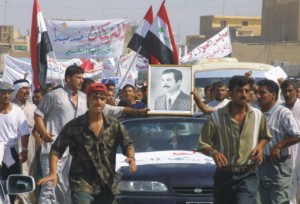
Iraq the latest battle-front in the war of Muslim versus Muslim |

