DU Medical Centre
Homeopathy Unit lacks fund, manpower
Durdana Ghias
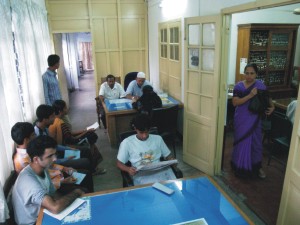
Dr Abdur Razzaq Talukdar is busy making a potion for a patient waiting in his chamber, crammed with some big glass cabinets which display an array of bottles containing homeopath medicines. Several others are also waiting outside to visit him. After he is done with the potion, he hands it over to the patient. Then the next patient enters the chamber and the doctor puts his name on the record book. Two other physicians sitting in the antechamber are also busy attending the patients, mostly students of Dhaka University. They maintain separate record books for teachers, students, officers and employees of the university. This is the everyday picture of the Homeopathy Unit at DU Medical Centre, which is unknown to many students but has long been serving the patients despite many adversities, including a severe shortage of funds. Dr Talukdar, the chief of this unit, has been working there for the last 22 years. He told Star City that everyday around 70 students, 30 teachers, 40 officers and 50 employees visit the unit for treatment. This unit has three senior physicians and three juniors. They work in two shifts -- from 8:00am to 2:00pm and from 2:00pm to 8:00pm. Many people think that the Allopath Section is the only unit of DU Medical Centre. But in fact, the centre is functioning mainly due to the activities of the Homeopathy Unit. The students allege the Allopath Section fails to give proper treatment to them. Talking to Star City, the doctors at the Homeopathy Unit complained of discrimination in the centre. A clear discrimination exists in the salaries of the doctors. A homeopath gets a basic salary of Tk 4,200 while his allopath counterpart gets Tk 7,200 a month. "If all the professors of different departments get the same salary according to their designation, then why won't we get the same salary?" says Dr Talukdar. The physicians also complain that they do not have any peons or fourth-class employees to help them. "Here the patients have to put their names on the record book themselves while the Allopath Section has staff to handle the registers," Dr Talukdar says. While the Homeopathy Unit is dealing with the bulk of the patients, the Allopath Section is in shambles. At least nine doctors are supposed to be on duty in the first shift but during a visit this correspondent found only two doctors available. The students allege that the Emergency Unit hardly has any doctors and the X-Ray and pathological lab are in a bad condition. The chief section officer was contacted for his comment on these problems but he refused to say anything without the permission of the chief medical officer (CMO). But this correspondent could not talk to the CMO as she left office before noon on that day. Rabiul Islam, a student, said: "The Allopath Section is of no use at all. Most of the time I don't find the doctors. But the doctors at the Homeopathy Unit are always available." Negligence is also rife in the section. Another student Zahirul Islam said: "Once I went to the Allopath Section. The doctor started writing a prescription before I spoke up. When I started saying something about my illness, the prescription was almost ready." The students allege that they are not given medicines which are worth more than Tk 10. They also complain that very often the expensive antibiotics are sold off in the black market by the employees of the Allopath Section. In spite of treating hundreds of patients, the Homeopathy Unit is allocated a very small budget in comparison to the Allopath Section. The Allopath Section has 22 doctors and 94 other employees with an annual budget of Tk 2 crore. On the other hand, the Homeopathy Unit, having six physicians and no fourth-class employees receives a very modest budget of Tk 1 lakh, which is not enough to buy medicines from America and Germany. Dr Enayetur Rahman Bhuiyan, a senior physician, says, "We can't buy the expensive medicines often due to the shortage of funds." The doctors said as most of the patients depend of the Homeopathy Unit, the discrimination between the two sections is quite unfair. "We want adequate funds for our unit and immediate measures to increase our salaries," says Dr Talukdar.
|