The political economy of fundamentalism-II
Abdullah A. Dewan and Ghulam Rahman
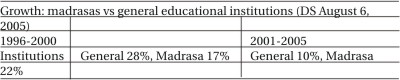
Fundamentalism is a form of ignorance, which originates from ignorance of the basic principles of true religion. Thus to fight religious extremism is to fight ignorance. The best inoculants against any form of ignorance are education, countrywide seminars, and debates. Back in high school we learned: "One who walks in the path of knowledge walks in the path of God." That knowledge was nowhere meant to be limited to religious education only. In addition to developing spiritual faculties, we must also learn to modernise our agriculture, fisheries, industries, businesses, healthcare and all other economic activities with new and innovative methods of productions and operations. Religious education and spiritual development may make one an honest and compassionate citizen with the promise of eternal heavenly rewards hereinafter, but such education makes no promise of a productive income. There are about 15,000 Qawmi madrasas under Private Madrasa Board with their own curriculum, in addition to about 9,000 state registered ones, with numerous more yet to be registered or enlisted. The number of general educational institutions, which receive state funds, has increased 9.74 percent against a 22.22 percent growth of madrasas from 2001 to 2005. The number of students in general educational institutions rose 8.64 percent while the madrasas saw a 10.12 percent increase in enrolment during this period. Economists argue that madrasas have negligible contribution in creating skilled human capital in the country while squandering nearly 11.5 percent of the total education budget in the last few years. "It needs modernisation. I feel the madrasa students should learn the same core subjects that the general educational institutions teach up to the higher secondary level," says the Education Minister. We also wonder how he felt when nearly 50 percent students in SSC exams failed, and not a single student passed from over 400 high schools in the last two consecutive years? A balanced academic curriculum includes choices of all subjects such as physics, chemistry, mathematics, biology, sociology and of course business and economics, along with religious subjects. If one wants to be a Hafiz in Qur'an, and specialise in religion, that choice must be supported, but his/her curriculum must also include basic principles of business and economics and certain amount of science courses. Economics, business, and science teach critical thinking with evidence. With the power of critical thinking any deceiving tricks of religious extremists are quickly disposed while injecting no prejudices about the tenets and teachings of religion. Once students are taught logic, reasoning, and critical thinking skills, as embodied in economics and science, they will decide for themselves what they will be. This should be done beginning with the earliest grade possible and by fifth year, the formal elements of logic and reasoning can be introduced at a very basic level. This will slowly help them recognise, and reject fallacious thinking. Pursuing this with honesty and consistency throughout the educational process will bring about a generation that will think logically as a matter of norm, rather than accepting pre-digested doctrines blindly. Once the student is aware of the nature of true religion, religious extremism, disrespects for other humans of different faiths and the devious subtlety of its appeals will disappear. Alongside a balanced education, the other effective way to counter religious extremism is to teach humility. Students must be taught that without the virtues of humility they can't maintain an open mind to be successful spiritually, academically, and socially. Historically madrasas were an integral part of the Ottoman Empire's social foundation and the political powers that governed them. Ottoman Empire, the longest and most diverse Empire in history, used madrasas to produce its scholastic output and individuals who became the backbone of the empire. Official documents of Ottoman Empire indicate that the purpose of education geared for the pursuit of science and wisdom alongside an explication of virtue, religion and the sharia. The madrasas were structured to provide a common education, culture and shared world-view among the mosaic of Muslim people of multitude of ethnic origins. These institutions also functioned to ensure equality of opportunity in education for the individual, as well as providing dynamism among the various echelon of society. The curriculum of the Ottoman madrasas was different from those of previous Muslim states. In comparison to one or two religious subjects, students during the Ottoman administration were taught morphology, syntax, and logic. These were followed by a study of Hadith and commentaries of the Qur'an. Studies in elocution, preaching, rhetoric, philosophical theology, philosophy, jurisprudence, inheritance, tenets of faith, legal theory, and methodology were also pursued. The charter of madrasas included the requirement that teachers be both well versed in religious studies and in the "rational" sciences, which included logic, philosophy, and mathematics. Since hospital establishments were found alongside certain madrasas and sites for astronomical observation were found to exist next to others are an indication of interest in medicine and astronomy at those particular madrasas. Introduction of business curriculum in our madrasas, teaching the principles and skills of entrepreneurship is consistent with Islam which is considered the most pro-business of all the world's major religions. Prophet Muhammad (pbuh) as businessman engaged in extensive commerce during the years before devoting himself exclusively to religious affairs in the year 611. Even during subsequent years, the Prophet continued his support for business and the free market mechanism. For example, he forbade the imposition of price controls, asserting that prices were in God's hands and that he wished to meet God without having to stand before Him for some injustice and unfairness that he might commit in this respect. In his pro-business stance, the Prophet forbade the imposition of special taxes on markets pleading what he called market "a charitable endowment" and those taxes were to be collected directly from individuals, instead of businesses. The Holy Qur'an is filled with passages that can be interpreted as favoring commerce. For example, the Qur'an states, "O you who believe! Squander not your wealth among yourselves in vanity, except it be a trade by mutual consent. And who does that through aggression and injustice, we shall cast him into Fire." For this reason, scholars have long looked upon Islam as fundamentally pro-capitalism. As Maxime Rodinson wrote in "Islam and Capitalism" (1966): "Economic activity, the search for profit, trade, and consequently, production for the market, are looked upon with no less favour by Muslim tradition than by the Qur'an itself." This is one reason why the Muslim world was the most vibrant on earth during the latter part of the Middle Ages. By contrast, Europe was repressed by the economic doctrines of the Catholic Church. Moroccan sociology professor Fatima Mernissi argues that Muslims who worked with foreign interests are usually the wealthier citizens and proposes that the fundamentalism among the poor people results from the desire to define oneself as still having a place in society. "Can it be that the most dispossessed in our societies cling to Islam because they fear being forgotten by their own people, who have found another identity and are involved in other networks, especially those very strong ones that create profit on an international scale?" But starting in the late 15th and early 16th centuries, Islam and Christianity reversed courses in economic progress and social reform. Under fear and pressure from a series of invasions, the Islamic countries looked inward and took refugee in fundamentalism. From that period onward, economic and scientific progress in that region slowly decelerated and came to a halt. By contrast, the Protestant Reformation salvaged Europe from the stultifying confines of Catholicism Even today, the resistance to modernity in most Muslim majority countries is growing intense in the more enlightened parts of the Middle East, such as Saudi Arabia, UAE, Egypt, and so on. Thus many scholars believe that the hatred of capitalism is less based on Islam's affinity for socialism, than on its fear of modernity. Capitalism is just one of many things that the religious extremists hate and fear as intrusions upon their religion and their lives. Western science and technology are just as threatening to the stability -- some would say stagnation -- of Muslim life as are Western economic ideas in the form of capitalism. Looking back we feel that one of the greatest miscalculations that Islamic world committed some 500 years ago with respect to modernisation and accepting scientific advances that still drags on with fanaticism and rejections among a few seriously misguided souls even today. Religious extremists can cause irretrievable damage to life and property, bring economic ruin by expelling foreign trade, foreign investment and commerce and the progress of science and new techniques of production. This will only aggravate miseries of the poor masses and eventually impoverish the already beleaguered country. To bring change religious extremists should follow the religiously grounded altruism of their counterparts in other countries. For example, in Egypt, Islamic extremists have provided health-care and educational facilities as alternatives to expensive private outlets and inadequate state institutions. In Turkey, they got involved building housing for the poor and worked in strengthening civil society. In Lebanon, they have organised farm cooperatives and provided facilities and services for the welfare of children, widows, and the dispossessed. In Jordan, Yemen, Kuwait, and elsewhere, they have run for parliament seats. Engaging in such social services will win them the hearts and minds of the people and help them win elections to create their own power base to the demise of the "merry-go-round" corrupt and morally bankrupt politicians whom all of us despise. The authors are, respectively, Professor of Economics, Eastern Michigan University and former Secretary to the Government of Bangladesh. Part-I was published yesterday.
|
|

