When camera is the narrator
Tales from a Globalising World
Karim Waheed
We all agree a picture is worth a thousand words. In fact, images or photographs delineate more. A photograph can leave a lasting impression on human mind. Often photographs have become icons, like the striking image of a hazel-eyed Afghan girl staring at the viewers on the cover of the April, 1985 issue of National Geographic. Another apt example is a photograph of crying Vietnamese children running from napalm bombs being exploded in the background: an image that continues to haunt generations worldwide. The photographs on display at the exhibition titled Tales from a Globalising World, being held at Drik Gallery, Dhanmondi, have remarkable stories to tell. But they are all part of a theme: The constructive and destructive forces that shape the world today. It also brings to light how our lives have been changed by the emergence of a flow in which people, goods, money, technology and often illicit materials circulate across borders. The exhibition was inaugurated by eminent economist Professor Muzaffer Ahmed, trustee, Transparency International Bangladesh on September 22. Dr Dora Rapold, Ambassador of Switzerland to Bangladesh was present as the special guest and Dr Shahidul Alam, Managing Director of Drik presided over the inaugural programme. The exhibition is a part of Drik's 16th year celebration. The project, Tales from a Globalising World is an initiative launched in 2002 by the Swiss Agency for Development and Cooperation (SDC). As part of the Swiss Ministry of Foreign Affairs, SDC focuses on humanitarian aid and cooperation of developing countries. Swiss photographer Daniel Schwartz, also the curator/producer of SDC, commissioned 10 photographers from different countries to illustrate selected aspects of globalisation in Asia, North America, Africa, Europe and Latin America. The photographers are: Andreas Seibert, Thomas Kern, Cristina Nuñ ez, Stephen Vanfleteren, Shehzad Noorani, Ziyo Gafic, Tim Hetherington, Bertien van Manen, Philip Jones Griffiths and Akinbode Akinbiyi. The exhibition begins with an exploratory trip through the urban expanse of the Pearl River Delta in China, where Swiss photographer Andreas Seibert documented the hazardous living and working conditions of migrant workers from the rural vicinity. Spanish photographer Cristina Nuñez's works bring to light the shadowy aspect that coexists with the glamorous fashion arena in Milan and Naples. Bangladeshi photographer, Shehzad Noorani's photographs follow the lives of the underprivileged, struggling to survive in Nepal, India and Bangladesh. The subject of one of his black and white photographs is an HIV positive sex worker, sitting on a pushcart outside a brothel in Mumbai. The caption reads: "I'm no one you want to know. I don't have a name any more. I have been thrown out of the brothel. I am too sick and people are afraid of me. I just sleep here awaiting my death." Another photograph shows a traumatised young girl, Nusrat with her brother sleeping next to her at a railway station. The caption reads: "My mother left us here two days ago. I ate a piece of bread yesterday morning. I'm very hungry and cold. I don't know when my mother will come back." The jadedness in the girl's stare is arresting. Bosnian photographer Ziyo Gafic's works display the recovery from war in Bosnia-Herzegovina, while Philip Jones Griffith's photographs cover the economic opening-up of Vietnam. Incidentally, Griffith's Vietnam Inc. was instrumental in mobilising western opinion against American involvement in the Vietnam War. Akinbode Akinbiyi, a Nigerian living in Berlin, rounds off the exhibition with an assemblage of works on primitive African religions which, through the transatlantic slave trade in an earlier phase of globalisation, spread all the way from Nigeria to Brazil, where they are practised to this day with undiminished vigour. After Dhaka, the exhibition will tour Cracow, Vienna, Cairo, Brussels, Strasbourg, Rome and New York. The exhibition at Drik Gallery will remain open till November 30.
|
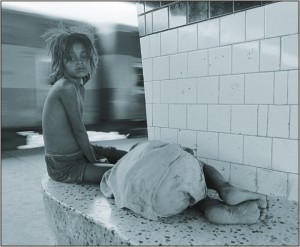
A photograph by Shehzad Noorani |

