Book Review
'I have often...imagined myself to be Charlie Chaplin!'
Farhad Ahmed
Exactly fifty years ago, in 1955, the release of Pather Panchali heralded the arrival of a master in the world of cinema. Over the next forty years. Satyajit Ray (1921-92) came to be regarded as one of the world's finest film-makers ever--Time Magazine had him on its cover of the world's top ten directors of all time. Today, more than a decade after his death, he continues to be South Asia's, and Bengal's, most respected name in international film circles. In 1992 he was awarded the Oscar for Lifetime Achievement as well as India's Bharat Ratna.Apart from his achievements as a director, Ray was also--perhaps appropriately so, as the son of Bengal's Edward Lear and Lewis Carroll rolled into one, Sukumar Ray--a prolific writer in Bengali of novels, short stories, and essays on cinema. Now Gopa Majumdar's translations in Speaking of Films brings together Ray's most memorable writings on film and film-making, which originally had been published in Bengali as Bishay Chalachitra. Aside from the subject matter, Ray is bracing to read simply for the clarity and authority of his sentences and expressions--qualities that have been amply preserved in the translation by one experienced in the job. Ray discusses a wide array of subjects: the structure and language of cinema with special reference to his adaptations of Tagore and Bibhuti Bhushan Bandopadhyay, the appropriate use of background music and dialogue in films, the relationship between a film-maker and a film critic, and important developments in cinema like the advent of sound and colour. There are many things here in these critical essays and writings that can be extrapolated by artists working in other mediums for good effect. The brevity and simplicity of Ray's writing style should not be equated with simplicity of thought: he brings years of experience to bear upon a couple of sentences, an accumulated hoard of wisdom in a few lines, as when he writes that 'Experience matters a great deal in working on a film's background music. Even when one has a fairly good idea of the theme or mood of a film, it is not easy to know which instruments should be played in a particular scene, or which melody, rhythm and tempo should be used to best effect. That is the reason way, even now, mistakes and lapses occur when composing the music for a film. There is plenty left to be learnt, especially in a place like Bengal where people's lives, their clothes, their speech, even the houses they live in do not have a clear and distinct character, everything is a great medley.' That 'great medley' is quintessential Ray. Ray is never boring; in fact, if anything, can be a little too crisply waspish, and certainly could be combative when goaded to the point of exasperation by all-too-un-knowing critics, as in his very firm 1964 riposte to a certain Mr. Rudra who had held forth a tad too orotundly on Charulata in the pages of the magazine Parichay. But Ray can also be wholly, and slyly, charming, as when he writes with obvious affection--effortlessly displaying the great artist's percipient eye for detail and obsessive involvement with his/her work--about the people he worked with: 'The man who was cast in the role of the headmaster in a village school in Aparajito had never done any acting, but had been associated with films for a long time. Subodh Ganguli had worked in his youth as an operator in various cinemas, handling the machines used to run the films. Later, he learnt to work in a laboratory and eventually became the director of the chemical laboratory owned by New Theaters. A special feature of the films produced by New Theatres in its heyday was neat and sleek photography. There is no doubt that Subodh Ganguli deserved some of the credit for it. After leaving new Theatres he joined Aurora Company. I met him in the office of this company. His appearance, and his old-fashioned clothes (they followed a style popular in the nineteenth century), made me offer him the role of Apu's headmaster. He gave me a beaming smile and agreed at once. "Is it a comic role?" he asked. "I have often looked into the mirror and imagined myself to be Charlie Chaplin!"' Ray displays a similar light touch in a priceless profile of Chabi Biswas (of Jalsaghar fame) which has the vintage actor leaning out at a dangerous angle from a verandah in order to properly conduct a village band. In conclusion, while some of the material is for the advanced cinema buff or film-maker, the rest can be enjoyed by the average movie-goes, and especially the Bengali Satyajit movie fan. Farhad Ahmed is a freelance writer/translator.
|
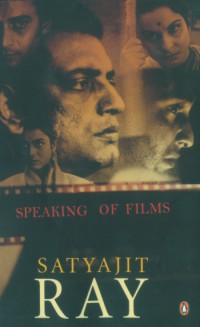
Speaking Of Films, Satyajit Ray (translated by Gopa Majumdar); Penguin India: New Delhi; 2005; pp. 220; Rs. 275 |

