In memoriam
Sufia Kamal’s death anniversary observed
Ershad Kamol
Begum Sufia Kamal (1911-1999) a poet, litterateur, social activist and feminist, passed away in Dhaka on November 20, 1999. To mark the day, Shamajik Protirodh Committee, a social organisation, arranged a programme at the National Press Club Auditorium. Selina Khalek, vice-president of Bangladesh Mahila Parishad (BMP), was the chairperson. Ayesha Khanam Kabir, general secretary of BMP, Sultana Kamal on behalf of Ain O Shalish Kendra, women activists Shirin Akhtar, Professor Sultana Zaman, Tagore exponent Sanjida Khatun, theatre personality Mamunur Rashid and others participated at the event. The discussion centred on the contribution of Begum Sufia Kamal to both social and cultural life in the country. Even in these hard times, they pointed out, she continued to be an inspiring force. Begum Sufia's achievements are all the more remarkable as she ventured out in the world at a time when women's movements were restricted. She was also able to develop her literary talent in Bangla. The influence of legendary women activist Rokeya Sakhawat Hossain's social ideals inspired Begum Sufia throughout her life. In 1952, Begum Sufia took part in the Language Movement. She was also actively involved in upholding Bangla culture. She protested vociferously against the Pakistani government's attempts to suppress Bangla and Bangalee culture, particularly the ban on Tagore. She also made a great contribution to our Liberation War. In addition, she founded and led many organisations. In 1969, she was the founder chairperson of Mahila Sangram Parishad (Bangladesh Mahila Parishad) which aimed to realise social, cultural, educational and political benefits for women. She remained closely associated with the organisation throughout her life. Begum Sufia was also president of Chhayanaut, a major cultural organisation, Bangladesh Protibondhi Foundation, a foundation for the treatment, education and rehabilitation of the handicapped, and Nari Kalyan Sangstha. Begum Sufia was a major literary figure. In her writing and the social causes that she upheld, she propounded humane and democratic values and continued to be the voice of conscience, protest and social justice. Author of more than a dozen volumes of poetry, Begum Sufia also wrote an autobiographical volume, Ekale Amader Kal (1988) about her childhood and her work with Rokeya Sakhawat Hossain, She also wrote several volumes of short stories, short novels and travelogues, among others. Begum Sufia received nearly 50 major awards, including the Tamgha-i-Imtiaz (1961), a national award conferred by the Pakistani government. However, she returned the award in 1969 as a protest against the government's oppressive treatment. Other prestigious laurels that she received include the Bangla Academy Award for Literature (1962), the Ekushey Padak (1976) and the Independence Day Award (1997). After the discussions, Kalpana Rani on behalf of Concern Bangladesh, proposed a few changes in the current social, political and cultural scenario of the country. Dr Maleka Banu of Bangladesh Mahila Parishad was the moderator of the programme. At the end of the programme Iffat Ara Dewan, Anusheh and Shushmita Ahmed rendered songs. Laila Tarannum recited a poem at the cultural event.
|
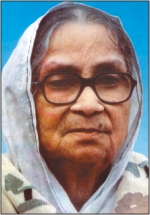
Begum Sufia Kamal |

