Living in a valley of blasts
ANM Nurul Haque
Two senior assistant judges were killed and four other were injured on November 14 at Jhalakathi district town when a militant member of the Jamatul Mujahideen Bangladesh (JMB) suicide squad hurled a bomb at the microbus carrying the judges. Police arrested a JMB member for his involvement in the bomb attack and also recovered a live bomb from his possession. The arrested militant member of the JMB, identified as Mamun, confessed to being a member of the suicide squad of JMB, and was ready to give up his life for the cause of Islam. Police arrested 11 more people including the principal of a madrasa and recovered huge bomb-making materials, books, and leaflets of banned JMB from the house of Mamun.In an unprecedented development of the JMB, whose successful attack on August 17 rocked the country, now has targeted to hit the most respected institution -- the judiciary. Five serial bomb blasts at the courts in Chandpur, Laxmipur and Chittagong occurred on October 3 leaving two people dead and 38 others, including a district judge and a policeman injured. Two perpetrators held from the Chandpur blast site and one from Laxmipur said JMB assigned them to carry out the attacks. Two of the three perpetrators caught in the Chittagong court premises admitted to being members of Shaheed Nasrullah Al Arafat Brigade (SNAB), the newly formed military wing of the JMB. The militants tried to kill a Speedy Trial Tribunal judge by throwing a bomb at him in Sylhet on October 18, but fortunately the judge escaped unhurt. The most worrying part of the story is that the banned JMB has already acquired the capability to explode bombs anywhere and at any time and to do so they have formed a suicide squad. The suicide squad has threatened to blow up Rajshahi central jail by blasting bombs unless all the detainees belonging to JMB are released immediately. The JMB suicide squad has threatened to kill the Law Minister and upazila nirbahi officers including all officials of Companyganj upazila under Noakhali district by December 16. It has also threatened a district joint judge of Pabna Judge Court with dire consequence if he failed to deliver justice "properly." The judges in the country are now under threat and unable to conduct the court proceedings fearing bomb attacks. The government has provided gunmen for the Supreme Court and High Court judges after the killing of the two judges in Jhalakhati. But the judges of the lower courts across the country were yet to get security even when they continued to receive death threats from the JMB suicide squad. Judges from across the country in a meeting held on November 21 demanded tax-free private cars, firearms, and personal gunmen and guards at their residences by December 21. Otherwise they will go for tougher movement including abstention from the courts and taking of leaves en masse. Security has also been geared up in the Secretariat to check subversive activities and ensure foolproof security. A scanner has been set up at the Secretariat's entrances, where each bag and parcel is checked in the wake of the threats of bombing the Secretariat. Prime Minister Khakeda Zia ordered to ensure immediate arrest and punishment of the culprits through the Speedy Trial Tribunal. She issued this order in the regular cabinet meeting on November 18 in reference to the killing of two judges in Jhalakati bomb attack. The police have so far arrested more than 400 suspected militants from across the country, but most of them are the carriers of bombs and field level activists. Police could not yet arrest the main leaders of the JMB. The JMB chief Abdur Rahman narrowly escaped arrest on November 18, disappearing from a house in the capital before a raid by Rab. Easy arrest and hasty trials are not the answer to this grave problem. Some ministers and senior leaders of the ruling BNP also believe that the efforts to deliver quick results will weaken investigation and allow the top militant kingpins involved in the attacks to elude arrest. Is there any government in the country? This was the question asked by the Secretary General of Bangladesh Judicial Service Association and Dhaka Division Special Judge Rezaul Karim Khan in a meeting with Communication Minister Barrister Nazmul Huda held at the Dhaka Judge Court on November 16. The question asked by an angry judge against the backdrop of the gruesome murder of his two colleagues also posed some other burning questions regarding the seriousness of the government in containing militancy. According to the media reports, many of the government functionaries, particularly some MPs from the greater Rajshahi district, had been instrumental to the JMB members in launching their operations. Abu Hena, a legislator of the ruling BNP from Rajshahi said that four-party alliance government may have had a hand in the recent rise of Islamic militancy in the country. He made this remark to the BBC's Bengali Service very recently. Questions have also been raised in the minds of the people whether the government has that much efficacy to tackle the Islamist outfit which is a menacing threat to peace and stability across the country. The people from all the strata of society are now quite worried over the growing inability of the government in tackling the outlawed Islamist outfits. The government cannot deny the grisly reality that the people of the country are now hostage to an organised group of religious fundamentalists. The government allowed the Islamist outfits enough time to organise themselves, denying their very existence despite the mainstream newspapers repeatedly published reports on the outlawed Islamist outfits to alert the government. Surprisingly the State Minister for Home Lutfozzaman Babor said after his meeting with the British State Minister for Foreign Affairs and Commonwealth Dr Kim Howells, that he still does not think the militant threat is too alarming. Really it is most unfortunate for the nation that the denial mindset at the government level is still at work when the danger with outlawed Islamist outfits lurks very ominously. It is widely believed that some of the BNP leaders along with their most important ally in the government have close association with the militant outfits. The Daily Star in its editorial on November 16, has contained a very sharp observation on the subject. It said: "In all the attacks, direct or indirect links have been found to alliance members of BNP led government. In fact many of JMB members have confessed to links with Jamaat, both present and past. BNP leadership should have no doubt in its mind as to the veracity of these facts, all of which are contained in numerous reports of the intelligence agencies." The international development partners of the country on November 17 came down heavily on the government for its failure to combat continuous killing and terrorism, lack of justice, malgovernance and massive corruption for which the country is known in the world. "If the trends continue, Bangladesh will be known to the global community as a land of more and more killings, terrorism and insecurity," World Bank Vice President Praful C Patel told newsmen following the concluding session of the Poverty Reduction Strategy Implementation Forum in the city. "If you want us to work with you should curb terrorism and militancy in iron fist hand," the World Bank Vice President was further quoted to have said in the meeting. Public anger and agitation against the government is growing apace for its failure to deal squarely with the issue of home-grown militants. The outlawed Islamist militants have already made people aware of growing inability of the government to show its competency to put down these elements. This has made people apprehensive of the motives of these anti-state elements and to feel that they are now hostage to an "enemy within." Government failure to contain militants has made them so defiant that they have now dared to threaten to blow up all Liberation War Memorials in Rangamati if the law of Allah is not introduced and the Martyred Intellectuals Day or the Victory Day is observed. The killing of two judges in Jhalakhati has already proved beyond doubt that their threats are real. The government now needs to thoroughly recast its militancy tackling strategy and be sincere in its efforts for providing public safety and security. The whole nation must also be united against the machination of the Islamist outfits, considering it as a national crisis. ANM Nurul Haque is a banker.
|
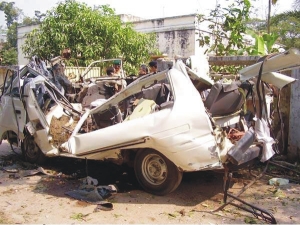
Islamist militants¿ attack killed two judges in a microbus in Jhalakathi on November 14 last |

