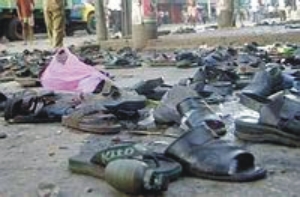
Terrorism is a home-grown problem, not international
Abdul Quader writes from Canberra
THE government appears to have gone the wrong way in diagnosing the continued scourge of terrorism being committed by the religious extremists in the country. The donors raised grave concerns about the deteriorating law and order situation, especially the acts of terrorism, at the just concluded three-day Poverty Reduction Strategy (PRS) Forum in Dhaka. In response to the donor concerns, the Finance Minister M Saifur Rahman said: "We have told them it is more of an international phenomenon than a national one. It is difficult to contain such type of terrorism with the normal enforcement tools."The Finance Minister also referred to international terrorism confronted by the United States of America and the United Kingdom, apparently to suggest that the kind of terrorism faced by Bangladesh is also international. This observation of the Finance Minister is absolutely preposterous and implies avoiding government responsibility to contain and root out the problem. No parallel
The terrorism that the US and the UK are facing has originated elsewhere in that a group of people at different places have felt aggrieved at the military intervention of these two countries in Iraq and Afghanistan, particularly the invasion and occupation of Iraq. We cannot draw parallel to the terrorism that Bangladesh faces and the kind of terrorism being faced by the United States or the United Kingdom. The problem in Bangladesh is home-grown and is related to domestic politics, whereas the US or UK problem is international in nature, and the apparent causes which gave rise to terrorist activities are different to those concerning Bangladesh. At the present time, there are two dimensions of crimes in Bangladesh. One is the persistent increase of incidence of criminal activities such as extortion, murders, rapes, mugging, armed robberies, tender corruption, smuggling of arms from abroad etc. and the failure of the government to contain or drastically reduce these crimes. The other, which is more alarming, is the growing terrorist bombing associated with Islamic religious zeal at different parts of the country that included the killing of two judges at Jhalakathi a couple of weeks ago. The recent religiously motivated criminal activities are alleged to have been committed by the banned Jama'atul Mujahideen Bangladesh (JMB). It has been reported in the newspapers that the JMB wants to turn Bangladesh into an Islamic state and as a mark of their protest against the current legal system, which is not based on Sharia law, the JMB operatives have mounted several bomb attacks across the country and killed the judges. It will not be unusual if it is found that the terrorists in Bangladesh have got financial or other support from outside the country. They may have also received spiritual inspiration from other Islamists elsewhere who hold extreme views (such as religious extremists in Saudi Arabia or Taliban in Afghanistan). But the core issue surrounding Islamist terrorism in Bangladesh is rooted in the country's politics. Shifting responsibility
I think the government has allowed the situation to grow to such a miserable and alarming state in which certain sections of the community (eg judges and those working in administration) in particular and the public in general are now living in constant fear and threat. The government has ignored the terrorist threat for a long time, claiming it is the creation of the media and those who oppose the government. The failure of the government to take notice of the growing threats of terrorism might have encouraged the religious extremists to be brave enough to continue their bombing activities. It appears that the government is still trying to shift its responsibility and downplay its failure by claiming that the terrorist problem in the country is an international problem and that it requires international cooperation to contain or root out the menace. As mentioned above, according to the finance minister the normal law enforcement forces are incapable of effectively dealing with the terrorist acts in the country. We know the government has reinforced and strengthened the capacity of law enforcement by establishing the Rapid Action Battalion (Rab), Cobra force and Cheetah force. Where necessary the government has the power to engage the military to assist the civil administration to check terrorism in the country. Avoiding responsibility and saying that the law enforcement tools are inadequate are counter-productive that may give the signal to the extremists that the government is weak and cannot catch them. Prevention and cure
Any politically motivated terrorism, be it Islamic or otherwise, is complex and is generally rooted in some sections of people in the society. It is associated with the belief system of these people, some of whom may have been misled and brainwashed by their leaders and masterminds. In case of Bangladesh, these religious extremists, especially the operatives at the grass roots level, appear to have come from poor or lower middle class backgrounds. Some of these people may have little education while others may have only madrasha education at the primary or secondary level. These people can easily fall prey to illusion and enticement from these leaders who are out there to wreck havoc in the name of religion. The government needs both "preventive" and "curative" actions to effectively deal with the festering ills of religious extremism in the country. That is to say, we need both short-term and long-term solution to the scourge of terrorism. In this context, "prevention" is associated with education, awareness, motivation and persuasion for people who are prone to committing acts of terrorism now and also in the future. The threats of terrorism are most likely to continue given the current trends and developments. To prevent the recurrence of acts of terrorism on a longer-term basis, the government needs to correctly identify the social and economic status or class of the leaders and their followers who hold extremist views and ideas so that it can target these classes of people to influence their thinking, behaviour and actions. This could help in persuading them to understand gradually that religiously motivated violence or terrorist activities do not bring any good to them, the people or the society. The message should be made loud and clear that radicalisation and politicisation of extreme views will not be tolerated and that terrorism is simply a criminal activity which deserves punishment under the law of the land. Moreover, it should be emphasised in government-sponsored education, awareness and motivation campaigns that any violence in which innocent people are killed and public property damaged is against the principles of the religion of Islam. It should also be emphasised that everybody is entitled to have a view on politics, government or legal system of the country and that they are free to campaign to enlist public support to their cause through peaceful means allowed in a democratic society. But there is no scope for intimidation, coercion and violence on the part of any individual or any group of people to press home their political or religious message. The "curative" actions taken by the government includes the arrest, prosecution and appropriate sentencing of those responsible for terrorist activities by applying the law. It is said that example is better than precept. The public are still not convinced about the seriousness with which the government has so far handled the prosecution and punishment of the perpetrators of the barbaric terrorist attacks. Terrorising the terrorists
Justice demands that the government must respond to the call of the time to secure the lives and property of the people by counter-terrorism measures, including death sentence for those who deserve such punishment under the law. One way to root out terrorism is to "terrorise the terrorists" by harsh punishments. All high profile cases of terrorist acts should be quickly disposed of so that the government's actions are proven credible in the eyes of the public and they feel safe and secure to live their normal daily lives. Abdul Quader is a freelance contributor.
|