Short Story
"Have finished..."
R. Dasgupta, (freely translated by A. Siddique)
After the first language movement of 1948, things never changed: waves of arrests of political workers and those who continued the struggle for freedom took place and continued on till the events of 1971. Once they put you inside a jail, they didn't let you out. Only big pushes could prise open prison doors--like, for example, the big push of 21st February 1952, the shove of the Jugto Front win of the '54 provincial elections, the formation of the NDF in '62, the massive surge of the 11 point-movement of '69. And then at the beginning of the fight for freedom in 1971 many jail roads became wide city boulevards. To those arrested at the beginning, during the late '40s and early '50s, time hung especially heavy on those who were locked up inside. They all would think that their struggle was for naught, felt that the whole earth was a desolate place. Our students, our common folk, when would they awaken and rise? Noakhali's peasant leader Momtaz Miah, a village chairman who landed inside the prison on one of the very first police sweeps, refused to lose heart. He would proclaim, "Haul the boat onto dry land, sailorman, while the tide's at ebb. When the tide comes roaring in, it'll lift the boar clear. And it'll be that kind of a tide, boys. It'll come, the tide will come. Then there will be no letting go." Such a tidal wave did erupt during the first days of '55. In '54, General Iskandar Mirza imposed his Section 93 rule after dismissing the Jugto Front government. Mass arrests Inside the jail, all despaired: this bloody lord isn't going to go, jail doors are going to remain closed. Four straight years, that's how long they had been there, those who were locked up inside Dhaka's old, dank prison building. When the jail's superintendent made his once-a-week-round, they would urgently implore, their one request: Re-locate this jail. Somewhere else. Anywhere. But nothing ever came out of it. But one day there was a storm. Like all those other storms that suddenly blew in from time to time. Morning of February 21st,1955. In the block where the political prisoners were held, assembling wherever they could, in groups and in bunches, in ones and twos, everybody swore the 21st oath. From neighbouring rooftops at dawn rose the clear, crisp cries of "May Shaheed Day be immortal," "Salam, Barkat, Rafiq, we will not forget you," "May 21st February be immortal." Section 144 had been imposed on the city. Which was why perhaps why there were no songs wafting in over prison walls to awaken to in the morning, why the rest of the day there was only silence. Nobody knew what happened till late in the evening. That winter day, morning, noon, and afternoon crept by, with only a stifled murmur in the wind. Evening was approaching; soon it would be time for lock-up. And then, suddenly, there was a hullabulloo--crashing noises--near the jail gate, as if it was being battered open by a huge crowd. Cries and shouts rent the air: "May Shaheed Day be immortal." "Salam Barkat, Rafiq, never ever will you leave our hearts!" "May 21st February live forever!" The sound of thousands of voices. Amidst which also could be heard a new voice--birds singing. Hundreds of cuckoos were ushering in spring. Male and female cuckoos. All together. Women's voices! The voices of many women! And joined with them in song were the voices of men! Evening descended and night began to fall. Still there was no lock-up. Through the chinks in the closed doors of the old jailhouse the prisoners could see jamadars, sepoys, jail guards rushing hither and thither in all directions. And from time to time came the songs of those hundreds of cuckoos. Then the doors were flung open as the head jailer, the deputy jailer and the warders marched inside as a group. To hurl, explosively, at them the sentence, that one lone sentence which then hung in the air: "All of you now will have to shift to cellblock 20, cellblock number 7, number 6, and the dewani. We need the space for the women--from the university--being brought here. The regular women's wing of the jail is full." It was like a flower bomb going off. Eight-thirty at night all the prisoners in the old jailhouse folded their blankets and were herded across to the designated cellblock area. Their heads roaring volcanoes, spewing fire. Section 144 had been defied, black banners flung across the sky, and then the assembled men and women had stormed out of the campus in a procession. About 30 women and a hundred men had been arrested. The women were being brought to the jail, their black flags still in their hands. This was one news. The other was that, 9:30 at night, in the free sky over the jail area there hung a spring moon. Later, the men were led in and the cell doors locked on them one by one. The ten o'clock bell rang. And everybody knew that, even in the history-packed life of the prison, tonight was a historic night: The calculation was right, it all added up. It was a long night, and then dawn came. In Dhaka, all over the land, on this morning the song of the cuckoos signaled the rise of a brand-new tune. Prisoners of number 7, number 6, old 20, the dewani after being let out, gathered by the field where the prison authorities let them grow cauliflower and ladyfingers. The whole area from cell number 7 till old 20 was unrestricted. In front of them rose the high wall of the jail. It was known as the "14-footer,"--the term given by Dhaka's Moti Sardar, when he had been serving his term after getting arrested during the elections. Under the 14-footer a warder and a prisoner were seen standing guard. For two days it was if the prisoners were, roaming up and down this free area. It was as if talks with some of the long-time detainees in the dewani block would never end. They couldn't stop conversing, East Bengal's political activists and those from Pakistan's western wing. Foot soldiers of democracy in both wings of the country had been thrown into jails, the populace oppressed; prisoners of the new capitalism, cannon fodder of the war-mongers. Still freedom refused to die. But of course everybody couldn't be political saints and holy men. Which meant a few souls started digressing on the matter of the women inside the jail-- on which of their beds in the old jailhouse building were those women sitting dangling their legs and unbraiding their hair. Were they by any chance curious about the ex-inhabitants of the old jailhouse? Had they enquired on this subject to the female sweeper? What did they look like? One man sighed out loud: "A leaf of flames is lying on my old iron cot, and yet I haven't been able to lay my eyes on her!" For the past two days Choudhury and Salam had been carrying on like this. They were perhaps twenty five, twenty six years old. They would stride up to the wall and then stride back, engaged in furious conversation. Suddenly they noticed something: that guard near the wall, something seemed not totally right about him! So, as they walked and talked they kept an eye on him. It was a thin figure, dark, scar-faced, in kurta pajamas. Almost doll-like. They watched him closely in the afternoon. Then kept him under observation the whole day next day. And felt that they had sized him up well. In the evening, when the quadrangle's men came with buckets of rice, lentils and vegetable curry they came to know that the wall guard was not a stick figure, but an actual man. A few words were exchanged while washing their plates before the food was ladled out. The man's speech had a regional flavour. Ah, so many regions of East Bengal tugged at her language! All of them familiar and dear to one, yet at first they seemed strange and foreign. One never did one get to fully know one's own people! Four days passed, a day at a time. Then the day the wall guard's weekly rotation was due, he beckoned Choudhury and Salam near with his hand. Said, "Tomorrow I have to go to another wall." Then raised a fist and said, "Salute." Choudhury responded, "Lal salam." The guard, too, replied, "Lal Salam." "You?" Choudhury asked, "a comrade?" The guard asked Salam, "And you?" Salam replied, "Comrade, lal salam. And your village?" The guard replied, "Haluaghat." And then beneath the 14-footer there was a spate of further introductions. Choudhury was from Netrakona. He was not unfamiliar with the Hajongs. Salam had heard many tales about them. They learnt that Golok Goon had been sentenced to ten years in prison. He had been captured during the big Hajong peasant revolt of '49. Choudhury and Salam wanted to update him on the events that had taken place since then. Then became aware that there was no need for it. Comrade Hajong, a broad smile on his lean face, said that he knew everything. He knew all there was to know. For the last several years he had been sheltering anonymously in the shadows. As prisoner, then as jail guard, and currently put on watch on the wall. Like all those framed on false charges of murder backed up by the equally false testimony of state witnesses, he too had been thrown in jail. Prisoner Third Class. Then these last five years in prison had quietly joined his life with that of other thousands; he was due to be out after two more years. He gave them to understand that he had no regrets. He had survived '52, had been through '54, had witnessed '55. And now, he said the women, too, had come to join the men in jail. Then, theatrically, he leaned forward, "Two tribal women are in there too. My niece, imprisoned without trial." Then added, "These women, these new captives, know sorrow. There are so many of them. I saw them the other day at the gate." Hardly were the words out of his mouth that he suddenly danced a strange jig right there in the shadow of the 14-footer. Made a fist out of his right hand, raised it high above his head and capered about, going round and round, chanting in a hymn-like voice, "Lal salaam, red salute to the revolution, 21st February zindabad. Barkat and Salam zindabad." His dance over, this warden informed Choudhury that they ought to finish up. Putting on his guard cap, tying the duster around his waist, picking up the plates and bucket, he got ready to leave. Then said, "My wife sent me a postcard. Wanting to know how it's going. She wrote, have finished the quilt, threw the needle away. I replied, don't you worry. And I too don't worry." Then he smiled his broad smile and said, "This city's women are in jail, the women's lock-up is overflowing, the old cell-block is jammed. The quilt is woven, don't worry. Lal salam!" "Lal salam!" "Lal salam!" Striding forward on skinny legs, grinning all the while, he crossed the field of vegetables and vanished from sight. A different guard posted at the wall the next day. Golok Goon had again disappeared in the midst of thousands of prisoners. After a few days both Choudhury and Salam sauntered over to the main gate. On their way back both looked around expectantly for Golok Goon. And behind them, one prisoner, his meal over, was being marched back to his lock-up. On his plate was a little water, on which floated a few jasmine petals. Laughing, he asked Choudhury, "Looking for somebody? Tell me, who's lost? A man, or," and here he glanced meaningfully towards the old jailhouse, a small mischievous smile playing on his lips, "or something else?" Choudhury felt like answering, "Looking for a needle." R. Dasgupta is a Bengali short story writer. A Siddique is an academic/occasional translator.
|
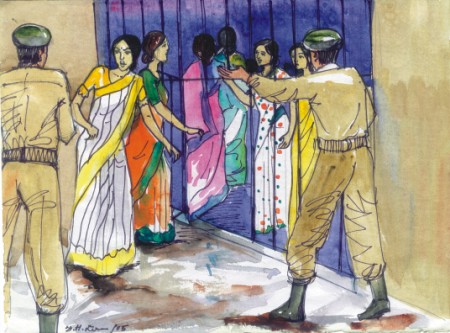
artwork by t h lisa |

