BOOK NOTES
In the midst of rejoicing on our independence day, we also need to take stock of how well the nation is faring. In their very different ways, both these books provide such a look. Ain O Salish Kendro (ASK) has brought out its yearly report on the state of human rights in Bangladesh. While a lot of the facts about human rights abuses may be known to regular readers of newspapers, the value of this particular volume lies in its having put together all the facts and figures within the covers of a single book, thus affording us a coherent and organized look at the situation. It is not a happy state of affairs. As editor Hameeda Hossain states in her introduction, "The record of human rights in 2004...illustrates a further downslide in state-citizen relations." There are, she writes, "...interconnections between freedom, democracy and development," and assaults on one automatically engender assaults on the other two. It is these assaults by the state on its own citizens, assaults on freedom of expression and religion, on ethnic and sexual minorities, on fundamental rights, and their impact on the nation's polity and economic health--as well as the fight back by various organized civil society groups--that is documented in the fifteen chapters of this book.The book has been produced crisply, the graphs and tables are laid out cleanly, and the writing is clear-eyed and unsentimental. It is a welcome development in terms of such English language publications in Bangladesh. Ain O Salish Kendro is to be commended for its efforts on all our behalves. The second book being noted here records our painful failure to take care of the victims (or IDPs, internally displaced persons) of riverbank erosion. As the introduction to this research undertaken in four districts of northwest Bangladesh notes, "natural disasters including riverbank erosion contribute immensely to the process of marginalization of a large number of people." In plain English, every year a terrifyingly huge number of people are victims of raging rivers, rendered suddenly and shockingly destitute, mowed down by circumstances beyond their control. And while strategies exist on paper, the state's actual response falls far short of what is needed. Despite accounts of self-help by the victims, it makes for bleak reading. This book was originally a project report, and its production values reflect it. It would have benefited greatly in terms of readability with a little re-write, as well as careful editing and proofreading.
|
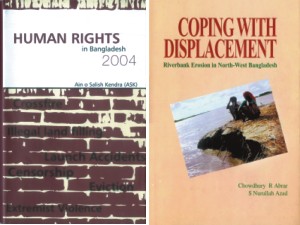
Book 1:Human Rights in Bangladesh 2004: Ain O Salish Kendro (ASK), edited by Hameeda Hossain; Dhaka: ASK; 2005; pp. 244.
Book 2:Coping With Displacement: Riverbank Erosion in North-West Bangladesh by C. R. Abrar and S. N. Azad; Dhaka: Refugee and Migratory Movements Research Unit; pp. 132. |

