Prospects ...
Musical Heritage
Signs of revival
Sadya Afreen Mallick
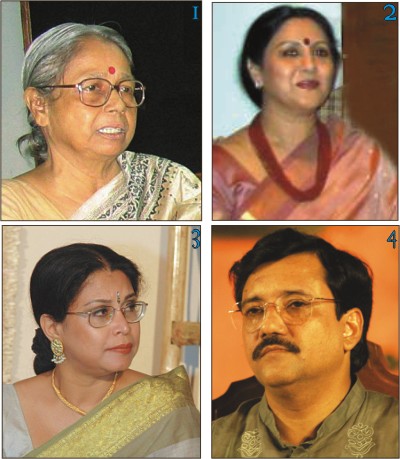
To what extent is the younger generation attracted to our traditional songs? The spate of new albums of re-mixes would seem to suggest that there is a slow but sure rejuvenation of interest in folk music amongst the young listeners. And what about our Nazrul and Rabindra Sangeet? Are remixes around the corner? How does one revive their popularity? Details of album sales could give us an idea of their relative popularity, but in its absence, we could depend on another reliable source -- talking to the leading exponents of Rabindra Sangeet. Besides being familiar voices to millions, they also run some of the most successful training centres for their art and are well placed to feel the pulse of the enthusiasts. Sanjida Khatun
Early '60s: A few friends had gathered at the house of Mukhlesur Rahman alias Shidhu Mia (eminent politician) and Shamsun Nahar Rose (parents of Bibi Russel), at Rankin Street in Old Dhaka. The couple lived in a house that had an L-shaped veranda, ideal for holding musical sessions. On a moonlit-night, in the season of Bashanto, music lovers sat around a simple stage on the L-shaped veranda. As the flickering lights emanated from the small earthen lamps, it was none other than Feroza Begum and Fahmida Khatun who entranced everyone, to a medley of Nazrul and Tagore songs. The night held a special significance. It was the first musical soiree held by Chhayanaut before it had begun its official journey in 1963. The untimely death of prominent Tagore singer and trainer Zahedur Rahim in 1978, prompted the organisers of Chhayanaut, to evolve an ambitious plan. A regional competition was organised every year as a tribute, titled Zahedur Rahim Smriti Parishad. With 45 branches all across the country, later known as the Shammilan Parisad, talented young singers flock every year from all corners of the country. The talent hunt steered by other organisations such as Shishu Academy and Notun Kuri hosted by BTV and the ongoing talent hunt Bengal Bikesh have all contributed tremendously to bring the latent talent pool to the limelight. This has worked as a platform and has motivated them to present the songs with perfection. With such a broad network of talent at work, I am optimistic about the future of our traditional music, particularly Tagore songs. Papya Sarwar
Currently there are several musical groups headed by prominent Tagore artistes such as Baitalik led by Tapan Mahmood, Shurer Dhara by Rezwana Chowdhury Bonnya, Sur O Tirtha by Mita Huq, Sadi Mohammad's Rabi Raag and Geet Shudha, which I conduct myself. Many of us have trained at Shantiniketan. I have directly trained under legendary artistes such as Konika Bandypadhyay, Nilima Sen, Subinoy Rai, Oshesh Bandyopadhyay, Shanti Dev Ghosh and others. Rendering songs is more than merely following the notations; it means the addition of minute details such as emotion that makes each presentation special. While performing, I try to deliver the finer aspects of the songs that I have learnt during my days at Shantiniketan. I teach those minute details to a small group who mostly join after their initial training in different institutions. The expiry of the copyright restrictions on Tagore's creations has left the songs open to interpretation and different styles of rendering. A handful of artistes have experimented with newer varieties. However, the majority of listeners, young and old, have responded poorly to any such undesirable change. It is obvious that preserving and propagating the purity of Tagore's original writings and notations would remain unhindered. It has always been the young generation, which has enlivened the music scene. Now, it is for us to give something in return to keep the wheels of culture rolling. Rezwana Chowdhury Bonya
With the introduction of several TV channels, artistes have a wider scope than before. Tagore singers are now more performance oriented and professional. Even the scope to learn has expanded. Students now have easy access and come all the way from Chittagong, Bogura, Khulna and other places to learn the original notations from their teachers. However, at times I feel, that the young generation is drifting away from the traditional genre. To avoid this trend we should eliminate rigidity while presenting traditional songs so that the younger audience is attracted towards the genres. Improvising musical accompaniment could be appealing to them and open newer heights. When performing overseas, while I am always overwhelmed by the warm response, I can't fail to notice that the younger generation forms a smaller proportion of the audience. This is a bit disconcerting when you think about the continued popularity of the songs. Tapan Mahmood
Artiste couple, Atiqul Huque Chowdhury and Hamida Huque were the heart and soul of the Bulbul Lalitkala Academy in its formative stage. The great dancer Bulbul Chowdhury established the Bulbul Academy of Fine Arts (BAFA) in 1955. This was a milestone as it was for the first time; different departments in Tagore and Nazrul songs, dance and classical music were set up in our country. Currently, with over 5,000 students, BAFA is divided in four branches in the city. This is proof enough of the younger generation's enthusiasm for Tagore songs. Apart from the traditional institutes, Tagore artistes run different music schools. Here the learners are students of colleges or universities. Even at the regular programmes held by different organisations, the listeners are mostly university students, who often outnumber the older generation. However, one must admit that there is shortfall of quality singers among the new generation. During pre-Liberation days, Kalim Sharafi, Sanjida Khatun, Fahmida Khatun, Zahedur Rahim, Rakhi Chakravarti and others were among the handful of eminent artistes. Iffat Ara, Iqbal Ahmed, myself and others formed the next batch of young performers. Soon came Papya Sarwar and Kaderi Kibria followed by Bonya, Sadi Mohammad and a few others from Shantiniketan who enlivened the scene. It is time for a fresh flow of talents to preserve Tagore's timeless compositions.
|