Dialogue
Dance through the eyes of Minu and Sharmila
Kavita Charanji
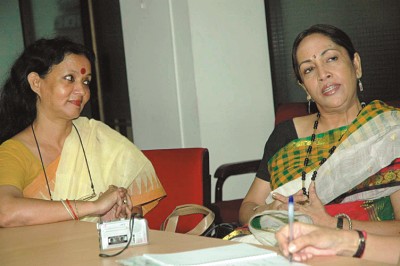
Odissi exponent Minu Haque and the versatile Sharmila Bandopadhyay, who is well versed in Manipuri, Odissi, Bharatnatyam, Kathakali and creative dance, share an easy rapport. This explains why the recent dialogue between the duo flowed smoothly. The conversation veered around to a gamut of issues, such as their choice of genres, their career paths and the current dance scenario.Genres
Sharmila: I learnt four classical dance forms. I only perform Manipuri and Odissi in their classical form. However, I teach Bharatnatyam and Kathakali too. I learnt Bharatnatyam for a long time but could not perform it because of severe back pain. As for Kathakali, Tagore was a great admirer of this dance form because of its vigorous movements and boldness. He introduced Kathakali in Biswa-Bharati in Shantiniketan. I also do creative dance and have added the essence of the traditional dances of other countries, such as Sri Lanka and Indonesia, by adding some of their movements in my choreography. As for Odissi, I found the torso movement very lyrical and I enjoyed the rhythm. I learnt classical dance forms, which would complement Rabindra Sangeet in terms of rhythm and beat. We first listen to the music to decide what dance style we will adopt. If it is rhythmic we sometimes use Bharatnatyam. Sometimes we could also use Manipuri dance. Minu: Basically I do Odissi and want to continue in this genre. After I trained under Odissi dancers, Sunny Mahapatra and Ipsita Behura and they left, I decided to teach and introduce it in Bangladesh where people had scant knowledge about Odissi. One of the attractions of Odissi is that the movement and beat are lyrical. The dance form blends well with Tagore songs. In Odissi, Rabindra Sangeet and torso movement go together. Promotion
Sharmila: Dance is the most expensive art form and therefore needs promotion. You might see two or three drama serials on TV, but where is the dance? There is also a lack of appropriate halls and auditoriums. Minu: Basically singers and painters get more support compared to dancers. Dance comes in various fields but the dancers are often shortchanged. Now I am very strict on this issue; my dictum is: No money, no dance. Dance is very expensive in terms of costumes, ornaments and hall charges. The dancers should be able to meet the production expenses at least. Unavailability of halls is also a major problem. Teaching organisations
Sharmila: As director of Nritya Nandan, I aim to popularise and spread dance forms from a sense of social responsibility. For instance, Nritya Nandan performed Chandalika to raise funds for the deprived children of a socio-cultural institute named Utsha, Bangladesh, and to raise funds for Chayyanaut's cultural complex. The organisation's repertoire includes the classical styles of Manipuri, Bharatnatyam and Odissi. It has also composed almost all the dance dramas of Tagore, as for example Shayma, Chitrangada and Chandalika. Besides the various dance forms, Nritya Nandan is unique in that it infuses the modern dance movement of the Uday Shankar Dance School on its Rabindra Nritya. I also teach Manipuri dance at Chayyanaut. Minu: As the convenor of Nrityadhara I strive to teach the poor free of cost. To popularise dance, Nrityadhara organises a performance once a month. In Pallavi, where I teach Odissi, I am the director. Pallavi is the first school for Odissi in Bangladesh. Teaching is my passion.
|