Bangladesh police: A tale of admonitions and inactions
Muhammad Nurul Huda
The largely ritualistic 'Police Week' is being celebrated from today. As in other years, this year too, there would be no shortage of grave and solemn assurances of rising to the call of duty and glowing account of great services rendered to the people. The government, in the person of the Prime Minister, will catalogue in her inaugural speech the achievements of police the measures taken for its efficiency and will once again admonish the police to be the real servant of the public. This is not unusual in our task-oriented society where admonition is the most favourite pass time.The reality on ground, however, is disappointing, particularly in the background of the rising expectations of a democratic polity. Little do we, as a nation, realise that our police system as introduced by the British was not conceived as a service. The main objective of the colonial masters was to ensure the continuance of their rule and the police acted as their chief agent. Substitute 'continuance of rule' by 'ruling party interests' and one will not naturally find much qualitative change because the police are increasingly appearing as the energised agents for promoting government interests. The people of Bangladesh having resolved to establish a democratic political system gave to the country a constitution which sought to convert the country into a welfare state. The ideals of social justice, freedom and equality intending to develop Bangladesh into a welfare state were incorporated in the constitution. The concept of welfare state implies extension of state activity in many directions for the welfare and security of the people. The needs and compulsions of the idea of welfare state demand police activities quite beyond the traditional crime control. The ideal
The police in a democracy must act as a service and not as a force; although they must be prepared to use legitimate and requisite force on occasion. They have to recognise that they also fulfil several ancillary roles and remember the distinction between state and society and state and government. The police service is there to uphold the law and is not responsible for making it. Too close an identification between police and the government of the day can bring trouble to the police. Constitutionally speaking, we believe in the values of democracy based on the rule of law. If the rule of law is to be maintained, then the laws must be enforced comprehensively, impartially and effectively. The official and legitimate law enforcement agency is the Police Force. The primary role of the Police is, therefore, to enforce the law, at the implicit wish of society, so as to make legitimate government effective. The question is, are our police, as enforcers of law, ensuring the supremacy of law? Or is it largely enforcing the wish of the government or the party? Since our state has legitimacy, the role of police cannot be one of repression of dissent. The reality and use of force
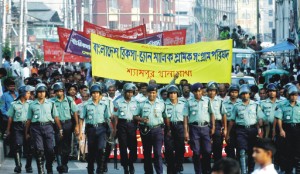
In Bangladesh, unfortunately, the government rather than the law is supreme and the major adversary of the police is the so-called political subversive rather than the criminal. Under our system it is a legitimate and indeed desirable activity of the police to gather information of all kinds and thus the ordinary, law-abiding citizen is no more entitled to privacy than the inveterate plotter or the reckless goon. Our policemen would appear more accountable to their superiors, rather than public opinion or the law. Their duties are tabulated for them and there is little or no room for discretion. The officers are given military-style badges of rank; and there is disproportionate emphasis upon strict discipline, drill and saluting which give the impression that this is a para-military organisation. If we look back we will find that the use of overt force was problematic and continues to remain so. Given the vast distances that many colonial police officers had to travel and the handful of men under their command, a display of force was not always advisable. The use of force, even if carefully controlled, could backfire. To some extent, the whole exercise in imperial policing rested on bluff and junior officers were expected and indeed oblige to use their initiative and discretion. In Bangladesh, however, the police are expected to use maximum force in quelling street agitations, political meetings and demonstrations. Indeed things have come to such a pretty pass that the major opposition political party cannot venture out of the immediate physical surroundings of their party office even for a peaceful procession on account of the presence of unusually large number of overbearing and combative police personnel. This is the reality for the last one decade and politicians and policemen relish such postures and reactions. It has not occurred to us that the police, as one of the administrative agencies, have a special responsibility to ensure the widest possible degree of individual liberty and security in terms of our constitutional guarantees. We seem to be oblivious to the reality that challenges to authority are inherent in a plural society. These are accentuated in a democratic polity and lead to agitations and disturbances. Additionally, there is the problem of right use of authority by parties which are in power. There have been many instances where governments have been accused of using the police machinery for political ends. There are instances of individual politicians interfering with the administration and work of the police. Unfortunately, we are yet to develop the norms that should govern the relationship between the party in power, the individual politician and the police. Lack of sensitisation
Our politicians have failed to sensitise our policemen in correctly understanding the rising expectations and aspirations of the people which result from the enunciation of national goals in the political sphere. Our policemen are not made to understand that any gap between the promise of constitutional ideal and the reality leads to strains and tensions which are mobilised for the 'politics of agitation'. There is still not adequate appreciation that the resultant politicalisation of the masses and the development among them of a greater awareness of their rights and methods of achievement intensify the ferment and lead to confrontations with authority. Thus our policemen often come into conflict with the forces generated by the political system which they are intended not only to serve but also to preserve. This delicacy and complexity is not adequately understood and impressed upon. The net result of such a scenario is that the police is cast into a rigid adversorial relationship. Under such circumstances, the hallowed talks of endearing the police to the community and the lofty ideas of community policing sound hollow. In any venture of promotional efforts the real stakeholders are conspicuously absent. The outcome remains less than desirable. Misplaced priorities
In the name of modernisation of police force we are procuring more sophisticated firearms and combat hardware like armoured cars. While this may be necessary, does not the physical uplift of police station premises deserve a greater priority, given our resource constraints? This writer is of the considered view that the cost of one armoured car would perhaps be sufficient for constructing a people-friendly police station building. And we all know that the police station is the focal point of service delivery. We need to know that human nature does not change. There will always be a need for a police force to control the vicious members of the society and support the weak. How well the police do this depends on the skill of individual policeman for they are in contact with the people. Technology, under such circumstances, can be of limited use although it is affecting police management and pattern of police organisation. Technological benefits will not alter the fundamental nature of policing which involves putting someone in uniform and asking them to patrol the streets with their eyes and ears open. The reckless advance of technology and the advent of fearsome vehicle while providing the police an apparent chance to perform their duties more effectively, carries a potential threat to the relationship between police and society. The police stand the risk of losing their remaining links with the ordinary public, which depend on random patrolling, gossip and chance. Virus in the recruitment
The unhealthy political meddling in the recruitment process of police, particularly in the subordinate ranks is a sad reality despite denials by successive regimes. We do not realise that however good the organisational structure, the procedures and the methods, it is the personnel who translate policy into action. We have continually failed to appreciate that the nature of the police role in a democracy requires that the members should be selected impartially; they should be administratively competent, politically neutral and imbued with the spirit of service. A police officer enjoys vast powers under the law and exercises wide discretion. The recruitment procedures should, therefore, be so devised that they are free from political, personal or corruptive influences. Unfortunately, our recruitment process has become tainted. So if policy makers do not realise the depth and consequence of irregular and illegal practices in the said exercises, the law and order situation will not improve for the relief of the citizens. The desirable way
As of now, many agitations which pose a threat to law and have a claim to social legitimacy. The police, therefore, has a risk of being cast in an anti-people role. In the changed circumstances of our society, a wholly law and order oriented force has to be transformed into one, which, while retaining a keen appreciation of its legal responsibilities to safeguard life and property, has also an understanding of the larger social issues involved in its day to day work. The implications of this are that police officers must be helped to acquire a high degree of professional competence and develop an understanding of the social purpose of their activity and attitudes in consonance with the concept of social justice with particular reference to the weaker sections of the community. We need to develop a self-respecting trim police force which is apolitical and professional in its outlook. Let us slow down the recruitment of unskilled labour in order to reach a stage in future where we will have the benefit of fuller and socially desirable policing. Policing has been less than a respectable profession in our environment for well-known but less appreciated reasons. Let us make a modest beginning to reverse the process. Are politicians listening? Muhammad Nurul Huda is a former Secretary and IGP.
|