Tragedy at Mecca
Saad S. Khan
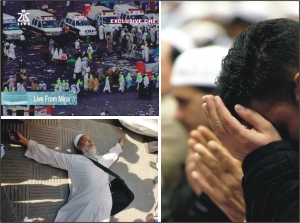
As if the Hajj flights fiasco, where the intending Nigerian pilgrims had to be sent home from mid-air due to the mismanagement of the Nigerian government, and the hotel building collapse where many pilgrims died, were not enough signs of mismanagement, over 362 pilgrims are confirmed dead in a stampede near Mecca. The incident happened at the ground of Mina, three miles off the city of Mecca, where the pilgrims go for a ritual called Ramee or stoning the devil. The pilgrimage, or Hajj, is one of the five pillars of the Muslim faith, and every able-bodied and financially sound Muslim is obligated to perform this ritual at least once in his life. Every year between two to three million Muslims assemble in Mecca to perform the pilgrimage. The ground of Mina becomes so congested where the pilgrims throw small pebbles at three pillars, called Jamraat, symbolizing devil. The three are situated at places where, the tradition goes, the devil came to seduce Prophet Abraham not to sacrifice his son before God. The idea of throwing pebbles is to express revulsion for Satan who tries to seduce mankind away from the path of God. This is exactly the fourth time in the past five years when a stampede has resulted in mass casualties. At the same ritual in 2004 Hajj, 251 got trampled to death; 35 died in a similar incident the year before, and 118 lost their lives to such a stampede in 2001. In 1994 another unfortunate incident had led 270 people to be crushed to death. In the past years, many other causes have also resulted in mass deaths, like the great fire of 1997 that gutted the tented villages of pilgrims in the outskirts of Mecca, taking the lives of 343 pilgrims, and the tunnel collapse of 1990 when the main pedestrian tunnel leading pilgrims to Arafat grounds (most pilgrims go by vehicular transport on road) caved in, burying 1,426 pilgrims. In at least one incident, the pilgrims lost lives due to political fury, when in 1987 the fierce clashes between Iranian pilgrims holding anti-US demonstrations on the eve of Hajj and the Saudi security forces led to the killing of 303 Iranians and 85 Saudi security officers. After the 2004 stampede fiasco, the ulema council of Al Azhar issued a fatwa (decree) recommending a few innovations in the mode of performing the stoning ritual. It has proposed doubling the time for stoning from noon to noon instead of from dawn to dusk. It has also proposed that women, children, and the old must stay away from stoning. Presently, there is an option for the women, children, and the old, whether to allow an able-bodied adult male pilgrim to stone as proxy on their behalf. There are several questions of jurisprudence involved here. Some people try to complete the ritual early in the morning, not only because of less rush and lower temperature in the early hours, but also to free themselves for other commitments for the rest of the day. Unfortunately, that fateful morning of February 1, 2004 many million people had thought that way and by half past seven in the morning the crowd had surged to unmanageable levels. Although women, the old, and the weak are exempted from performing the ritual themselves, but most prefer to do it on their own rather than through proxy. At 8:05 am the surging numbers making the way from behind pushed the ones in the front to the extreme and then there was a general confusion; some lucky ones jumped inside the walls around the pillars and escaped with minor injuries since there were foams spread all around inside. However, the panic caused the stampede and many hundreds died under the feet of the running crowds or due to suffocation. There were a few, of course, who died due to cardiac arrest. By the time the situation was brought under control, 251 men and women representing a broad cross-section of age and gender, nationalities, and ethnic backgrounds, had lost their lives. This year the causes were slightly different. Pieces of luggage had spilled over from some of the moving buses in front of one of the entrances of the bridge. The pilgrims had to trip over the luggage and thus a bottleneck was created in front of the surging crowds from behind. A minor confusion led to stampede and then it was mayhem. The 22,000 officers on stand-by could do nothing as a sudden movement by them into the crowds could have increased the casualties. By the time the situation was brought to control, hundreds of pilgrims had been crushed, among them people from India, Pakistan, China, Turkey, Egypt, Indonesia, and the United Kingdom. The space in Makkah is what it is, and the number of intending pilgrims in the coming years is likely to grow manifold, owing to a multiplicity of factors, including the rising standards of living and economic status in many parts of the world, and the faster and cheaper modes of communication and travel. Not the least contributor is the fact that Islam is the fastest growing religion on the globe because of higher natural growth rate and the rapid conversions as a result of missionary activities. There is no gainsaying the fact that the present Saudi dynasty has the credit of accomplishing enormous development in the two holy cities of Makkah and Medina in the last three decades. Both the cities are now gleaming with broad roads and underpasses, tall buildings, modern shopping malls, international food chains like Pizza Hut and KFC, and also universities, offices, and banks. The renovation and expansion of the Masjid-al-Haram complex alone has cost a whooping 70 billion Saudi riyals in the last 20 years. But can this investment absolve the Saudi government of the recent mishaps? It is only totalitarian regimes that can survive the blunders by the sheer force of bayonets. Could the Italian government survive a stampede killing that many people in the annual Christmas night mass at the Vatican? Could the government of the East Punjab in India survive a stampede or an arson at the Golden Temple in Amritsar? But in Saudi Arabia, even the Minister for Hajj did not feel enough moral responsibility to offer to tender resignation. The resignation of the concerned minister on the basis of principles, even if it has a mere symbolic value, is a decency not yet introduced in the Middle East, except, let us be fair, in Israel. After the last incident, the Saudi government announced a 20-year plan for modernization of Mecca and its surrounding areas where the Hajj rituals take place.. It has also been decided to construct a nine-storey structure around the Jamaraat that will include four level bridges for the pilgrims. The pedestrian walkways in Mecca will be expanded from the present 60,000 sq. meters to 120,000 sq. meters, while the parking space would be enhanced to cater for 45,000 vehicles. The accidents have also underlined the need for trees and green areas and it was decided that parks would be developed on over 30,000 sq. meters of area. The Senior Scholars Council has also convened an emergency meeting to be held shortly to discuss the Shariah related issues pertaining to these rituals. The Ulema shall deliberate on the ways that will minimize such accidents. Many proposals are coming up in the media of the Muslim world. Besides the ones proposed by the Al-Azhar, one way is to allow a select group of religious leaders representing the pilgrims from each country to do the stoning on behalf of all pilgrims from their country. And a more narrowed version suggests that King Abdulalh of Saudi Arabia, as the custodian of the two holy shrines, may do it in a simple symbolic ceremony, on behalf of all the pilgrims at the end of Hajj each year. Another might be to enable one third of the pilgrims to perform the ritual for all three days on any one day from the 10th, 11th and 12th of Zil'haj. That is to say that instead of throwing seven pebbles each at the three pillars for three days, the pilgrims would be obliged to throw 21 pebbles in one go at each pillar in a single day. The next day would be reserved for the next third and the last day for the last third batch. Whether it would be permissible under the Shariah and if at all it would be technically possible are the issues to be dealt with by the Ulema and the engineers, respectively. The writer is a Cambridge-based scholar and a widely read analyst on politics, governance and human rights in the Muslim world.
|
|

